Showing posts with label 2005. Show all posts

Wednesday, 13 May 2015

Where's Ten Years Gone?


With a flypast from two starships named Enterprise as Archer, Kirk and Picard recited the now famous "Space, the final frontier..." opening, the titles rolled and that was it.

Ten years ago today, 13th May 2005, These are the Voyages..., the last and by no means best episode of prequel series Star Trek: Enterprise aired. Yep, it's a decade since the crew of the NX-01 skipped a few years of adventures to tell one last story and become guest stars in their own finale. Jonathan Frakes and Marina Sirtis tried their best to play Riker and Troi as if they were actually discussing events that happened during The Pegasus. Note to fans, that was an episode made 12 years earlier so any form of consistency was lost to begin with however much effort was put in.

From recent reports it continues to be nailed into our skulls that there's going to be no new series on TV. While the cash is rolling in thanks to the rebooted JJ Abrams universe which has already seen two multi-million dollar movies take the big screen by storm and a third, suggested to be titled Star Trek Beyond, lined up for 2016 it's movies or nothing. Think about this though - it was ten years from the end of The Original Series to the release of The Motion Picture and we've been lucky enough since the end of Enterprise to get two new movies and a whole ruck of fan series and flicks that have satiated some of our thirst for original Star Trek content. In some respects the future never looked so good especially in comparison to that barren decade of the 70's.

Now Some Kind of Star Trek has given a fair amount of column inches to the rumours, the stories, the suggestions and even THAT Captain Worf series. We could easily spend this 10th anniversary of the end of first run Star Trek by crying into our blood wine and lamenting its passing or moaning about the way in which JJ chose to take the franchise or that the likelihood that a new Star Trek TV series is an eternity away (please let's not get into that Jonathan Frakes angle).

So instead of picking over old bones once more, let's be uplifted. While These are the Voyages... might have been a poor way to say goodbye, what were the five best ways that Star Trek closed a season? What were the best finales the show produced over 49 years? I'm going to take a pot shot and select my favourites. Be free to disagree.

The Best of Both Worlds

Let's start with the obvious one and work away from it. Undoubtedly one of the biggest episodes of all time and arguably the defining cliffhanger in Star Trek history. The Riker sub-story, Picard captured, the return of the Borg, a seemingly lost cause, a magnificent, haunting soundtrack; all add to make this hit every single marker you could want. The conclusion is nowhere near as good simply because there was no way it could live up to the hype of part one. Those final few moments where we realise it really is that bad are seminal.

Notable Quotable: "Mr Worf - fire". - Riker

Key Moment: The cube ship appears for the first time accompanied by that haunting choral theme which plays out across the rest of the episode - we have engaged the Borg.

Cliffhanger: Jeez. Millions went into meltdown as resistance seemed to be 100% futile. Boxsets make it do much easier. Note that in part two however it's not Worf that does the firing but Geordi....!

All Good Things...

It formulated the way to make a show finale for both Deep Space Nine and Voyager with both series attempting to provide a "full circle" experience. Returning Q, linking three distinct time periods and bringing back a couple of our favourite characters made this a must see in every respect. Let's not forget it also marked the first time a Star Trek show had chosen to finish rather than being cancelled. Science fiction was growing in popularity thanks to the show and the future for Star Trek was increasingly bright with Deep Space Nine closing a second season and Voyager due for premiere in the following January of 1995. We all loved that final scene at the poker game and the whole episode was an exhilarating experience that did the show 200% justice and I can watch it again and again and again in a heartbeat. It's not about the suspense here, it's about the experience.

Notable Quotable: "Bye bye Jean-Luc it's been such fun but alas all good things must come to an end." (either than or the last line...) - Q

Key Moment: Admiral Riker's suped-up Enterprise-D blows the hell out of two Klingon warships.

Cliffhanger: Not applicable. This was the end. Until Generations....


In the Hands of the Prophets

Deep Space Nine planted itself firmly on the map with the closer from it's first season. In the Hands of the Prophets is all about the placing of key characters, a reflection on the pilot episode and the preparation for season two. Usually we'd expect (as we'd come to see on The Next Generation) that the finale would be simply concluded in the first episode after the summer break. Deep Space Nine broke that mould by introducing Winn and Bareil ahead of the election for Kai that would take another year to occur plus examined the pairing of Sisko and Kira and their journey since Emissary. A masterstroke that firmly said they would be back for a second year and that it would develop from the events of the first season. Still a tense episode, it's a lot more about the people and the Starfleet officers' acceptance that the station is becoming their home just as much as it's about the assassination plot. Watch it back after a thorough rewatch of the show and it's still brilliant. Bajoran politics never seemed so amazing.

Notable Quotable: "Is the Emissary of the Prophets blaming me for this act of terrorism?"
"The commander of this station is." - Winn and Sisko

Key Moment: The bombing of the school. Hands down that's one way to make fans take note of your season closer.

Cliffhanger: None. All about the set-up.

Call to Arms

It was a toss up between this and The Jem'Hadar because both of them were huge Deep Space Nine game-changers that altered the way in which the series progressed. Call to Arms finally delivered the long-awaited Dominion War in dramatic character-driven style that became the show's trademark. Dark, as far from optimistic as you could ever expect and grounded in the reality that Starfleet are on the back foot, there's a foreboding that this is going to get even worse before it gets better. Losing the station to Dukat and his Dominion allies was a masterstroke we would never have predicted when Emissary aired. This was a close knit family who had come to see the gloomy Cardassian mining station as home and didn't want to leave - a big change from where we were at the start of the show. I won't bore everyone about the whole baseball scene but needless to say it's simply one of the best episodes ever made and far better than Janeway losing Voyager in Basics.

Notable Quotable: "...But no victory could make this moment any easier for me. And I promise, I will not rest until I stand with you again. Here; in this place where I belong." - Sisko

Key Moment: Sod it. The baseball bit. I love it.

Cliffhanger: Not officially but that fleet sure isn't just for show. Deep Space Nine didn't like to do proper cliffhangers because almost every week was one by this point.

Equinox

The what-Voyager-could-have-been story which was one of the best things the show ever did. A similar small science vessel forgets its principles for the sake of a quick trip back to the Alpha Quadrant. John Savage is perfectly cast as "Rudy" Ransom and the chilling modifications to the ship's EMH are a horrifying twist, showing just how far the captain is willing to go. Ultimately it's a comparison of how far the show and the cast have come since Caretaker. Experimenting on aliens is always a winner for the moral dilemma and while we kind of knew that Voyager would be OK, it was more about what the heck was going to happen to the Equinox crew. Personally I also think it's Voyager's best ever two-parter with the quality just as strong in part two and I'm a sucker for the Nova Class.

Notable Quotable: "May I ask you something, captain to captain? The Prime Directive: how often have you broken it for the sake of protecting your crew?" - Ransom

Key Moment: Hard choice but switching the two EMH's was a clever twist.

Cliffhanger: We never thought Janeway would be killed but it's all about the set up of where the characters are and how Voyager has been abandoned for dead by Equinox.


And now you're wondering about The Original Series  and also Enterprise? Fair enough. For me none of their season closers came close to the quality of these five. For The Original Series there was no real season close feeling - it was just another episode to turn out and for Archer's shift, it never reached the levels of excellence that I decided to go with. I, of course, look forward to your suggestions and reasons!!!

So what was your favourite closer or are you still lamenting the passing of Enterprise? Let us know in the comments below!

Want to continue the discussion on your favourite social media platform? 
Like our page on Facebook 
Follow us on Twitter
+1 us on Google+
Add us on Tumblr
Pick us out on Pinterest
Add to to conversation on Star Trek: Risa

Wednesday, 25 December 2013

A Little Unfair on Rick Berman

Going all the way back to January I decided to go easy on JJ Abrams and even defended him in light of the ferocious revelation that he would soon be helming Star Wars Episode VII. 

Then I spent some of March blubbering on about whether or not we should recognise the JJ reboot universe visualised in 2009's Star Trek and it's 2013 sequel as official material. Then it dawned on me that we had been in a similar situation some time ago with another individual. His name wasn't JJ Abrams but the anger directed at him from fandom was probably just as vehement (although after seeing some of the comments about Star Trek Into Darkness I'm tempted to retract that). 

My fingers flew over the keyboard and an article took form however, I let it piece fester and wallow around in the backwater of Draft Hell as the reboot sequel came and went; then the DVD and blu-ray came and went...and before you know it, it's Christmas 2013. Indeed, what could be a better time to dust this piece off as, appropriately, it's also Rick Berman's birthday. 

Already some of JJ Abrams' comments have, apparently, placed him in deep water with Trekkies since he wants his Star Trek to be the only one that's remembered etc etc... with fans supposedly crying out for a return to the "old ways"  of Star Trek that was known and loved from 1966 through to 2005; what JJ was doing "just isn't Star Trek".

Flip back a few years and the odd thing is that towards the end of Enterprise we were a grumpy old lot especially when it came to Rick Berman. As the cartoon I was inspired by (top) goes to show, we didn't like what he'd done to the franchise when it came to Enterprise and, dare I even write the name, Star Trek NemesisThe grass had to be greener so to speak. Manny Coto had taken over the reins of the faltering, stumbling Enterprise but alas it was too late and the franchise disappeared into a Bajoran-sized wormhole for the next four years. A real shame given the quality of that last season. Circling the back of beyond is precisely where Abrams found it, kicked it a few times and  rebooted it - and then we all started grumbling again....you get the picture I'm sure.

But was the "Berman Era" really THAT bad? Should Trekkies/Trekkers across the globe be as disgruntled with Rick as history suggests? I would say not but I'll make sure I back this up with some evidence. 

Rick Berman was pretty much at Gene Roddenberry's side from the inception of The Next Generation in 1986 until the Great Bird's death in 1991. During those years he would take on more and more of the day to day production of the series and helm the show to its end in 1994. It's a harsh thing to say, but once Gene was no longer part of that Star Trek equation there was more freedom for the writers and we were presented with some intensive character development and edgier stories. It was interesting to watch Trek Nation which has helped map my thoughts for this piece as Ronald D Moore notes that there was more they could do with the Star Trek universe post-1991 even though Berman appeared to keep hold of the reins fairly tightly.


Yes, he allowed the infamous space pirates two-parter, Gambit, in the shows final season but we got to understand the characters a lot more if we dig deeper than that superficial yet very entertaining story. Look at where the writers went in the second half of the fifth season for instance. The earlier stories are very much science fiction based whereas there is a definite flexing of wings when we hit installments such as The Outcast, New Ground, Hero Worship and Perfect Mate to name but a few. These were stories tackling slavery, sexuality, childhood trauma and more which were never attempted just a couple of years before. 

Now Rick was never The Next Generation's most prolific writer, penning as he did two episodes in the entire run from 1987 to 1994; Brothers and A Matter of Time. All other episodes that Berman was directly involved with in the scripting paired him either with Michael Pillar or latterly Brannon Braga. That said, he had the final say on what would make it to the screen and let the writing staff explore the cultures of their characters in a great deal more depth especially the Klingons through Worf in season five and further more with Birthright and Rightful Heir the following year. Data was expanded with the dream programme, Troi got a uniform, a promotion and dare I say it a significant amount more respect from the viewers. It was the heyday of Star Trek and the characters were not stagnating. I'm not sure we can really complain about his input into The Next Generation but could this be due to the fact that it was built on such a solid base to start with by Roddenberry? It's certainly a thought to ponder over but then how do we account for Deep Space Nine? In my opinion the greatest of any Star Trek generation. Is there more to this?

Perhaps most revealing is the interview Berman conducted with startrek.com back in 2012. He truly believed in Gene's vision of the 24th Century and fought to uphold those elements that the shows creator held dear even after his death. However Berman knew, just as Abrams did in 2009, that Star Trek had to change and develop if it were to survive. Maybe his choices weren't as extreme as those that have enshrouded the latest two big screen adaptations but by taking Deep Space Nine and Voyager into the uncharted depths of the Gamma and Delta Quadrants respectively there was chance to do something different under the security of the franchise umbrella. Now significantly with both these shows Berman held overall control but the day to day decisions were in the hands of others. Michael Piller and Ira Steven Behr ran the show at one time or other on Deep Space Nine while Jeri Taylor and Brannon Braga did likewise on Voyager

Now I think this shows a great contrast between Abrams and Berman - while JJ's attitude appears more hands on, Rick allowed those who understood the material and "lived" the experience of each show to develop it and nurture the creativity. He seems to have placed people in particular spaces to ensure the quality of the franchise continued. It would only be when Enterprise became the sole focus of the production team that Berman would be more directly involved and certainly more influential in the direction of the show. Notably Enterprise would be the series where Rick received more credits for stories than any of the other Star Trek series he had worked on.


This change in focus might reveal where Berman wasn't as strong. Enterprise would be more in the hands of Braga than anyone else during its four year run but it would be the first series Berman had not created or run in the Star Trek universe with Michael Piller. 

Piller himself is highly regarded for his work on Star Trek especially when it comes to a certain Borg-based two-parter from 1990. Maybe his influence was more than we can appreciate in just a few blog paragraphs but without Rick Berman managing the overall shape of the franchise these pieces would not have been in place and the show would not have lasted in some form on TV until 2005. Since Berman took over the franchise in 1991 there have only been 8 years where there has not been an episode of Star Trek in production and during two of those the Abrams movies were released. If it had been "killed" by Gene Roddenberry's heir-apparent would we have seen so much Star Trek over three decades? Would we have even had the films in 2009 and 2013? Potentially not. If Berman's involvement in the franchise was indeed so toxic towards the end, why are they releasing Enterprise on blu-ray and why do Voyager and Deep Space Nine continue to sell DVDs, magazines and a million tons of other material? If the effect had been that bad then the franchise would not have survived nor evolved.


What really gets me is that fandom complained so bitterly about how Enterprise was ruined by Berman especially in its second year. I would challenge fans to look back at any of the previous three series and say that the early years of those shows produced consistently brilliant material. All three took time to evolve and only really hit their stride in the third and fourth years. Enterprise's problem was the whole prequel premise and the Xindi attack which you just knew had to work out fine in the end because of the effect it would have on all other series thereafter in the timeline. 

While the Xindi were a bit like a knockoff Dominion, Berman directed the show to do something that no other generation had attempted. Not only was he showing how it all began and in some way reinventing the wheel (or warp drive) but he upheld the beliefs and standards of Roddenberry and created a season long arc which did work in my opinion. Bringing Manny Coto in for year four was another good move (whether his choice or not) but it left Rick in charge of Star Trek with some great three-part concept stories only tragically let down by THAT horrific finale that did nobody any justice.


JJ Abrams had the chance to reboot from the beginning; to do what he wanted with the franchise and make it his own; a new version of someone else's creation. A re-imagining as we're fond of calling it. Berman had to remain true to the fold and the finale is an attempt to pull everything together when it was apparent that the series was being cancelled and there would be no more new Star Trek on TV. But it failed. While you can see the attempt to make it cuddly, warm and in some respects have a similar feel to something like All Good Things... it nosedives. Producing something new for the show week in week out for such a long time can't be easy. After all there are notoriously only seven types of story and after a while things can get a bit "samey". I still stand in the belief that everything Rick did was in the name of the fans because he knew what Star Trek meant direct from its creator. 

Abrams might have regressed the show back to a fist-fight-of-the-year concept with low impact on themes and characterisation but even at its worst points under Rick Berman these were key factors that were always maintained and time invested in to make sure they retained the mythos. You have to consider that when one or two series were in production there would also be one or two movies hovering in the background. Berman must have, for a fair few years between 1994 and 2000, been spread quite thinly in his control of the franchise which might well have contributed to some of the stories surrounding Ira Steven Behr tricking Berman into allowing certain actions to take place on Deep Space Nine.

Berman allowed the Dominion War which was something Gene might never have allowed. He also brought in conflict among the main cast (but not Starfleet characters) which added not only dimensions for the actors to explore but expanded the potential of the Star Trek universe. While this added another level of action and adventure to the story it didn't stray from ensuring there was always a theme or a motive underlying each story - something JJ might want to reconsider for his third big screen Star Trek outing. Playing on the unexplored was key to the vision of the universe while, in some respects, Abrams has stayed on safe ground, close to Earth - oh, that and blowing up Vulcan. 


Let's be honest here, Rick Berman wasn't afraid of trying new concepts which is easily highlighted by the very existence of Enterprise. His role lay in ensuring that the series remained true to its origins and that it really was "Based upon Star Trek" as created by Gene Roddenberry. Maybe things went the way they did because he felt constrained by that Big Picture and the need to stay true to the Great Bird. Abrams has no such concerns and even Roddenberry himself, as part of an interview I saw on Trek Nation, was keen for someone else to put their spin on the Star Trek universe. Abrams did and so did Berman - so much so his bust of Gene now, legendarily, wears a blindfold. 

He could take risks and allow more exploration and still be the preserver of the Roddenberry vision. Perhaps look at it another way - if Gene had remained in the seat for another 10, 15 or 20 years, would we have seen Deep Space Nine develop from the "adventure of the week" format that had pervaded The Next Generation and The Original Series? I suspect not - which might have seen it dwindle and die after three years because I think we can be certain that the arrival of a certain squat warship in The Search, Part I would not have been the first or last thing Gene would have done - nor perhaps would we have had the Klingons withdrawing from the Khitomer Accords in The Way of the Warrior.


OK, OK, so clearly I like to defend Mr Berman. Why? Because he put the right people in the right places to make a difference and make the shows what they were. Piller, Berman, Moore, Braga, Echevarria, Taylor...all were brought in during Rick's tenure and made Deep Space Nine and Voyager especially into their own. They made us care and he helped and directed that evolution. It can't have been easy juggling three series at various points in their lives plus a motion picture series and maybe that's the problem.

There was, eventually, too much. For me there was a Star Trek peak around the mid to late 1990's, probably reaching a climax with What You Leave Behind. Once that had closed the quality seemed to take a dip. We, as fans expected a lot and didn't get it. There were a lot of good things that did come out of the Star Trek stable by this stage but it needed something fresh and the people that had made it successful in the Golden Age of the 1990's had moved on. Braga was a good writer but as a producer his inexperience, I think, showed through which led to the arrival of Manny Coto which was too little too late. I think his work on the final year of Enterprise is superb and produced some moments of true brilliance. A fifth season and the Romulan War would have really set the show apart but we never got the chance to see how it could have evolved. 


Is it Berman's fault he stayed so long? Maybe not. He was doing something he was passionate about and was doing it for the audience and more significantly he believed he was doing what the fans wanted. His over familiarity with the material by 2004/5 may well have assisted the toll of the bell for Enterprise and after such a long run the franchise was more than a little out of puff. A break was due, it needed a holiday and a change of management. Berman had done his best and given his all to uphold the standards but, as someone once said, All Good Things...must come to an end.

So let's thank Rick Berman for giving us some damn fine shows and classic stories over the years and you know what, it wasn't that bad after all - and for the record he had nothing to do with the movies that are rated at the bottom of the pile. So let's start lighting the torches for JJ and Shatner shall we or are we all waiting to see who will be taking the reins for the third reboot movie? We'll be keeping track in 2014 you can be assured of that.


Saturday, 28 September 2013

26 Years On

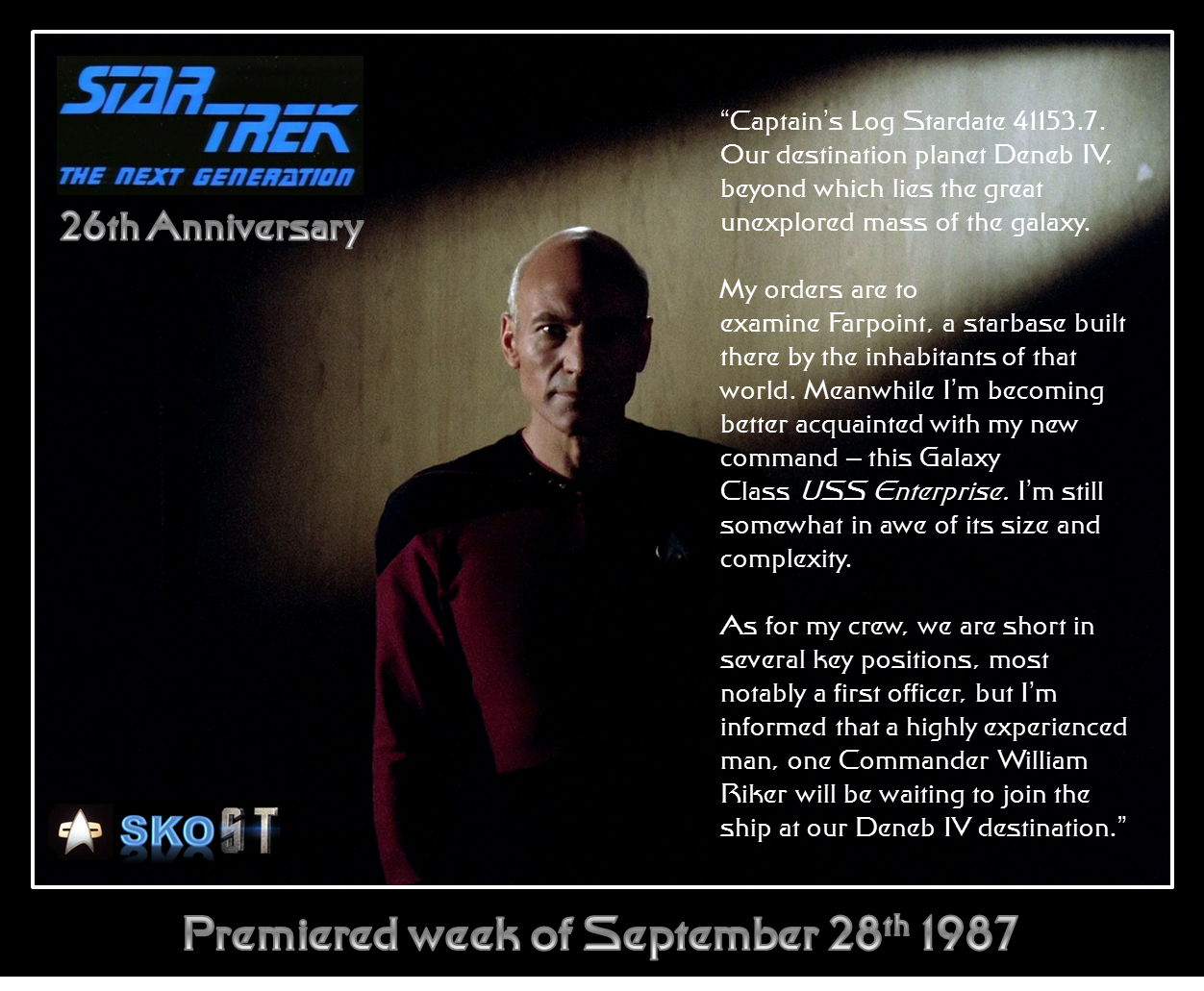
After 18 years Star Trek was back on the TV and in syndication from the start. This week marks the anniversary of the first airing of the pilot episode of The Next Generation. Do you remember the first time you saw Encounter at Farpoint?


For me I would first see Encounter at Farpoint three years later when the UK broadcaster BBC Two aired the show on 26th September 1990 (wow - 23 years ago this week!). 

The pilot of The Next Generation would be the start of 18 years of first run Star Trek on the TV, ending in 2005 with Enterprise's final episode These Are the Voyages....

Happy birthday The Next Generation!

Thursday, 26 September 2013

Twelve Years On

With the recent 47th anniversary of The Original Series you would be forgiven for forgetting that September was a busy month for Star Trek....


Happy twelfth birthday Enterprise. Short-lived but still one of the fold.

  • 98 episodes
  • Four seasons
  • Pilot aired with a viewing figure of 12.54 million on UPN
  • First series to see the launch of the main starship
  • Last episode aired May 13th 2005
  • Created by Rick Berman and Brannon Braga