Showing posts with label In the Hands of the Prophets. Show all posts

Wednesday, 13 May 2015

Where's Ten Years Gone?


With a flypast from two starships named Enterprise as Archer, Kirk and Picard recited the now famous "Space, the final frontier..." opening, the titles rolled and that was it.

Ten years ago today, 13th May 2005, These are the Voyages..., the last and by no means best episode of prequel series Star Trek: Enterprise aired. Yep, it's a decade since the crew of the NX-01 skipped a few years of adventures to tell one last story and become guest stars in their own finale. Jonathan Frakes and Marina Sirtis tried their best to play Riker and Troi as if they were actually discussing events that happened during The Pegasus. Note to fans, that was an episode made 12 years earlier so any form of consistency was lost to begin with however much effort was put in.

From recent reports it continues to be nailed into our skulls that there's going to be no new series on TV. While the cash is rolling in thanks to the rebooted JJ Abrams universe which has already seen two multi-million dollar movies take the big screen by storm and a third, suggested to be titled Star Trek Beyond, lined up for 2016 it's movies or nothing. Think about this though - it was ten years from the end of The Original Series to the release of The Motion Picture and we've been lucky enough since the end of Enterprise to get two new movies and a whole ruck of fan series and flicks that have satiated some of our thirst for original Star Trek content. In some respects the future never looked so good especially in comparison to that barren decade of the 70's.

Now Some Kind of Star Trek has given a fair amount of column inches to the rumours, the stories, the suggestions and even THAT Captain Worf series. We could easily spend this 10th anniversary of the end of first run Star Trek by crying into our blood wine and lamenting its passing or moaning about the way in which JJ chose to take the franchise or that the likelihood that a new Star Trek TV series is an eternity away (please let's not get into that Jonathan Frakes angle).

So instead of picking over old bones once more, let's be uplifted. While These are the Voyages... might have been a poor way to say goodbye, what were the five best ways that Star Trek closed a season? What were the best finales the show produced over 49 years? I'm going to take a pot shot and select my favourites. Be free to disagree.

The Best of Both Worlds

Let's start with the obvious one and work away from it. Undoubtedly one of the biggest episodes of all time and arguably the defining cliffhanger in Star Trek history. The Riker sub-story, Picard captured, the return of the Borg, a seemingly lost cause, a magnificent, haunting soundtrack; all add to make this hit every single marker you could want. The conclusion is nowhere near as good simply because there was no way it could live up to the hype of part one. Those final few moments where we realise it really is that bad are seminal.

Notable Quotable: "Mr Worf - fire". - Riker

Key Moment: The cube ship appears for the first time accompanied by that haunting choral theme which plays out across the rest of the episode - we have engaged the Borg.

Cliffhanger: Jeez. Millions went into meltdown as resistance seemed to be 100% futile. Boxsets make it do much easier. Note that in part two however it's not Worf that does the firing but Geordi....!

All Good Things...

It formulated the way to make a show finale for both Deep Space Nine and Voyager with both series attempting to provide a "full circle" experience. Returning Q, linking three distinct time periods and bringing back a couple of our favourite characters made this a must see in every respect. Let's not forget it also marked the first time a Star Trek show had chosen to finish rather than being cancelled. Science fiction was growing in popularity thanks to the show and the future for Star Trek was increasingly bright with Deep Space Nine closing a second season and Voyager due for premiere in the following January of 1995. We all loved that final scene at the poker game and the whole episode was an exhilarating experience that did the show 200% justice and I can watch it again and again and again in a heartbeat. It's not about the suspense here, it's about the experience.

Notable Quotable: "Bye bye Jean-Luc it's been such fun but alas all good things must come to an end." (either than or the last line...) - Q

Key Moment: Admiral Riker's suped-up Enterprise-D blows the hell out of two Klingon warships.

Cliffhanger: Not applicable. This was the end. Until Generations....


In the Hands of the Prophets

Deep Space Nine planted itself firmly on the map with the closer from it's first season. In the Hands of the Prophets is all about the placing of key characters, a reflection on the pilot episode and the preparation for season two. Usually we'd expect (as we'd come to see on The Next Generation) that the finale would be simply concluded in the first episode after the summer break. Deep Space Nine broke that mould by introducing Winn and Bareil ahead of the election for Kai that would take another year to occur plus examined the pairing of Sisko and Kira and their journey since Emissary. A masterstroke that firmly said they would be back for a second year and that it would develop from the events of the first season. Still a tense episode, it's a lot more about the people and the Starfleet officers' acceptance that the station is becoming their home just as much as it's about the assassination plot. Watch it back after a thorough rewatch of the show and it's still brilliant. Bajoran politics never seemed so amazing.

Notable Quotable: "Is the Emissary of the Prophets blaming me for this act of terrorism?"
"The commander of this station is." - Winn and Sisko

Key Moment: The bombing of the school. Hands down that's one way to make fans take note of your season closer.

Cliffhanger: None. All about the set-up.

Call to Arms

It was a toss up between this and The Jem'Hadar because both of them were huge Deep Space Nine game-changers that altered the way in which the series progressed. Call to Arms finally delivered the long-awaited Dominion War in dramatic character-driven style that became the show's trademark. Dark, as far from optimistic as you could ever expect and grounded in the reality that Starfleet are on the back foot, there's a foreboding that this is going to get even worse before it gets better. Losing the station to Dukat and his Dominion allies was a masterstroke we would never have predicted when Emissary aired. This was a close knit family who had come to see the gloomy Cardassian mining station as home and didn't want to leave - a big change from where we were at the start of the show. I won't bore everyone about the whole baseball scene but needless to say it's simply one of the best episodes ever made and far better than Janeway losing Voyager in Basics.

Notable Quotable: "...But no victory could make this moment any easier for me. And I promise, I will not rest until I stand with you again. Here; in this place where I belong." - Sisko

Key Moment: Sod it. The baseball bit. I love it.

Cliffhanger: Not officially but that fleet sure isn't just for show. Deep Space Nine didn't like to do proper cliffhangers because almost every week was one by this point.

Equinox

The what-Voyager-could-have-been story which was one of the best things the show ever did. A similar small science vessel forgets its principles for the sake of a quick trip back to the Alpha Quadrant. John Savage is perfectly cast as "Rudy" Ransom and the chilling modifications to the ship's EMH are a horrifying twist, showing just how far the captain is willing to go. Ultimately it's a comparison of how far the show and the cast have come since Caretaker. Experimenting on aliens is always a winner for the moral dilemma and while we kind of knew that Voyager would be OK, it was more about what the heck was going to happen to the Equinox crew. Personally I also think it's Voyager's best ever two-parter with the quality just as strong in part two and I'm a sucker for the Nova Class.

Notable Quotable: "May I ask you something, captain to captain? The Prime Directive: how often have you broken it for the sake of protecting your crew?" - Ransom

Key Moment: Hard choice but switching the two EMH's was a clever twist.

Cliffhanger: We never thought Janeway would be killed but it's all about the set up of where the characters are and how Voyager has been abandoned for dead by Equinox.


And now you're wondering about The Original Series  and also Enterprise? Fair enough. For me none of their season closers came close to the quality of these five. For The Original Series there was no real season close feeling - it was just another episode to turn out and for Archer's shift, it never reached the levels of excellence that I decided to go with. I, of course, look forward to your suggestions and reasons!!!

So what was your favourite closer or are you still lamenting the passing of Enterprise? Let us know in the comments below!

Want to continue the discussion on your favourite social media platform? 
Like our page on Facebook 
Follow us on Twitter
+1 us on Google+
Add us on Tumblr
Pick us out on Pinterest
Add to to conversation on Star Trek: Risa

Tuesday, 5 November 2013

Rediscovering Deep Space Nine's First Season (Part 1)


Ahhhhhhhhh, season one of Deep Space Nine. In it's day it was OK. It wasn't up to the standard perhaps that The Next Generation was showing as it ran through season six but it was still lightyears from where that show had kicked off in 1987.

I even thought of walking away during those initial 20 episodes but stuck with it and was princely rewarded. When I rewatched the 1993 season recently though I found there was so much I hadn't appreciated until this full viewing or had missed when I saw it the first time.

This made me think - what do I appreciate about the show's first year now that I didn't back then? What bits have I noticed with the benefit of two decades of hindsight? Was it really as bad as I imagined when I was in my teens? 

Apparently I've wizened up in my old age and there's a lot more than meets the eye. It might be misguided in places and muddled in others but on the whole it does show signs of making a different stand and being the odd child of the Star Trek universe. 

So here's my take on Year One - after 20 years what did I spot or appreciate a little more especially with the knowledge of what happened over the course of the series. Well....

1. Starfleet Doesn't Trust Odo

Who can blame them at this point? This guy can turn himself into almost anything he wants and he was previously employed by the Cardassians. What's not to be suspicious of?! 

For just two episodes however he's accompanied by James Lashly as Lieutenant George Primmin in The Passenger and Move Along Home. For me this character just doesn't work and he seems like a glorified extra. He was then never seen again or even mentioned and nor did we even hear that he was reassigned. Gone in a second.

Almost two years later though, Eddington turned up to so the same job and we all remember how that ended. Odo was certainly the outsider from the start and having a Starfleet overseer, even for a brief time, only emphasised that more. Noticably there is an inconsistency as this concern comes and goes where necessary. Once Eddington was out of the way Starfleet seemed to be a lot happier with the Constable - even odder when by this time they knew his people were the Founders.

From memory there's conversations much later in the show around the trust that Sisko instills in his chief of security but here he's a mysterious unknown element - hey, it's made quite clear from Emissary that even his origins are a total blank. Clearly his story was going to be told but I would wager it had zero to do with the Dominion when they wrote the script.

2. The Bajoran Religious Focus

Considering how much airtime this would receive later and just how pivotal to the overall arc the Bajoran religion was it's odd that it only takes centre stage in three of the first season episodes; Emissary, The Storyteller, and In the Hands of the Prophets. In fact Vedeks Winn and Bareil only turn up in the season closer. That final story, perhaps unknowingly at the time,  does kick off a lot of things including the election of a new religious leader since the Kai herself got killed off before half the year was out in Battle Lines

Now that was a shocker, but it does also indicate how much set up there was in the first year of the show. It wasn't until the dying 45 minutes of the year that the religious aspects of the series were highlighted and then the spark was really ignited as we moved into season two and the opening three-part story. 

The pagh aspect of the Bajoran religion fades over time too. It's prominent in the bookend episodes of season one but beyond that there's not much in the way of reference to the act. From here on in the show focused more on the relationship of the Emissary to the Prophets than anything else.


3. Plain, Simple Garak (and Others)

...is nothing like the character he would become and only appears in one episode right at the start of the season (Past Prologue). Yes, there's the sneakiness and the fact that there is a lot more to this character than we are seeing. His motivations aren't clear and nor do we have any idea why he's on the station. There are a lot of questions thrown up in conversations Bashir has during the episode but then we don;t see him again until season two and Cardassians. Oddly he isn't featured in Duet where his input would no doubt have been more than helpful. 


Gul Dukat, the former Prefect of Bajor turns up just twice in season one; Emissary and then in the genius that is Duet. As with Garak earlier it's odd to think how integral Dukat would become to the overall story arc by What You Leave Behind and how many changes the character would go through. The relationship with Garak for example would itself only come out in the second season story Cardassians and only then in passing. Personality-wise Alaimo nails Dukat from the pilot and the way he carries the character changes very little. The swagger and arrogance start from the second those office doors open and he arrives back on the station.

His appearance in Duet is subdued as it's merely on a screen giving information and doesn't add anything to the character. It could have easily been Anon Cardassian sitting there giving information rather than Dukat. As with a lot of these points it's only later in the run that you realise how much season one is an anomaly of sorts, missing the boat on so many key points.

I'm also including Rom, Nog and Jake in here for a few reasons. In regards to Quark's brother and nephew, their characters went through a lot of development. In The Nagus Rom is just, if not more conniving than Quark - a characteristic that was erased fairly quickly and replaced by his more bumbling traits. Nog is fairly bland for the first season, keeping to Ferengi values and maturing in time. 

Jake is a character out of place for a good while and his inconsistent appearances seem to betray a notion that the writers didn't really know what to do with him he too would get a decent fleshing out in the future. The "brat" image they created him with never seemed to ring true if you ask me. It's only really seen when he and Nog are hanging out on the Promenade. Other than that Jake spends a lot of time in school or working out what a self-sealing stem bolt is.

4. Bashir is Annoying. Very.

My god Siddig El Fadil (as was) created a great character here. From the off he's naive, arrogant and annoying in every respect. For the first time there was a character who made you just a little uncomfortable for most of the first year. Heck, O'Brien couldn't stand being around him until Armageddon Game and then it's only because he's been infected with Harvesters. For most of the first season Bashir is throwing puppy-dog eyes in Dax's direction and stumbling around with not much of a clue with all the enthusiasm of an unleashed jack-in-the-box. He virtually falls into the station in want for a date with Dax in Emissary which comes to a head later in If Wishes Were Horses with the faux Jadzia. 

Maybe this shows just how good an actor Siddig actually was and he does get a lot to do, even having a body-possession incident (The Passenger). For one, I look back now and think that the doctor was the most developed character from the show's run. Here he's got that bucket of arrogance and brilliance that seems to come from youth and inexperience however hindsight turns this in a different light after Doctor Bashir, I Presume.

5. Mining The Next Generation

Deep Space Nine was created at the best of times and the worst of times. It was a different Star Trek, brave and unique but it came when The Next Generation was riding high in its sixth season. Deep Space Nine sort of hung off its tails a bit in 1993, bringing back not one, not two, but three recurring The Next Generation guests with the Duras sisters, Mrs Troi and Q. 


I'm not a fan of Q Less and luckily it's the only time Q turns up on the station as with Lursa and B'Etor. Lwaxana came back again in season three but it's almost as if there's a fear of stepping away from the origins of The Next Generation. These installments, I personally felt, actually detracted from the facets of the story, station and its personnel. We didn't need to be reminded of The Next Generation and Deep Space Nine would easily stamp its mark on the Star Trek universe. 

A couple of guests would drop by but on the series' terms and not their own (Klingons, Tom Riker...). From season two this would stop being the Enterprise in a fixed location and a story in its own right with its own alien races and issues to deal with rather than moping up Picard's problems.

6. Quark and Odo Made-Up

Probably one of the biggest makeup overhauls aside from Worf's transformation during The Next Generation would go to Odo who starts and ends the season looking very very different. He looks quite haggard and unfinished in Emissary but by In the Hands of the Prophets the change is very noticable. The hair is flatter, the nose and eye sockets more arched. You can see some of Auberjonois' face clearly though the latex in the Emissary makeup and even by the season end there's still some more improvements to be made. The more refined, smooth finish would come in season two and last until What You Leave Behind.


One thing that is announced at the start and was clearly something the producers were looking forward to exploring was Odo's origin story. The mystery of Odo is present from about 45 minutes into the pilot and plays a part in his mini-arc through to The Search in season three.  He's quite gruff here those edges would get some smoothing out - just like the makeup.

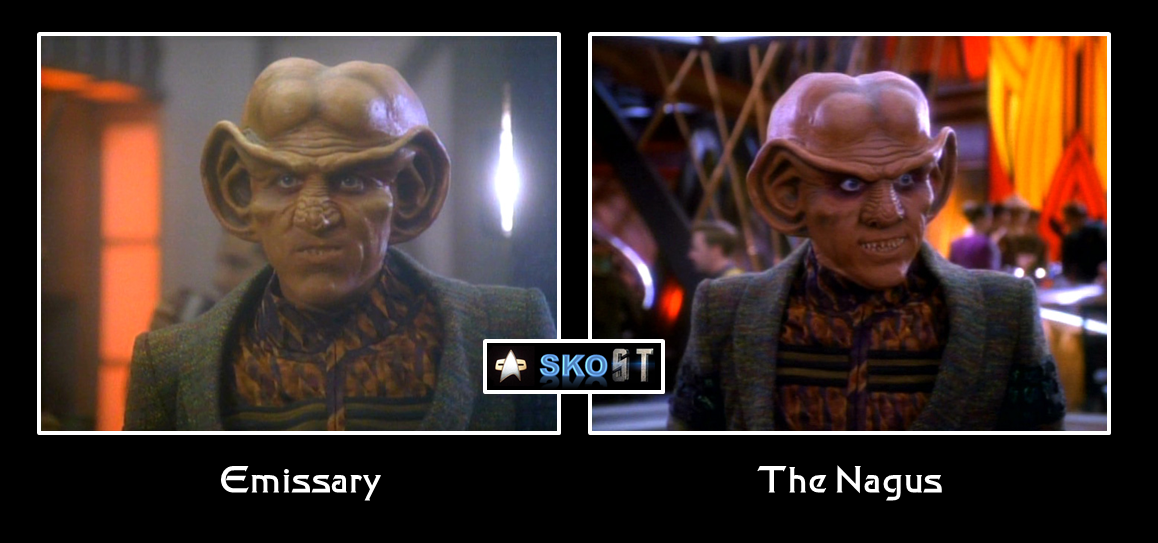
Quark is the other piece I hadn't noticed - his nose isn't his nose in Emissary. Honestly. Take a look. I could never quite put my finger on the difference but here's a way to compare...


That nose in Emissary makes him look a lot more sinister and serious than the more familiar one Shimerman would sport for the rest of the show. It really does make a difference to the nature of the character!

7. Monster of the Week

The Next Generation not only has to answer for recurring characters turning up on the station but also for the standalone stories that pervade the first year of the show. It's all about moving on to the next adventure which is, ironically, the one thing that the station physically can't do. People come to visit, the station deals with it, roll credits and wait for next week.


This could have become very repetitive - alien comes through and panic ensues etc but fortunately the static nature of the station forced the hand of the show's producers. Could it actually be that this first season sets up the pieces that season two would then develop before season three brought it all to fruition?

Saying that, season one has no repercussions. It takes until the final episode for any kind of arc to emerge and that would only be fully realised in the following year. The twenty shows here focus on building the characters but nothing follows on, no-one deals with anything further down the line. There's a lot of trial and error going on here leaving you pondering what year two would bring about. Luckily the mentions of the Dominion started to appear from The Rules of Acquisition onwards and the rest is history...

8. The First Visitors

Captive Pursuit marked the first visit from the Other Side of the wormhole. Looking back it's funny to think that we never, ever even hear of this race ever again. Period. The skirmishes here are a welcome break to some of the more mundane elements of the first batch of episodes and Michael Westmore got to stretch his creative might designing two new races for the encounter. Just a note that the guy playing the leader of the Hunters would return in season two as the "other" Q...


9. The School

Do you remember how much focus there was on the school in season one? Neither did I until this rerun. It's mentioned almost every episode and then plays a pivotal role in the season finale when it gets bombed. The funny thing is that as time moves on the school, which was so prominent here and of such significance with the roles of Jake and Nog in particular, just vanishes. It gave Keiko something to do for the first couple of years but after that botany took over and things got back to normal. 

In retrospect the school was a great device to provide conflict between the Federation and the Bajorans over Mrs O'Brien's teachings. It also acts as (although we didn't know it at the time) a springboard which would eventually lead to Nog entering Starfleet - consider the fact that at one point in this season Jake is teachning him to read.


10. What was it before it was Deep Space Nine?

Yep. We all know now that it was called Terok Nor and that it was a Cardassian mining platform. It's made clear from early on in the series what the station was used for and who was in charge. There's a lot made in Emissary about the former occupants laying waste to anything useful before their departure but at no point in season one do we find out what the place was called before it was Deep Space Nine. Alongside this it's actually interesting to note that we find out very little about the characters background beyond Sisko (mainly from Emissary and some visions) and Dax in Dax. Kira, to be fair, probably gets the most exposition however with background info popping up all over the place. 


Scene setting takes precedent here and finding out what has driven our crew to this point in their lives is left unsaid in the case of everyone else. I actually thought examining the history of the station might have been a bigger part of not only the first year but the show as a whole. The only time we really get to see any unusual parts of the station is in Civil Defense from season three. For the record, the first time that Terok Nor is mentioned is in season two's Cardassians....


Next time we'll take a look in more detail at the first season and it's impact on the Star Trek franchise in 1993....