Showing posts with label Phase II. Show all posts

Tuesday, 3 December 2019

DC Fontana 1939 - 2019


One of the lights of the galaxy has faded.

News has broken today that Dorothy Catherine "DC" Fontana, one of the key members of the original Star Trek writing staff from The Original Series has passed aged 80 on December 2nd.

Meeting Gene Roddenberry while he was making The Lieutenant, Fontana would follow him across to Star Trek and act as story editor for the first two seasons and was involved with writing ten episodes in total - Charlie X, Tomorrow is Yesterday, This Side of Paradise, Friday's Child, Journey to Babel, By Any Other Name, The Ultimate Computer, The Enterprise Incident, That Which Survives and The Way to Eden. The latter two were written under her Michael Richards pseudonym as a freelancer.

But her association with Star Trek would not end there and Fontana would return not just to write the rather excellent Yesteryear for The Animated Series (acting also as associate producer and story editor) but later step onboard for The Next Generation when Roddenberry reunited some of the original team for a second stab at success. 

As associate producer Fontana oversaw story editing once again, penning the first version of Encounter at Farpoint as well as The Naked Now, Lonely Among Us, Too Short a Season and the first true Klingon story of the series, Heart of Glory before moving on due to disagreements and differences that were brewing during the early days of the show. In a sense, DC Fontana is also responsible for the very genesis of The Next Generation, taking it and scripting the pilot episode to launch the series and bring the delicious set of characters to life for the first time on paper.

Her final scripted episode of Star Trek however would be the Deep Space Nine courtroom episode, Dax from its initial season in 1993. She would also go on to write for the fan series New Voyages for their 2006 episode To Serve All My Days which would return Walter Koenig to the role of Pavel Chekov one more time. 

DC worked again in Star Trek on video games Bridge Commander, Tactical Assault and  Legacy but her work was not solely confined to the Star Trek universe seeing her writing for productions for series such as Babylon 5

Fontana's footprint on the Star Trek franchise is certainly far and wide, stretching from 1966 and the first season into computer games and fan series. She is responsible for some landmark events in the show such as the introduction of Spock's parents as well as the birth of one Leonard James Akaar (Friday's Child) who is still now used as a character in the ongoing Star Trek novel series as the head of Starfleet. Fontana also managed to create one of the more memorable (for the right reasons) episodes of Star Trek's third and final season with the return of the Romulans and the plot to steal a cloaking device. One more notable point that the Romulan commander would be another character reused later by Star Trek Continues. In that instance the actress' real life daughter would play the role. 

As for Yesteryear, it is regarded as one of the few animated episodes that strongly resonates even 40 plus years later and many regard as canon due to its insight into the early years of Spock's life on Vulcan. This episode works in much the same way that Dax does or Heart of Glory, in that Fontana has brought background and depth to important characters within the franchise and built believable and memorable facets that are turned to again and again, forming the backbone to many a performance across six decades.

Truly a sad loss to the Star Trek universe. 

Monday, 2 December 2019

Jefferies Ideas: The Official Starship Collection Bonus Editions; Galileo and Phase II


It’s 1966 and Star Trek needs something. 

While the transporters are fantastic and save having to find a way to inexpensively land the USS Enterprise, the good starship needs a shuttle.

Who better to design it therefore than Enterprise creator himself Matt Jefferies. So was the shuttlecraft born however before it did make an appearance it would go through a drastic change to look like we now know it from what it was originally conceived.

Jefferies has a much broader and more unrestricted vision for the Enterprise’s supplementary vessel and Eaglemoss have wisely chosen to highlight it as part of the bonus editions of the Official Starships Collection.

So ignore the box on legs that was the Galileo and check out the smoother, swept finish to this beauty of this model, the Al-Biruni. Wider at the front, the forward section of the ship is dominated by the triple window offering almost 180 degree visibility. Eaglemoss have definitely encapsulated the art deco feel of Jefferies concept with an admirably smooth hull finish and a shape not too dissimilar to the sub from Voyage to the Bottom of the Sea. The dual hatches are a subtle indent into the metal body either side of the windows which is then succeeded by the USS Enterprise moniker and NCC-1701/5 registry. This takes up a large proportion of the shuttle's sides, covering the very light grey/white scheme 

The retro feel continues down the spine of the shuttle which seems more movie era than The Original Series with venting evident as well as a much more industrial theme than is evident on the rest of the ship. It's not overly filled with gimbles although the layered panels do look more like armour. This darker grey section extends down the rear of the shuttle and also out along the sides, recessing into the hull with a heavy grilled effect. 

One thing that is particularly striking is the way in which the warp pylons seem to sweep out from the main hull into a wonderfully unusual double arch which results in the warp engines. These warp engines are almost identical to the ones on the USS Enterprise complete with "golf ball" exhausts. These are a little larger in scale to the ones on the Enterprise and also have white bussard collectors fitted rather than the glowing red on the starships. 

The overall paintwork is immaculate for the body however around the windows, the black does seem to have chipped/not quite covered at all points and slips in a teeny bit of disappointment given how much I love this craft.

A more tragic misfire with this otherwise exemplary model is that you can't display it without the stand as you would with the other shuttle sets. The wing "feet" do sit slightly proud of the main struts as indicated in the magazine and the original designs but without the rear support strut it just falls backwards.

The nature of the strut probably makes it incredibly fiddly and expensive to add on here but I do know of at least one person that has managed to build and fit one...(thanks to @bobmat for the pic...)

If you don't manage to build yourself a third leg(!) then the underside of the Al-Biruni is somewhat plain with only the dividing line between plastic and metal around the lip of the central structure being a visible "feature" if you will. To give credit, the ventral section of the shuttle is completely smooth and blemish-free, continuing the off-white paint scheme across the full surface. Does it need any extra detail here? Absolutely not because there's a real awareness of a functional minimalism that does transfer across from the original starship of Jefferies design. 


This is one cracking design and the Jefferies Concept special issue magazine dives straight into the initial story around the necessity for a shuttle, the fact one was missing for some time and also the point that the Matt Jefferies concept while brilliant and in keeping with the look of the show was not feasible when it came to a quick construction schedule - enter AMT and Gene Witfield who came up with the Galileo that we know today.

The whole magazine covers this story and is filled with a ton and a half of design work from Matt Jefferies. Some of it is very familiar but there are even very early almost alien-esque/Jetsons craft that wouldn't have looked right on the flightdeck. Damn good read here and a lot to look over.

Skipping forward just over a decade we get to one of the most fascinating sections in Star Trek history with the never-made Phase II

Eaglemoss have already included the concept for the USS Enterprise into this series as part of this bonus line and now we have the Matt Jeffries Concept Shuttle to add in and it's just as impressive as his vision for The Original Series.

Stepping away from the conventional design of a box with nacelles, this one is actually a redesign of a ship from a never produced War of the Worlds TV series. Opting for a more tubular shape, the NCC-1701/9 shuttle takes a line from a winged rocketship or an airliner and certainly shows the influence of 70's styling. Bizarrely it does carry some parallels to the Enterprise NX-01 shuttlepods especially to the front.

The curved nose arcs out to provide the craft with an oval shape from all sides and under that nose there looks to be some form of sensor or navigational deflector sunk back and painted very precisely. This upper hull section carries a decent amount of weight - it's a very large metal piece making up two thirds of the resulting model. There is a lot of space taken over by the blacked out windows and the fuselage is marked up with The Original Series livery including the pennant and blocky registry. Eaglemoss have also included clear lines sunk into the metal to demonstrate where the entry hatches are on both sides of the shuttle.

The detailing is pretty crisp and minimal with only red stripes across the nose and around the rear of the passenger compartment, just ahead of a very inconspicuous engine painted in the same light grey as the hull. I would have thought this would have warranted something more striking to lift it from the rest of the ship.

To the back there are the swept wings which make this appear more like a plane than a shuttle, jutting sharply back and out from the hull, these are attached to the plastic "flat" bottom and are surprisingly strong. To the front they are wider due to the grilled effect, tapering to a sharper edge at the rear. The panel detail on the wings is slim at best with the upper sides probably fairing better and looking more "winglike" than the ventral surfaces.

Now from some angles the odd vertical fin arrangement doesn't look right and is a distinct move away from the shuttles of ol'Star Trek. In reality all this aerodynamic fluff would offer nothing in space but on the flip it might work more in favour of the ship once it's heading down to a planet. Quibble here has to be that the probes sticking out from the wing tips on mine are ever so slightly bent down. Very, very minor I know.

The underside provides a flat base so this one can be displayed without the standard black base and clear grip piece.  Aside from the wraparound grey, the base has a series of metallic painted ovals and circles which could be magnetic locks or some form of landing thrusters - your guess is as good as mine.

The Phase II Concept magazine offers lots of dribble-worthy CG images of the shuttle steering more towards how the design was forged and then swapped to the Star Trek show. The story of Jon Povill takes over the majority of this one though, covering his journey with Star Trek through its multiple revival attempts in the 1970's right up to Phase II itself before splitting into a second secton looking at the development of the proposed return of Star Trek that would eventually mutate into The Motion Picture. A veteran of TV, this section covers Povill's work plus his relationship with Gene Roddenberry in great detail and as a fan of this era of the franchise it's an insightful read.

Both craft are available now online from Eaglemoss.co.uk.

What's your take on the concepts? Is there one that stands out more? Are they in the Star Trek mould?


Enjoyed this article? Why not like and share to spread the word!

Like our page on Facebook 
Follow us on Twitter

Find us on Tumblr


Sunday, 19 March 2017

Simple Lines: The Official Starships Collection Issues 94 and 95


The latest offerings from Eaglemoss highlight two great traits of the designers from Star Trek; the ability to keep it simple and the brains to think outside the box - or several model boxes in this case. 


The Suliban Cell Ship in issue 94 comes from Enterprise and for once you're getting something incredibly basic from the prequel rather than one of the more intricate and finely detailed starships. 

Following in in the wake of the Borg Sphere (issue 10) and the Borg Tactical Cube (issue 58), the hexagonally shaped craft seems somewhere between a space skip and a large gaming dice with all the grace of a brick.  It's certainly as repetitively patterned as the two geometric Borg craft from previous issues but it's not a shade as exciting. The individual panel lines are well marked and very distinctive here but there's no real substance. 

Envisaged as a single occupant craft with some impressive technological capabilities, the Cell Ship might actually work best on display with another two or three formed into some sort of display with them interconnected to provide a vision of the Suliban helix being formed. The previews, even with their slight colour retouching and very forgiving lighting, didn't manage to make this look much more interesting and it does come across much better in the flesh. 

The colour - mainly due to John Eaves having some left over from Ghosts of Mars - isn't too far off the reds of the Vulcan fleet and gives it a used and worn feel emphasised with the "blotchy" effect finished off on the larger, square panels but isn't carried through into the smaller observation window sections which are placed at the corners.

Tragically these sections are left in the same colour as the rest of the ship meaning there is some definition and differentiation between features that is utterly lost with this one. Could have done with being translucent or a different colour at the least but I would think that fiddly angles and tight shapes have restricted the flexibilty to make that happen here. It just ends up being incredibly flat even with the best intents and purposes. The Borg Tactical Cube and the Sphere were different from a number of angles but whichever way you look at this one - and that's by design - it's identical. Clearly a decent bit of worksmanship to build but from a photographic and reviewing perspective this is hell on Earth. 

For note there are two points additionally worth calling out. Here both halves of the ship are plastic with the central connecting ring being metal. This is the only thing on the whole ship that defines exactly which way is "up". Secondly the stand fitting is a literal "drop on" this time and fits comfortably around one of the square panels.Could be a toppler though since there's no proper securing clip. Best stick her on a lower shelf although with no protrusions anywhere this might well be in the top three most durable models in the collection but unfortunately at the same time it's probably one of the most boring and simplistic to come out. 


The Suliban ship is an unavoidable entry into the series and I'm surprised it's taken until issue 95 to slot it in. Countering that though I'm not shocked because I can imagine the conversations over how to make something this basic more exciting must have been a nightmare. 

The cover pic on the magazine do the model a lot more justice because those transparent viewing ports are called out and there's a little more depth to the detail on the hull. The ship overview provides a potted history of the NX-01's encounters with the Suliban while covering off some of the key details of the boxy craft. The ship info is a bit sketchy with the magazine relying more on the stories to fill space this time. Had to laugh at the views of this one since they are all nigh on identical except when viewed from the top. Well played on space filling, Eaglemoss, well played.

For those of us who like to find out what went into making these ships come to life, there's a staggering eight pages dedicated to the designing of this cell ship. Yes, amazingly for a ship with such a basic, plain design there are eight pages handed over to discussing its creation and a ton of drawings that chart its development. While I can't say I'm it's number one fan, the originality factor here is top-notch with John Eaves steering away from a traditional hull and engines/wings design for something more unusual. It certainly works on the screen although in the flesh it's not as impressive!

Now the next one up has been long awaiting and hotly demanded by collectors. When the First Contact fleet was ticked off and completed there could only be one other way to go and that was to resurrect the classes featured in the Battle of Wolf 359.


A lot of those ships were seen only for a few seconds passing the Enterprise or drifting across her viewscreen but their inclusion in the show and the background of their creation is legendary in franchise circles. They were onscreen therefore they are canon. Period.

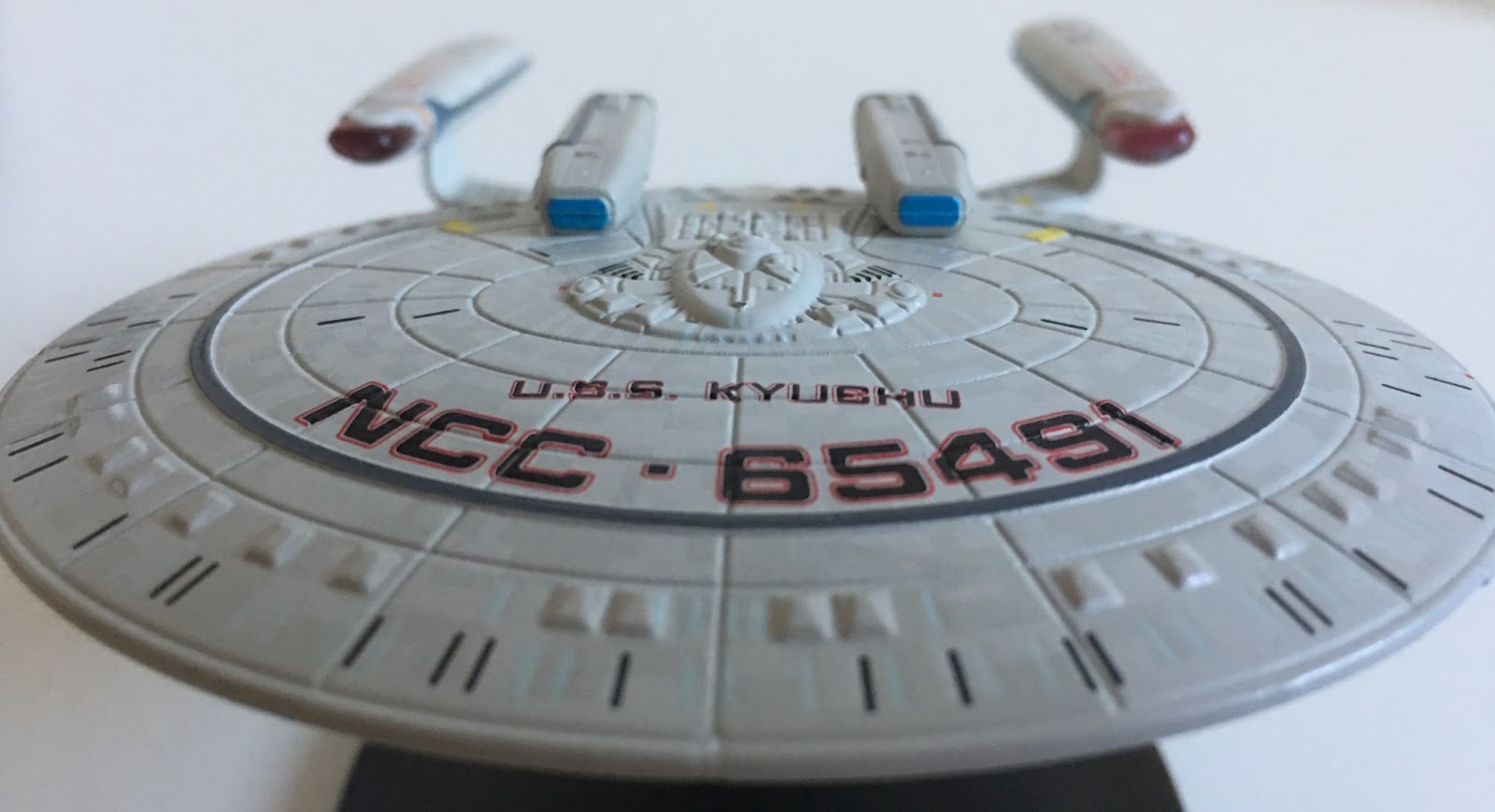
So the first of those graveyard ships comes out of the box and it's the New Orleans Class USS Kyushu NCC-65491. A blatant Galaxy Class kitbash, the Kyushu has the same distinct saucer and secondary hull shape as the Enterprise-D but that's where the similarities end as there are a significant number of modifications.

According to the stats the Kyushu is half the size of the Galaxy Class which, technically, means we get to see everything a little bit larger(!). The most immediate difference when comparing the two is the significantly smaller number of windows on the saucer. While the Enterprise-D has three rows between the lifeboat hatches and the outer edge, the Kyushu has just one. Impressively those windows are perfectly aligned with the saucer grooves as they should be but not, as collectors will know, as they always are. The larger scale will definitely be a help in ensuring this fine tuning and if this is an indication of the quality here it's going to be a great ship to review. Keep that in mind because when you flip her over the recessed windows on the underside are totally misaligned, sinking towards the centre of the saucer rather than sitting in their respective slots.

Moving back there's a single row of lifeboat hatches which circles the primary hull. Again larger than the Enterprise-D versions they are very pronounced against the flush saucer surface and draw your eye ever inwards to the dark grey phaser strip and then the massive ship registry. Sadly though the colour difference of hull versus lifeboats that we see on the magazine cover isn't carried across but at least you can make out their locations.

With such defined hull lines, the ship name and number do sit into the panel edges which at a couple of points has meant that the decal has split due to the slight variation in level. Nothing that a fine line marker won't sort I'm sure but it was a little disappointing. 

The increased surface detail on this Galaxy Class kitbash is at its best right at the centre of the primary hull and the bridge/shuttlebay complex. Here Eaglemoss have really gone to town with different surface structures and definitions which make it easy to navigate to the bridge dome and break up the smooth surface with some bobbly greebling. We also have the ship registry number planted firmly to the rear on the shuttlebay landing pad. Must be a tricky landing because...a tour of the primary hull of the New Orleans Class wouldn't be complete without noting the two distinctive dorsal pods.

Fans will know these are, in reality, two highlighter pens glued on and coloured but somehow they just, well, work. Not only do they create a very individual silhouette for the starship but clearly they have a very effective and highly scientific purpose as well...

Moving every rearwards the stubby cobra neck (again clearly halved in size from a kit of the Galaxy Class) opens out onto the oval secondary hull. Interestingly the New Orleans Class retains three impulse engines - two at the rear of the saucer and the third in the neck however there doesn't seem to be a need for it since there's no indication of a saucer sep feature.

The lower hull again has some very precise window alignment in play as well as some minor yellow venting detail evident at multiple points on the ship as a whole. The scale opens up the chance to get much clearer hull panel definition once again plus even the spine running along the back of the secondary hull has variations in the detail packed onto it. It also seem quite long with two phaser strips lying across the underside with a third "highlighter pen" ventral pod slotted between them and protruding down from the hull.


To the front is the eye-shaped deflector dish once more atypical of the larger Galaxy Class but here much easier to see with at least a bit of the edged/ribbed detail marked in for effect. Again comparing this to the "D" it does add more depth and realism to the model even though it's fairly well hidden under the saucer.

What isn't too evident is the subtle aztec paint scheme. Since issue one this has been refined, refined and refined more to the point now where the two shades are almost impossible to tell apart and the only way to really see it is to get the right lighting angle. I think this is a strong move that doesn't make the starships look too basic or toy-like and reflects the development of the series furthermore. Notably the scheme is fluid right across the metal saucer and down into the plastic secondary hull. There are a couple of very obvious join lines under the saucer but it moulds together nicely even around that fiddly neck section.

While I keep coming back to the Enterprise-D here, the construction of the pylons and warp engines have a very unique look. Sweeping back from the neck section rather than the rear of the secondary hull as in so many other cases, the wings actually end up placing the nacelles in exactly the same place if they were hung from the back of the hull. On both sets of wings you'll find the ship registry which is a tiny but cool touch as is the panelling detail which covers their whole length. While these could have been forgotten they carry on the two-tone aztec colour scheme but in a more blocked out form. Very nice to see this distinction in such a small part.

It's a striking design feature with the engines actually appearing slim and long emphasised by the twin sets of (what I can best describe as) vertical holes. The engines do feature the usual translucent bussard collectors and blue warp coils as well as the fine finishing details of the Starfleet pennant. Only grumble here is that one of my engines is a little bit gappy at the front end. A slight fitting issue but nothing that affects the build of the vessel.

The Kyushu is a cracking little ship to display. Aside from the larger decals and markings, the small finishing touches around the ends of the phaser banks and the markings behind the saucer impulse engines add a touch of flair to the result. It is certainly not bland and counters the disappointing (but necessary) Suliban ship it accompanies for subscribers.

Over in the pages of the magazine and the CG shots are just magnificent showing off the best angles of the New Orleans Class. Noting the stats for the stumpy kitbash, the opening Ship Profile also reminds readers that the class was "featured" in Conspiracy as well as it's more famous appearance in the wreckage at Wolf 359.


We do get to see the ship both in pristine condition thanks to an efficient Rich Sternbach taking some "before" shots plus we have the "after" pics as the class took to the screen for its fleeting appearance. I did note that the aztec scheme seems a lot stronger on the page than it does on the model while in contrast the bright blue of the pod ends is totally against what we have in the magazine at every angle and on every reference photo.

Unsurprisingly the issue is rounded out with a huge article on the writing of The Best of Both Worlds. I mean, how could it not be? The real tragedy here is that Michael Piller is no longer with us, robbing fans of his current take on the classic two-parter which cemented The Next Generation as a hit and a show no longer overshadowed by its 1960's predecessor.

Again there's a real big gap between the two issues this month. On the one hand we have the essential Suliban Cell Ship which, while super-bland has to be included and is, for all intents and purposes, a well-finished and nicely presented...box. It will however always play lesser fiddle this month to the USS Kyushu. It may only be a screen filler for a second but its reputation and very existence as a Federation starship are sure to drive fans wild. It's this month's clear winner because of the detail and maybe solely because it's rare to get this close to such a cracking kitbash. 


Slight niggle mind that there are a few cartoony features on the Kyushu which make it look a little odd and therefore the Cell Ship the more screen accurate but a good Federation replica will always pull at the heart strings more. Remember we still have the Springfield, Cheyenne and Challenger classes to make an appearance over the next 18 months if the leaked list is to be believed.

Little bit of news too is that cgreactor.com has now been updated with the Phase II USS Enterprise (as above). I'm over-excited for this one. It's a fine piece of lost Star Trek history and an essential. A critical essential to any collection. Check out the views of this stunner and try and resist buying when it's released...!

Next month we have another remastered starship, this time with the Orions making an appearance in their ship from The Original Series' Journey to Babel and then it's the upgraded Nova Class USS Rhode Island featured in the Voyager finale Endgame

Looking forward to the other Wolf 359 ships or is this the best of the lot?


Live on YouTube
Like our page on Facebook 

Follow us on Twitter
+1 us on Google+
Add us on Tumblr

Saturday, 23 January 2016

Mothering Instinct: New Voyages' The Holiest Thing


After an extensive delay it seemed that New Voyages' latest offering slipped on line with almost no fanfare whatsoever.

Which is an utter disservice because The Holiest Thing is a cracking hour of original Star Trek material; in fact one of the best they've produced. Be warned if you've not watched it yet, there will be SPOILERS as we examine their ninth installment. 

With a slight revamp of the ship, we find the USS Enterprise attending Lappa III and a terraforming project led by Doctor Carol Marcus (Jacy King). An apparently freak accident vapourises the Federation ground base and leaves a large crater prompting Kirk to launch a full scale investigation.

The episode, written by Rick Chambers, is the origin story of the Kirk/Marcus relationship that formed a central part of The Wrath of Khan and will no doubt be totally overlooked for the upcoming Beyond.  It also marks the first time Brian Gross took on the role of Kirk even though we've already seen him in Mind Sifter which was released last year. That episode was a lot darker than the material Gross is presented with in The Holiest Thing and acts as a great comparison to show the range he is able to carry in the lead role. I actually preferred Brian here in a story that felt much more personal which I suspect was helped due to the fact that this is a script which focuses on a select number of the crew.

It's been a long time coming for The Holiest Thing. Originally set to be uploaded for Valentine's Day 2014 - as promo'ed at the end of Kitumba - but the choice was made to hold the release, rework it, give it an even better polish and present it to the world in a format that the production team were happy with. I can't fault the decision because it's a great episode for the most part led by a top script and some of - if not the best - lead acting in an episode of New Voyages.

As I've noted, Brian Gross is exceptional as Kirk and suits the more intimate one-on-one material and certainly exploring the captain's softer side is something that he's nailed. Perhaps the bigger surprise - and a pleasant one - is Jacy King as Carol Marcus. Whether delivering technobabble or expressing her emotions to Kirk as their relationship develops, King is totally believable and may well be the real star here. I found her performance one of the best in New Voyages and certainly their strongest guest star to date.

Also returning are Brandon Stacey as Mr Spock and John Kelley as Doctor McCoy. Both are firm stalwarts of the New Voyages episodes providing their usual, excellent portrayals of the iconic characters. Oddly though, Stacey does seem to be opening up Spock's emotional side with a hint of his human half ebbing through in more than one scene. Both Spock and McCoy play critical roles here. The science officer leads the investigation into the events that have transpired on the planet surface with Doctor Marcus and stands to the "business" aspect of Kirk. On the other side we have the Chief Medical Officer who acts to calm the captain's emotions as he falls for Carol. Kelley always seems to revel in the role and his interactions with Kirk are particularly good to watch and balance against some of the conflict/uneasiness you can sense the captain has with Spock in this story. I kind of think the Vulcan is finding his bromance threatened with that discomfort more than evident.

The choice to place Scotty, Sulu and Uhura (no Chekov this time) very much in the background does mean that their actors don't get a huge shot at the limelight here but it means the pacing is kept particularly tight and there's no baggage here. Everything just damn well works and it's a great episode from beginning to end. Chambers also drops in some key points that homage the second Star Trek feature film - terraforming, life from lifelessness, protomatter and more. The nice thing is that they actually work within the script and don't feel like the writer is just hammering them in for the sake of making fans go into continuity overload.

Graphically it's once again superb. The updated nacelles and forward torpedo tubes start to make the transition from TV to movie starship. For some this might seem a bit weird but I'd recommend watching the vignette Going Boldly which shows the upgrades taking place.  Sadly there's no CG Lieutenant Arex this time but we can hope for the future! The Ferengi ship too is very faithful to their species and the confrontation between the two vessels is stunning with the Enterprise emerging from the darkness to discover the hidden opponent. The environment of Lappa III is well realised in both the opening segment and in the away mission undertaken by Spock and Marcus. Nod for the homage to the forcefield spacesuits of The Animated Series too! 
However...


This is all well and good for the first 43 minutes but then things take a bit of a turn. For the first section of the episode we've been wondering what has been the cause of the explosion - an accident or outside intervention? When it's revealed that there's an alien ship hiding out we have some idea that there's more to this than we initially thought but the problem I have is who these aliens are revealed to be - the Ferengi.

While their motivations are feasible and trade with the outpost (unbeknownst to Doctor Marcus) to provide them with the ability to make protomatter makes total sense, I don't see why it had to be the Ferengi. It could have been a new race, even Romulans for instance but the appearance of the galaxy's most profit-hungry merchants doesn't seem to fit. The performance of guest star Clayton Sayre as the Ferengi Commander is spot on but they aren't a race I would associate at all with The Original Series.


The other challenge this episode has is the pacing of the last ten minutes. Chambers has done a magnificent job to this point but then we seem to have a lot that he wants to cover in a very short period of time; the reason for Carol requesting that Kirk leaves her alone and "stays away" and that she's pregnant. Hang on a minute - haven't these two only been together for a matter of days?! That's good going if ever...

I appreciate that the Kirk/Marcus origins story is something never covered onscreen but to ram such big plot points into a tight epilogue does make it feel very rushed. I actually believe they could have left off both these points and kept this story as an initial meeting and the start of a relationship. Certainly the concluding revelation does line up with the concept of Marcus as the "mother" of new worlds (if only she knew...) but this could have been explored in a follow up or even just a little vignette/afterwards.

One final point has to be to recognise Carl Sheldon who appears as the older Scotty in the prologue and epilogue of The Holiest Thing. Very similar to the wraparound of Captain Sulu in World Enough and Time it shifts the series firmly to the modern day and recognising the later spinoffs while adding a new twist to the classic series. It's also one piece of the episode that was shot long after the original material was filmed thanks to Kickstarter funds raised by fans.

New Voyages has played a blinder here. A truly great character episode that has evaded the screen for too long. Gross has certainly affirmed his abilities in the role of Kirk and I simply can't wait to see what the next story, Torment of Destiny, has to offer. This is set as a sequel to the classic For the World is Hollow and I Have Touched the Sky guest starring Battlestar Galactica's Richard Hatch. Plus it seems we may eventually get to see the lost Origins story written and directed by David Gerrold. Hopefully more on that one soon.

Did you enjoy The Holiest Thing? Is it one of New Voyages' finest hours?

Check out their website for more adventures and news HERE


Live on YouTube
Like our page on Facebook 
Follow us on Twitter
+1 us on Google+
Add us on Tumblr
Add to the conversation on Star Trek: Risa

Thursday, 30 January 2014

Phase II: Why Aren't You Watching?!


Hi, my name's Clive and I have an admission.

Star Trek: Phase II (nee New Voyages) is a revelation. The downside is that since it's arrival back in 2004 we've only been privy to nine (soon to be ten) episodes. But what a collection they have been so far.

The first thing is that until I saw Kitumba my knowledge of the series was purely based on what I read on the internet.  I'd never watched a single solitary minute. The poster for that episode enthralled me; there was hype, there were Klingons and it was one of the "lost" episodes proposed for the original Phase II show in the late 70's. I watched, I reviewed...and then I thought; OK, that was pretty impressive....what else have they done...?

"More than I thought" was the straight answer so let's rewind back and talk about what I believe to be the best online fan series created. Now I've had several conversations with +Carl Thomson and +Mark Thwaite telling, nay preaching...nay ordering them to watch at least one episode from start to finish. Truth be told I'm still waiting but maybe this post will spur them (or shame them!) into watching some Phase II. I believe I may have said something along the lines of:

"Have you seen Phase II?"
"No"
"Then ******* watch it!!!!"

So it's time to prove a point, to reinforce the facts and my argument. From the start then...

Back in the beginning Come What May and to some extent the subsequent In Harm's Way were a little out of focus, definitely fan-produced and reminded me more of 70's Blake's 7 rather than 60's Star Trek. James Cawley's Elvis hairdo sticks out like a sore thumb in the pilot but is mercifully laid to rest by the follow up. They're both fairly average and my attention dropped in and out. The pilot has it's moments with some cute little flash forward moments courtesy of the whirly alien effect and it's bouncy human companion. Now when I watched the first episode after having seen Kitumba I nearly went into cardiac arrest. Was this really the same show I'd reviewed? It seemed light years away but at that moment began a wonderful, somewhat unexpected journey but there were sparks of genius buried within that even I allowed myself to give a little nod and smile to.

So I successfully restarted my heart and ploughed on. While I have to admit the existence of Come What May it was In Harm's Way that really suggested the potential of the show. Bringing back the Guardian of Forever and introducing a substantially larger plot device sibling as well as drawing on Star Trek history with the inclusion of Pike and the crew from The Cage do work a treat. Not only is Phase II exploring the galaxy but also the rich Star Trek universe and history. Cawley, Quinn and Kelley as Kirk, Spock and McCoy are ok but you're always going to be raising comparisons; it's natural. The spark of Shatner, Nimoy and Kelley isn't quite there but these guys are very watchable together. If anything, Jeffrey Quinn does seem a bit young for Spock however the story is very engaging crossing time and space - and reminding me a little (by its conclusion) of the three Enterprise scene at the end of All Good Things....


The script from Doug Drexler and Erik Korngold is total fan immersion with all the references to classic episodes with unexpected cameos from William Windom as Commodore Decker, reprising his role from The Doomsday Machine and Barbara Luna. The latter is ok but Windom looks a little uncomfortable with his lines. A great shame as his return to Star Trek is a great moment that brings in a ton of continuity which is something that New Voyages/Phase II does manage with greater aplomb than The Original Series. More on that in a bit. Oh yes, and while we're mentioning the unexpected, what could be more so than a shuttlecraft in the garage of a suburban house?!

This episode truly drew me in more than the iffy pilot because there's so much going on and a ton of curve balls that make it super watchable. However, it keeps getting better.


The next two episodes could have done with a little more separation as they both deal with main cast members aging so that Walter Koenig and George Takei can guest star as Chekov and Sulu. Now I'm not complaining as it's great to see them back and appearing to thoroughly enjoy the experience. To Serve All My Days, penned by D C Fontana is a something sequel to The Deadly Years while The World Enough and Time offers something akin to Children of Time with a "future" Sulu storyline. The ending of the Chekov focused To Serve All My Days is bitter-sweet but effective and reminds the audience that Phase II does have some poetic licence to mess it up a bit and for good reason here. The Sulu show even did something that surprised me more than the ending of the preceding Chekov one; it set both the prologue and the epilogue in the future. Clearly not something that would have been possible in the 1960's but here it's a beautifully executed maneuver that even Picard would be proud of - and I'm glad of any excuse to see the Excelsior on screen. So it's a big tool just to get Takei into the Phase II universe (and Grace Lee Whitney) but it works and while we expect the reset it kind of makes sense to a degree. George looks totally engrossed playing a not-quite-Sulu Sulu and I'd happily watch this again and again. 

The show is almost a split for me - the stronger stories are certainly the later ones which also include several cast changes with new actors for Spock (Jeffrey Quinn to Ben Tolpin to Brandon Stacey), Chekhov (Andy Bray to Jonathan Zungre), Sulu (John Lim to J T Tepnapa) and Uhura (Juliette Irons to Kim Stinger) as well as the additions of Peter Kirk and Xon. While this may seem like bloating what was already a fairly sizable ensemble it does add a great deal of diversity and more varied character relationships. But that's not exactly what I'm stabbing a finger at here - the stories themselves keep getting better (with the blip of Enemy: Starfleet in the middle actually). 

Starting with Blood and Fire, passing through to The Child and into Kitumba is a masterful batch of lost Star Trek finally able to make it onto the screen. Gerrold's legendary story that touched on homosexuality gets expanded into a superbly acted, directed and written two part/move length story. Justice is truly served after such a long time and the bar just keeps finding it's being raised just a little more. It's no wonder the calibre of guest star that this show can get when you look at how innovative and boundary pushing Phase II has been. Not only are there those mentioned here, but add in Malachi Throne, Grace Lee Whitney, Eddie Paskey and John Winston to what is an exemplary mix. 

OK, so we would never have seen movie uniforms turn up in a flashforward back in the 1960's  (etc) but that's where this series is different. While it's in keeping with The Original Series it can think and act outside of that box with the benefit of 50 years experience. It draws on the known future, the inherited forward-story if you will and makes it even more watchable just to see what we "missed" and what could have been. I particularly like the way in which stories are continued across episodes (Ensign Kirk's loss from Blood and Fire for one or the returning villain Kargh) and, on a little nod to his role in the movies, Chekov making it as Head of Security and putting on a redshirt.

Newcomer to the show (at this point), Bobby Quinn Rice, has a big role to fill here as Peter Kirk and does an admirable job from start to finish. While he's not overly used for the subsequent stories (as with Xon), his presence is still felt in each. For me, his arrival marks a key change in the quality of Phase II. I hit Blood and Fire in one sitting. I was glued. We know why this never originally made it to screen but here, with an additional guest appearance from Denise Crosby it's wonderfully realised with some genuinely decent effects, dialogue and CGI to boot. This story has humanity, action, Klingons, blood worms, geniuinely surprising moments for a few characters and a starship load more to enjoy. A true top notch story that SHOULD have been made.

It does become apparent though, even in the double-length Blood and Fire that budget is restraining the show to the established ship sets with the occasional pop over to a Klingon bridge or sneaky away mission. All of the two-parter appears to be on starship sets however because of the quality you tend to only realise afterwards. It's not until Enemy: Starfleet that we get the real feel of an away mission complete with sandy camera filter. Saying that, the CGI also makes dramatic steps forward along the way from some not-too-bad shots at the start through to full blown battle scenes and fleets of Klingons by the time we reach Kitumba


Actually, I want to stick with Enemy: Starfleet for a moment. The title made this one anticipated episode and while there is a great story at the heart of it, I felt decidedly let down after the two-part juggernaut. The Eagle is a mighty piece of CGI but sadly it's let down by Barbara Luna in my humble opinion. Whether she meant to aim for a panto performance or not I can't say but it's just a little too much and does detract from the episode. Her appearance in In Harm's Way was nothing like the one she puts on here and the seduction scenes with Kirk are slightly toe-curling. Sorry, readers, but I just can't get excited about this one; probably the weakest of the latter half and maybe of the show thus far and I so wanted it to be the best one.


I can't however strike that at The Child. Now I had read a lot about taking it back to the original idea and making the show as it was meant to be -and they weren't joking. This eighth installment is unrecognisable to the "travesty" that introduced the shorter second season of The Next Generation. Itself a "lost" script from the original Phase II production it makes a heck of a lot more sense and praise has to go to both Anna Schnaitter as Lt Isel and Ayla Cordell who plays her rapidly aging daughter Irska. Their performances truly lift the show and make it an excellent example of how Star Trek could and should have been done. John Povill's story and direction show this story has been (no pun intended) his baby for a long time. Great to see a Deltan on the crew as a nod to Illia from The Motion Picture who was originally intended as the mother figure here.

My thoughts on Kitumba have already been well-documented but I honestly can't wait for The Holiest Thing. New Kirk, Carol Marcus...brilliant. It will also mean that John M Kelley is the only main cast member to be retained since the pilot in 2004 as James Cawley moves off screen to focus on the production of the series. I think for Brian Gross this will be a very hard act to follow. While there is the occasional glimpse of a facial movement or vocal intonation that reminds us of Shatner, Cawley has set out his own portrayal of Kirk admirably - even if there was that hint of Elvis at the beginning! Let's also not forget two other long serving cast members. I've been a little harsh on Charles Root's accent in my Kitumba review and I'm going to take that back. He's done a great job in the role and frankly who cares if Scottish isn't his native vocal sound, I really like the part he plays and hope he sticks with the show. Up there as well is Ron Boyd's DeSalle. He's the Phase II version of Kyle - always there but not too prominent - and he's a redshirt that's survived more than one episode so he's clearly doing something right!


One thing that I cannot heap enough praise on for this show is the effects and the stunning work of Tobias Richter who is also going to be master of the CGI for the much-hyped Axanar. I didn't think it would be possible to produce such stunning work on very little money but you can when there's this level of ability. The USS Eagle of Enemy: Starfleet, the USS Copernicus and surrounding space in Blood and Fire, even the nebulous materials that the Enterprise encounters in The Child are awe inspiring on the screen and make every episode a fantastic spectacle. Yes, at the beginning the ship movements were a little bit too smooth and some of the graphics a little jittery but things have moved on at a phenomenal rate to create some very memorable moments. In fact, how many times can you remember the original Enterprise carrying severe battle damage through an episode on screen that you could see?


Oh and then there's the vignettes that have popped up in and around the series. I think there are four to date - Centre Seat, No Win Scenario, 1701 Pennsylvania Ave and most recently Going Boldly which act to whet the appetite between episodes. The first deals with both DeSalle and the returning Lt Cmdr Sulu and a minor navigational error, the second with Kargh as he works to devise a plan of attack against the Federation border. The next is set on the day of the Moon landing in 1969. It's an inspired 11 minutes which is, to say the least, off the wall in more than one way. Klingons, tribbles, Nixon - if I say any more it might all make sense.

What I do want to focus on though is the fourth; it's truly the start of a new era. Kirk has a new face and a little less Shatner. Times are a-changing with the arrival of Brian Gross and also this new swanky vignette that offers something of a prelude into the upcoming The Holiest Thing. While saying goodbye to both Enterprise crew lost on missions and real life individuals who passed away and were associated with the show, it's a glimpse of what could well be Phase II.1. After that wonderful, if brief "hello" to Garth of Izar played by Alec Peters (who is the guy behind Axanar) we get to see a few sneak peeks. 

There's The Animated Series' Arex at the navigation console which is perfect sense now Chekov is down in security and Scotty has a nice shiny new warp core to play with (above).  What was that i said - yes - Arex - a CGI character!!! You have to see it. Go on YouTube here and take a look, it's genius!

It's ALSO the exterior shots which just make this a salivating treat of a vignette and there's definitely a homage here to the drydock departure scene in The Motion Picture as we see the starship's new warp engines and torpedo tubes. Clearly Phase II is starting to increase the notable links between the TV series and the first movie. At the core though the USS Enterprise is very recognisable as her original self but these new tweeks do help to add to the production's individuality. Love it.


Not only do we have The Holiest Thing but Bread and Savagery is in post-production and there's work going on to complete The Mind-Sifter for future release. Despite some behind the scenes rumbles, overly-long delays and the fact this is all done on volunteer time, it's a fan-made masterpiece. We may not be getting a new episode each week, Star Trek fans, but at the moment if we want to get the feel of the Roddenberry universe back this is absolutely the first stop you should be making and exploring.

So, gents, ladies, one and all my original question stands - with the quality that we're getting from this series Why Aren't You Watching?


Did you know you can now join up with us on Facebook or follow us on Twitter or even +1 us on Google+? If you didn't why not drop over there now!

You can learn more about Star Trek: Phase II at their website and view their episodes too at YouTube