Showing posts with label Lore. Show all posts

Monday, 10 October 2022

Picard: Third Try at the Greatest Adventure?


The third season of Picard might only be due in February but already the second trailer has the pulse racing.

Featuring, unsurprisingly, the whole of the TNG crew, the last season of Jean-Luc's story is set to be the biggest the show has produced and maybe even the biggest risk in the franchise's history.

I say that with just as much trepidation because the trailer throws all in perhaps with the exception of that kitchen sink cliche. 

TNG has been owed, some would say, a decent send off since the disappointment of Nemesis and the subsequent "final" movie that never happened. There was franchise lethargy back in the early 2000's and we wont retread those board here but this could be the closure that fans of the now 35 year old series may actually deserve.

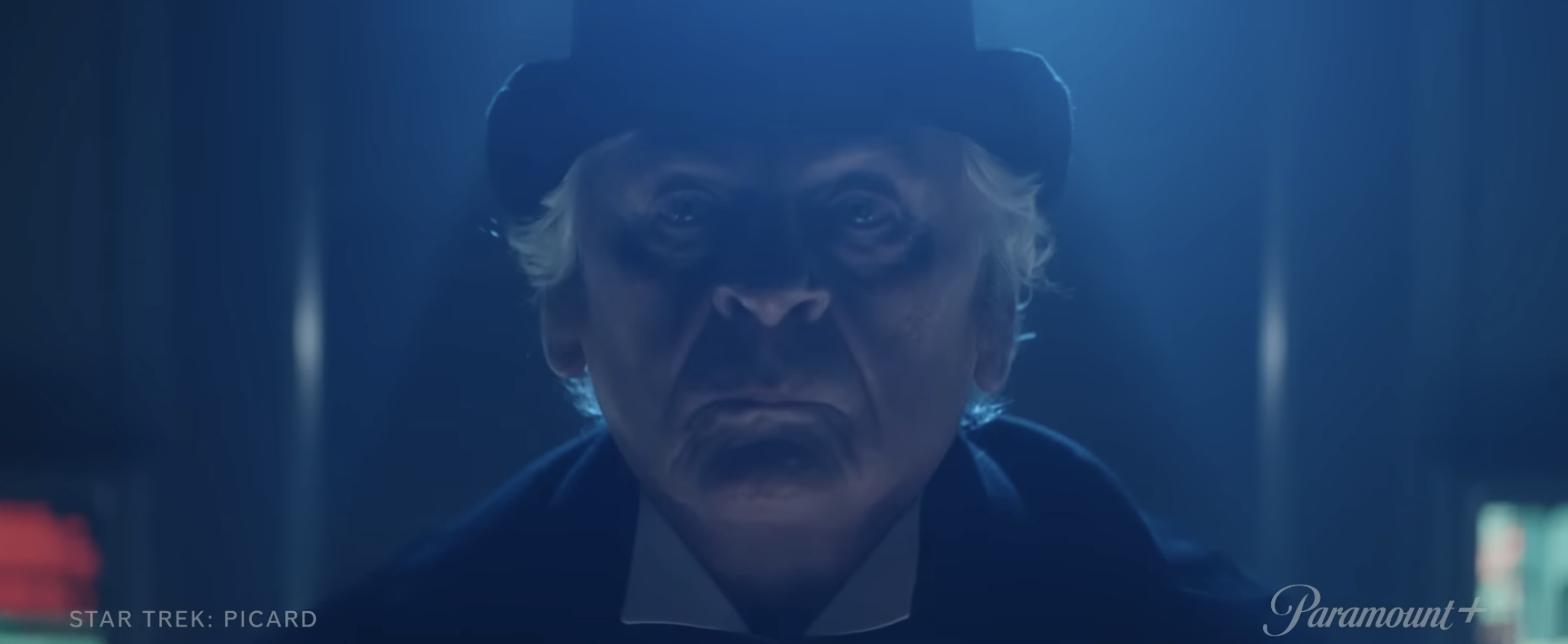
Posing not one but three nemeses in its last run, Picard apparently has the crew reassembled to go hunting for Beverly Crusher and her ship but ending up in all sorts of trouble at the hands of incoming main baddie Vadic played by Amanda Plummer.

Perhaps more well known for her appearance in Pulp Fiction, Plummer is also linked to the franchise through her legend of a father Christopher who raised hell in 1991's The Undiscovered Country as renegade Klingon General Chang.

Alongside her there will be a return for Daniel Davis' Moriarty previously seen in Elementary, Dear Data and Ship in a Bottle. His character has seen further life in the expansive universe of the Star Trek novels but this marks his first onscreen appearance since 1993. As yet, his involvement in the season is unknown.

Many fans were also wondering how Brent Spiner would be able to return to the show and be alongside his fellow TNG crewmates for, as we have been teased, at least one scene. Featuring in both seasons as Data and also two family members of the Soong dynasty, that question has now been answered - Lore.

Looking significantly different to his last appearance in Descent, Part 2 from 1993, the new question is how did he come to be reassembled given the verbal reference in that episode and also in Picard's first season?

Alongside her father, Geordi we have a new La Forge in Starfleet with his daughter at the helm of possibly the Titan-A or... could it be the other ship we spot in the trailer?

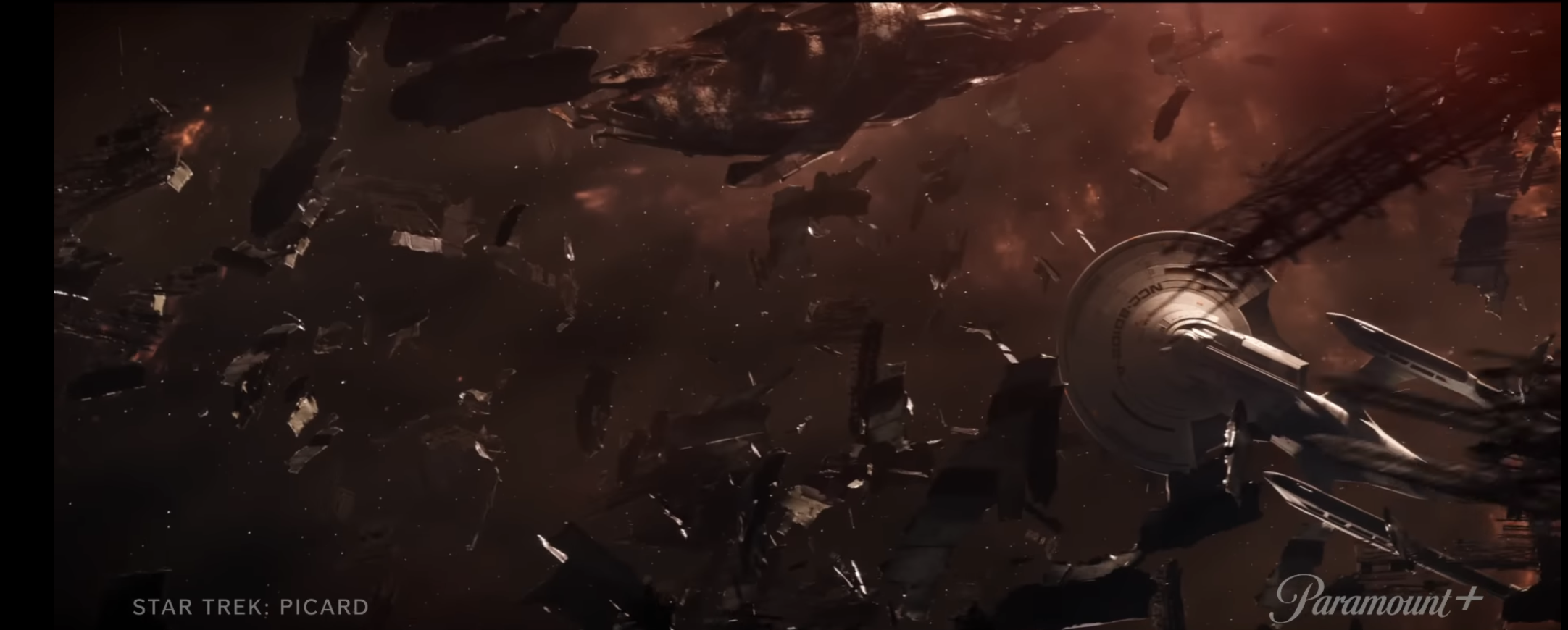
Fans of Star Trek Online will have no doubt rejoiced at the confirmation that the USS Enterprise NCC-1701-F is an Odyssey Class with its first ever appearance in live action coming this season. STO has made a mark in the show already with the provision of ships from the game in the season two Starfleet armada including the Gagarin and Venture Classes yet this is the step that fans have been screaming for. We already had (via the Picard prequel graphic novel) known that the Odyssey Class existed with the USS Verity so it was only a matter of time.

News has it too that viewers will learn the fate of the Enterprise-E. If you think about it, that starship had a maximum life of 25 years which is pretty good for any craft with the name when you review its history!

The trailer itself looks near-cinematic with its battle sequences, enormous enemy vessels and a true feel of one last mission. Raffi and Seven are also back, being the only members of the original Picard ensemble to have made it through the previous two seasons fairly unscathed. Note that Seven finally has a Starfleet rank of commander, something that was teased heavily towards the back end of season two.

Yet even with the news, the trailer and the overall excitement for what will concretely be the final final season of Picard and the last time the TNG crew assembles, the show still has a mountain to climb.

For entertainment value it's been great and nostalgic if nothing more. Season one provided much promise with the return of Data and the closure of his narrative in a more suitable way. Indeed, that final scene with Picard was truly one of the show's greatest events. Season two likewise seemed to have gone big with the inclusion of both Guinan and Q, the latter receiving one heck of a final scene that eclipsed the Data version from the year before.

When watched on a binge viewing, the 20 episodes are a good run but there are so many timing issues, plot holes, pointless directions and a narrative in both seasons that doesn't hang together. There's either too much going on that not everyone gets to play a suitable part or there's filler that doesn't add a thing to the story. Season three has to iron these points out and provide a stable, cohesive story that will satisfy fans and ensure that this send-off is remembered for all the right reasons.
I openly admit I enjoyed both batches of Picard. Initially it was fortunate to be up against Discovery and quite easily trounced it for quality but both Lower Decks and Strange New Worlds have upped the expectation of fans in this Kurtzman era. Yes, it started well with seasons one and two of Discovery but I for one feel that the show has lost its way and the trailer for the fifth season doesn't look like it's trying anything new. Ok, season four was affected by Covid and they did what they could but the move to the 32nd Century hasn't been quite the success I would have hoped nor does it have the heart of those 90's iterations.

Picard's final journey looks to have ticked a lot of fan requirements but to do that and manage a coherent narrative will prove its worth. Can all of these elements - the TNG cast, a new villain, Lore and Moriarty (plus whatever else we don't yet know) work in a ten episode arc? Viewers won't just want to see those aforementioned boxes ticked but will want Star Trek to deliver a worthy story for one of its most beloved characters after a very uneven two series.

We can but remain hopeful and the signs do seem to point in a more positive direction yet we'll only really know how it works when the show returns on February 16th.

What are your hopes for season three? What DON'T you want to see?

Enjoyed this article? Why not like and share to spread the word!
Like our page on Facebook 
Follow us on Twitter

Monday, 15 December 2014

Mind Over Matter: Dream on Data


"Data...sometimes a cake is just a cake..." 


Season seven's Phantasms is among my favourite The Next Generation episodes ever. I spent a whole weekend in my teens transcribing the script from VHS volume 79 and typing it up. In some respects it makes Schisms look like a trip out to the seaside for utter weirdness yet it has me enthralled thanks to its unique plot and imagery. Then real shame is that the basis for the story is only explored in two episodes of The Next Generation and tragically never gets any more airtime due to the demise of Data in Nemesis

I guess it was one if those things that really would need it's own episode to talk about and I guess coming up with plots surrounding a dream programme aren't the easiest of things to come up with. This breakthrough in Data's programming was unleashed about half a season earlier in Birthright, Part I which I now think is a great little story. While the plot around the activation of the dream programme is only explored in the first part, it's one of the strongest indicators that Data is capable of becoming so much more and gets to keep an improvement for once rather than having it bestowed as a thank you or stolen from him. 

Now, Phantasms. I would absolutely love to wax lyrical over this one... Oh go on then, I will. Twenty years since it first aired (Really?! That long?) it's one of those classic The Next Generation moments for me. As an immediate successor to Birthright, Part I,  it does the story of Data's dreams the justice they were ill-afforded and ignored by the concluding part of the sixth season instalment. Brandon Braga is of course the man behind the script while Patrick Stewart held the directorial reins for the episode. This could easily have mutated into a schmaltzy "Data-learns" story as he comes to terms with his dreams and what they mean it goes as opposite in direction as possible. 

While saving the ship from some slug-like hitchhikers, we gain a troubling entrance into Data's psyche. Perhaps placing it against the recent emotions he experienced due to Lore in Decent would be as justified as relating it back to the more understandable visions that were realised in Birthright. There it was about Soong as creator, forging Data using his own hands and then letting him loose to explore and evolve. It was evidence that Data could make significant jumps in his understanding and abilities but there is a far more poignant moment in the sequel of Phantasms. When I rewatched it I still got the tingle of amazement that this line made it into the final version. When Data awakes from his second dream sequence he speaks to Geordi in engineering and starts to say that when he woke up he..... And never finishes the sentence. 

Is it that eventually the emotion chip he finally receives in Generations (and conveniently turned on and off for First Contact, Insurrection and Nemesis) would not have been required? Was Soong's surprise in his appearance to Data in Birthright to do not only with the fact that his ultimate creation had managed to access such a deeply ingrained programme that he knew it could lead to self-development of emotions without external assistance? For me it's one of the most jaw-dropping cast off lines of the entire series, even more "argh" inducing than the Picard/Crusher romance that never quite happened. Had we explored the dreams of the android some more would this have been an eventual outcome?

The benefit of hindsight, hmm? I actually think we'd never get an answer to that unfinished question and it's important to remain on target here. Phantasms perhaps highlights how far Data has come since the beginning of The Next Generation while perhaps showing that he still has a great distance still to complete. His dreams bleed into reality and while it eventually becomes clear that there is a purpose to his "waking dream state" which reveals the existence of the creatures feeding on cellular peptides, it genuinely emotes some of the most chilling sensations I've ever felt within an episode of the series, specifically the sequence with Troi in the turbolift which was originally trimmed by the BBC when they first aired the episode. While Data is able to dream and thus be a step nearer to his goal of becoming human he still has the ability to turn it on and off at his will - there is still that last hurdle to overcome where it will "play" automatically rather than being instigated when desired. While the Troi incident is naturally chilling, the reminder of the dream sequence which repeats itself through the story is as bizarrely imagined as it is apparently logical by the tale's end and it would be more than criminal to avoid at least one reference to the "Troi Cake". All signs of consumption - and did you notice that the slice Worf is eating is cut into the Starfleet delta shape?


Anyway, let's look more like at what these stories say about Data. I actually think that the dream programme is far darker than we sense here. I I personally don't think Data really understands the power of the visions even when realises the significance of the visions at the conclusion of Phantasms which ultimately leads to the salvation of the Enterprise crew. In fact it could be seen that this addition is a weakness. I look at it this way, not only does he oversleep but there is the attack on Troi to consider. In Birthright, Data is wiling to effectively self harm to experience the programme again and becomes fanatic to the point of obsession with recreating images from the initial vision. While he might see it as some kind of Holmesian mystery to solve there is genuine danger to reach that goal and learn what it might all mean. It is perhaps more of a lost opportunity in Phantasms to push Data to yet another level that would be artificially provided in GenerationsMaybe this belays that Data's personal evolution is not finite and that he simply does not understand how the dream programme could aid the ongoing development of his humanity even when there is moment that could define his future and is (almost) missed. 

While the choice of location for both of Data's dream experiences are firmly on the Enterprise (budget limitations i expect) is limited his dreams relate firmly to his past with fantastical embellishments - Riker's straw, Soong as a blacksmith. This latter vision has a thread carried into the sequel with the workmen i dressed in equally period garb. Interesting that such a futuristic being as Data would hark back to such an age - maybe hints of his preference for the odd Sherlock Holmes mystery coming through his android subconscious here! The very unsophisticated look of the workmen as well as Dr Freud's involvement perhaps are even further suggestions that Data's dreams and possibly his evolution are still in their infancy - he has yet to evolve to a more high-tech age and is still regarded by his now-deceased creator as a child in so many ways. 

While the workmen and Freud, like all the aspects of the dream are in some way symbolic, they are the most memorable aspects of the story. Where else would you find three manual labourers attempting to dismantle a plasma conduit in the office of a famed psychologist in the dream of an android lieutenant commander on a starship (souonds even more bizarre when you read it back). The addition of that emotion chip back in Brothers might have been a bit early given some of Data's nuances over the later seasons (particularly when fed emotions from that very chip in Descent).


Just to take a few moments to indulge in Phantasms it is more unusual when you look at the structure of the story. The Data plot is also aligned with a faulty warp core, the Annual Starfleet Admirals' Banquet and a love-struck young ensign in Engineering. It's packed to the saucer section with great moments which all intertwine into one strand at some point along the way whether we realised it or not. Data's dreams act as the core to the narrative with all these elements packed around it seemingly separate but yet all fundamental to the solution - even if that solution is keeping the captain busy for a few minutes elsewhere.

While the dream in Birthright is all about expression and growth, the second tale of Data's mental state is much darker and unnerving as a whole. Birthright is more open and inviting to Data, making him want to explore the possibilities buried within his cranium but that's totally flipped by the surrealism and haunting melodies that are played throughout Phantasms.  You're never quite sure what the visions mean right up to the close of either installment and it's the deciphering of the experience which helps us to not only, perhaps, get to grips with the story but also understand how Data deals with a new experience, function or program. How we would have seen this expanded further we will never know. Interestingly after Phantasms there is only one more throwaway reference to Data's dreams in a single line at the end of Masks near the middle of the season. 

Not only that, but while it's one of my favourite episodes I would really like to find out how the cellular peptide eating critters manifested themselves into Data's dreams in the first place. Maybe it was one of the great misfires of the latter years of The Next Generation alongside the cringe-worthy Force of Nature's warp five speed limit. I think an even more mind-bending third story would have been necessary to top these two pieces. Data as a bird and Troi as a cake? Surely Picard as the White Rabbit had to be the logical next step?

Wednesday, 6 February 2013

Cold Equations Book One: The Persistence of Memory

They say honesty is the best policy - so here it goes. I haven't read a Star Trek novel for a long, long, long time. Even then that might not be enough to cover it.

The last Trek novel I read was probably something from Voyager while it was still on TV so that gives you an indication of how long it's been. Now, to be fair I've been much more of a fan of the background material such as Action!, Where No One Has Gone Before, numerous companions, technical manuals and the like but I felt now was the time to start getting back into something meatier; I was starting to have withdrawals for new Star Trek stories.

So that's brought me to this point and just to be a bit different, here's how it all began a week or so ago....


Admittedly I don't think Spielberg is quaking in his boots after that, but hey, it's the first attempt and something a bit different - oh yes, and that is me; no stunt double or pre-recorded audio I can assure you.

I have the perhaps enviable benefit of a bus journey to work and back five days a week which gives me ample opportunity for a good read and in the case of this book I was not disappointed. What I would add here is a SPOILER ALERT - it is very, very likely I am going to mention plot details in here so if you haven't read it, skip to the final paragraph for my overall opinion!

Set over a time period of 16 years, numerous planets and including several major races, there is one thing I can say without doubt after just the first few chapters of The Persistence of Memory - David Mack knows his material and of that fact alone he should be very proud. The time period of 2367 to 2384 covers events from the last few minutes of The Next Generation's "Brothers" to a point a few years after the credits rolled on Star Trek Nemesis but not in a linear manner.

Mack has split this trilogy opener into three sections with the first and last set in the "present" of 2384 while the central - and perhaps more substantial third - is an autobiographical account of events from one of the novel's main protagonists. Let's first summarise the plot here before we get into the meat of this story.

The Enterprise is called to the Starfleet Annex of the Daystrom Institute on Galor IV by Captain Bruce Maddox but upon arriving discovers that the facility has been attacked and the Soong-type androids under the cybernetics expert's care have been stolen including Lore, Data's daughter Lal and B-4. Worf, now first officer of the Enterprise leads search teams across the planet to locate the missing androids before they can be secreted from the surface...

As an opening section and probably due to the fact that it's been a while since I last read a Trek novel I was wow-ed and at some points confused.  Mack does an excellent job of introducing us to the story.  The first chapter or so is a nice mini-potted history of both Maddox ("The Measure of a Man") and the various droids that were in his care. Fans will no doubt remember Lore, Lal, B-4 and Juliana Tainer but I admit it took a few moments to recall the three early non-functioning prototypes mentioned back in "Inheritance". Now it's been a while since we last actually saw this crew on the screen so there have been a few changes in the faces; no more Troi, Riker or Data (of course), instead we have a Cardassian exchange officer Glinn Dygan at Ops and Jasminder Choudhury at Tactical. Worf now takes his place as Number One next to Captain Jean-Luc Picard. I think David Mack has done an excellent job of recreating the Enterprise crew and adding his own flavourings including the fact a certain captain and doctor are now married with a son. Significantly, and it's something that is evident throughout the expanded Trek universe is that continuity is a massive factor and cross-referencing is vitally important - kind of unusual when you consider that TNG was probably one of the series less concerned with having ongoing narrative threads unlike its shadowy relation, Deep Space Nine.

Sadly I can't compare it to his earlier Destiny trilogy so I can't say if these are details carried across and that's one of my niggles from early on. There are occasionally bits which are inaccessible to newer readers, namely the crew alterations and also the peppering of references to the "recent" Borg attack. It can make you stop and think about whether you've missed something but for those of you who have followed the author's earlier works I don't think you'll have a problem joining the dots. In truth while it did confuse me it has made me inquisitive over the earlier novels so they might get added to the reading list (after the next two in this series) just to fill in these gaps in my post Nemesis knowledge. Anyway, Mack does a good job of recreating our regulars and introducing his own assorted group of cast members. While Geordi, Picard and the blink-and-you'll-miss-her Doctor Crusher receive accurate portrayals which meant I could concretely envisage them in my mind I do have reservations to some degree with the character of Worf. As probably the most documented Star Trek character of all time I'm not convinced that some of his dialogue works or that some of his character motivations, particularly in reference to personal relationships, are totally believable considering what this Klingon has been through since Farpoint Station. This is not levelled at Worf as a character for the whole of the novel mind, only one or two occasions but they do take a bit to adjust to and seem out of alignment with my understanding of the character.

As the chase for the missing androids continues we are privy to Mack's extensive Trek standing with name drop/guest appearances from Admiral Nechayev, Captain Sisko and Lieutenant Barclay among others (two of whom appear within about the same number of pages) but that's not where this is heading.  What is evident from section one is that this story would have cost an absolute fortune to film what with Starfleet security squads, planet-hopping, cityscapes and even a wink to a lost Generations scene with an orbital skydive are all within a matter of pages and packed tightly into the story. The pace is break-neck at times but progresses in a very logical and easy to follow manner up to its conclusion and the identity of one of the main protagonists is revealed.  Interestingly this is essentially a massive set-up piece for the second and third portions of The Persistence of Memory and while I thought this was a really good intro I never expected what came next.

Now, for those of you who kept reading after I said that there were likely to be spoilers, this is your second and final warning. There are DEFINITELY things here that will ruin your enjoyment of the book so turn away now.

Whether I agree with the revelation that Noonien Soong isn't dead is neither here nor there as sci-fi always requires something of a leap of disbelief and it's actually an essential part of the experience that anything can happen.  If I thought Mack was in his element in the preceding 85 pages then I sorely misjudged him as the fast pace is set aside and we get a marvellous and intimate narrative from the perspective of the cybernetics genius.

So he didn't die at the hands of Lore and we get to follow him across the galaxy, setting up a complex web of businesses to support him for the future as he explores, settles, evades and spies on a number of people and planets. David Mack does a great job here of creating a character we have previously only seen as a dying old man, a hologram and as part of a dream program. I can see the nuances that were part of the character here but I found myself far more fascinated with the story of the doctor himself and the tragic past that is interwoven with his androids and Juliana Tainer; his one true love. 

At first I was a little tepid over where this section was heading - was it going to be a "What Dr Soong Did Next" or was there a bigger point to it all?  Of course there's a point! Moreover I suspect that the introduction (or is that re-introduction?) of another canon character will be a key move that will echo through all three volumes of the Cold Equations trilogy. I ended up thoroughly enjoying this section as Mack provides extensive detail to the doctor's actions while reminding us of how it fits in with events in Data's life through the final seasons of TNG and into the subsequent movie series. Very cleverly done - I even felt that Soong became overly obsessive with his creations as even in death he follows them everywhere, never completely moving on with his life, searching for the answer to keep them alive forever more. For the doctor it's all set up and preparation, back up plans and out-thinking his opponents although ultimately there is one person he can't outwit who manages to do for one of his androids the very thing he has been hoping to master himself. What I didn't get was any real emotional resonance around Soong even as each of his sons is declared dead and then he realises that Juliana too has passed away. 

Now the clever bit through all this is the relationship we are witness to only by proxy that existed between Ira Graves, Soong and Emil Vaslovik. This is key to the book and Mack weaves it within the narrative almost unnoticed and natural while it will evidently become key to everything that is happening in relation to one individual in particular. As viewers we know all three of these characters to some extent but once more Mack has pretty much free reign to develop Vaslovik if only, at this point, from a distance and from one perspective.  Let's not forget that, for a good portion of The Persistence of Memory we are getting one person's viewpoint and subsequently one person's viewpoint.  I'll be interested to see how this has potentially jaded our view of Vaslovik by the time we will no doubt meet him again.

While I won't give anything away about the final section of the book I have to say the conclusion left me a bit uneasy and I wasn't as satisfied as I thought I might have been. It is most certainly action-packed and to a much greater degree than the first section however the scenarios that play out left me a little cold and I felt that David Mack wanted me to have a much more emotional response than I did on a couple of occasions however because these events were not involving more familiar characters it perhaps didn't catch me in the right place. 

There are unanswered questions too; lots of threads left for us to follow into Book Two and this is a good thing. It certainly worked in my case because I wanted to pick up the following volume immediately. In fact, I did because I had it with me on the bus in preparation for finishing Book One!

Mack has done a first class job here and although, as admitted, I've been a bit out of the loop for a few years in terms of Star Trek novels this was a great reintroduction to the series (and I've now got an understanding on the Typhon Pact - cool idea and more in Book Two please!). The difference in pace over the course of nearly 400 pages works well to balance the character and temperament of Soong against the action and adventure that he ultimately finds himself in during 2384. While not a central character at the beginning, Soong is very much the cornerstone of the final section and the showdown which takes place in a most unusual setting. His legacy appears to be the thing that will drive the narrative in Book Two, Silent Weapons, and probably beyond that into the final novel too.

I must congratulate the author here once more referencing the extensive TNG back catalogue while still making many of the characters, situations and settings very much his own at the same time - which no doubt will add weight to the sequel, Silent Weapons. I can only hope that the remaining two books live up to the hype and the buildup that David Mack has moulded here. It's controversially something of a new beginning that could well ignite a good round of heated debate amongst TNG fans. I never thought you could play with canon as much as is here and get away with it however the author does and to some extent, begrudgingly, I must admit it makes The Persistence of Memory a damn good page turner.

Good work there, Mr Mack; let's see what Book 2 has to offer.

Star Trek: The Next Generation "Cold Equations Book 1: The Persistence of Memory" is available now from Simon and Schuster priced £6.99. ISBN 9781451650723

You can read my review for Book Two: Silent Weapons now!