Thursday, 11 April 2013

Commanding Positions: Jellico and Madred

"Get it done."

I've now reached the heights of The Next Generation's sixth season and another classic two-parter in the form of Chain of Command.

Notably the piece is remembered by fans for Captain Jean-Luc Picard's insistence that there are four lights shining down on him during his torturous interrogation at the hands of Cardassian Gul Madred. However, what I find even more interesting and is not immediately obvious during the story, are the interpretations of command that we see throughout. Unusually there are several senior officers involved in this story. We have Commander Riker, his nose out of joint at being passed over for command of the Enterprise; Picard, displaced from his ship and in charge of a small group of officers on a remote planet and Lemec, the cold Cardassian in charge of a hidden fleet. We can even manage a cameo appearance from Admiral Necheyev to add further weight to the title. Then there are the two we're going to be concerned with in this blog - Gul Madred (David Warner) and Captain Edward Jellico (Ronny Cox).

Their styles of command are the elements which drive this story more than any other. Their decisions as well as their mental and physical presence make them fascinating to dissect and discuss. Jellico plays much more of a mentally aggressive game than Picard would ever attempt, effectively turning into a loud, demanding bully at times to make his demands heard and met. He certainly has no time for sitting back and providing a more relaxed atmosphere aboard ship. He makes the Cardassians wait and places himself into a physically dominant position very quickly using his senior staff to placate their visitor, Lemec. In fact Troi reveals to Riker that Jellico is far from confident in his abilities, relying on this mental play and a touch of arrogance to take the lead. Perhaps this shows him as superficial and I don't think we see the real Jellico until his candid conversation with Riker towards the second part's conclusion.

His abrasive no-compromise style sees Counselor Troi ordered to don her duty uniform for the first time in six years and even Data in command red as soon as Riker is relieved of duty. Jellico's insistence on protocol is, in this respect, second to none and he has no time for dawdling during his short tenure in command. We've never had uniform changes made this quickly and it doesn't stop there. Crew rotation goes from three to four shifts from the second he steps on board, there are a heightened number of drills and the new Enterprise captain pushes the ship and crew to its limit. He even rebuffs advice from the out-going Picard, further demonstrating a level of arrogance not seen before in a commanding officer. His relationship with Riker never develops beyond a recognition of rank because the views of the two are so diametrically conflicting. 

The negotiations with the Cardassians are straight-forward, argumentative and there's no backing down from Jellico when he confronts them, even after making apparent "concessions" that he had anticipated. Using mental plays, Jellico stands as the aggressor but comes across as slightly unstable and unsure of his abilities in such a high profile position. One which places his crew out of sync and themselves uncertain as to how to deal with the new captain.


In some ways Captain Edward Jellico is very similar to Gul Madred. In the case of the former his focus is the Cardassian fleet while Madred's is the isolated Picard. Both begin their approach as the dominant party through both mental and physical plays; making an aggressive stance to impose their dominance. Madred however goes just that bit further, stripping Picard of his identity as well as his clothes, leaving him to hang from his wrists for the night before beginning the interrogation proper. What we do see differently between the Cardassian interrogator and his Starfleet counterpart is that Madred truly believes in what he is doing at this stage while Jellico is, as Troi noted (and we have too), not that self-confident. Madred remains calm in his approach to the task at hand, knowing he is in command of the situation from the very beginning as Picard is in every way a fish out water.  He never overtly showing it through his mannerisms, keeping the initial interrogation placid if not due in part to the drugs which he has among the tools of his "trade". Perhaps this is our first sign of the differences between the two as Jellico is forced to push more to the mental extremes to deal with his challenges while Madred can rely on more technological and medical advances to do his work for him.


With the introduction of the pain-giving device there is no requirement for the Cardassian torturer to act as dominant party because of this factor. He no longer has to act as though he is in control because there are many methods to suppress and control Picard that aggression is not essential; he has a device with this pain-giver that acts as both threat and deterrent. Jellico too introduces such an instrument with the mines that he has Riker lay around the Cardassian ships. While it is one demonstration there which puts their foe on the back-foot  Madred's continued and perhaps overuse of his torture methods act to show Picard that he is not the one in control. He is hiding behind his technology because the Enterprise captain is himself a fish out of water with nowhere to go. Indeed, the threat of torturing Beverly (even though the viewer knows she has escaped) forces Picard to remain and sustain further barbarism.


Where the change comes in their command positions is in how the relationships with their opponents continues. Madred, as with Jellico, is a family man but the visit of his daughter to the torture chamber containing Picard creates an uncomfortable moment where these two worlds are in severe conflict. He even openly discusses Picard with her before she departs with her pet. Jellico on the other hand retains pictures by his son but family ties are clearly kept separate from duty and is another suggestion that he would fit into life aboard the Enterprise even less so than his predecessor. Why? Because while Picard was never the greatest fan of children he still accepted that they were on-board the ship and a part of life whereas Jellico has demonstrated that he is distinctly separate to his close family. Why this is we cannot be certain and it may be that they are still aboard his former ship, the Cairo waiting to transfer if the move was more permanent - or are they separated/divorced?

The point I'm making here is that we never really get to know Edward Jellico. He keeps a brash distance, remaining business-focused even though there are hints of a more personable character through his chosen decoration of the Ready Room. None of Picard's additions are retained and we find that Jellico's decoration retains a look of formality with oddly out of place children's drawings which seem to contradict everything we see about him. Madred's more placid, conversational style linked with his ability to inflict pain on a whim contrast against Jellico who must continue to tow the line but one thing that the Starfleet captain never does is introduce his enemy to his personal side. This is where the commanding position that Madred has throughout the interrogation is lost because he lets Picard into his life and the status quo is shattered in a few lines of dialogue. Picard from this point on sees him as a weak child unable to defend himself and ultimately pitiable. There we see Madred's weakness - he is a bully and perhaps not one fit to be in a position of command.  

All Madred has at the end is the ability to inflict pain and that, ultimately would have led Picard to say there were five lights. Now his counterpart, Jellico, retains the respect of his opponents but it may be that his conflict of command is closer to home than that of the Cardassian Gul torturing the Enterprise captain. Will Riker I think is his sparring partner and more abrasive challenge than the Cardassians. Interestingly the XO is direct enough to tell him that Jellico is a poor captain (probably in comparison to Jean-Luc) but they have to lay aside their differences for the success of the mission as Jellico needs their best shuttle pilot - Riker, of course. At the end essentially both the characters under the microscope ultimately fail in the bigger picture. Jellico gets relieved of command in a much quicker and less ceremonial manner than he received it. While he has achieved the withdrawal of the Cardassians and the return of Picard he ultimately crumbles at managing the crew of the Federation flagship. Madred meanwhile loses control of the interrogation of Picard because he fails to get results and not because of the person he is. He tried everything to break his prisoner but one minor slip and the slightest reveal of a personality beneath the torturer's armour and his grasp was lost.

Now I for one quite enjoyed seeing the Enterprise managed in a different manner. Perhaps the one thing that this does show us is how much of a "family" this crew have become as they clearly take an instant dislike to Jellico because he changes the dynamic. It's funny in a way that they can't adapt to a new style when this would surely be an absolutely essential quality when working in Starfleet and they have done many times before (pick an episode and this will probably ring true!). Riker's insubordination for one illustrates that maybe it isn't time for him to take a command and serving as first officer under another captain might be the perfect chance to learn some new skills.

A unique chance to see a shake-up of the usual The Next Generation playing field, Chain of Command is more about the strengths and weaknesses of its guest cast bouncing off the familiar series regulars. Madred is an excellent character who ultimately is defeated by time and the actions of, funnily enough, Jellico. Perhaps one appearance for this interrogator was just enough for us to stomach. On the other hand I would have loved to have seen the character of Edward Jellico return in this or DS9 to really flesh out his background. With this second watching I fully appreciated him more as a character than as a distraction to the overall story. As I've just said, the conclusion of Chain of Command is due to him more than any other character. He puts the plan involving Riker and the shuttle into play and forces the Cardassians to return Picard. 

Jellico's exit is uncomfortable and rushed to place Picard back in command of the flagship and it's a shame he isn't recognised as the saviour of the hour that he actually is. We are influenced in that decision as a viewer by our ongoing relationship with the principal cast, this is still a disappointment as is the lack of ongoing fallout from Picard's experience as previously with Family but then this could have easily turned into a carbon copy of that installment. Deep Space Nine would have managed to eek out the repercussions for weeks if not seasons! Perhaps this episode also raises the query about which other The Next Generation guest characters we would have wanted to see for a second time and in which series (or even season seven of this show)? Would we have welcomed the Conspiracy aliens one more time or wanted to find out what happened to Lal? 

Maybe one day we'll see Captain Edward Jellico again (most likely in print) and get to know what exactly made him tick. Here's a suggestion to anyone considering it; "Get it done".

Sunday, 7 April 2013

The Starfleet Escape Podcast: Listen Up!


If it wasn't for the rather excellent Google+ Star Trek community I would have missed out on a gem of a podcast.

Now up to their 17th installment (with number 18 coming soon),  the SF Escape Podcast looks set to become one of my must listen to Star Trek audio shows of 2013. Hosted by Aaron, Marty and Eric it's informative,  funny and exceptionally accessible to fans both new and well-established.

You might ask how that's possible considering the amount of material that's out there (and what you're reading!) but Trek Trio manage it with ease. I like to think I have a fairly decent understanding of the subject however I even realised a couple of things during the Borg show that I hadn't noticed in the TV shows after several reruns. That, for one thing really impressed.

It's a straight forward format to the podcast; 90 minutes (approx) of chat and banter separated into distinctive sections. For a starter in this Star Trek audio restaurant there's news and opinion followed by a main course of good wholesome and filling debate into the topic of the podcast.  Once that's been cleared then you get to enjoy a dessert of subspace comments from a range of social media channels where a question of the podcast has been asked.  Bringing it all together as the coffee and mints at the end are a few moments to air some grumbles they may have over the subject which just helps to remind us all that it is a work of fiction and open to the wonders of human error and almost 50 years of attempted continuity.

Due to a bit of a hectic home, blogging, work life recently I'm combining my reviews of The Borg and The Romulans podcasts into one piece.

Now I really enjoyed Episode 16 and the Borg discussions,  possibly because I was fortunate enough to get my comment on the cyborg nemeses read out (sorry it was only slightly shorter than War and Peace gents,  I'll be concise next time!)   but it's great to get some clever,  witty and genuinely entertaining words on Star Trek even when you might think think that everything there is to say has been said. The news section was good although I would have liked to hear a bit more opinion than news fact which we can pick up at the newsagents or off the web. When there is, it lifts the show and makes you listen because it's absolutely worth taking in. I would say for newer Trekkers and those who are just getting into the franchise with the most general audience friendly reboots it's an excellent avenue and devoid of technobabble I can assure you. As you would expect there's talk If of the new JJ Abrams movie but also fan productions such as Star Trek Continues, the Green Girl documentary and Star Trek Renegades. Upcoming releases such as the timeline video game are also covered but there does seem to be an absence of printed Star Trek be it novels or comics. The good thing is with this piece of the show is that if you're not keen on trying to sieve your way through the internet the news section will help you out admirably. Also there's a great bit where our hosts consider whether or not they would purchase a chosen Star Trek product. Have to agree that the Bye Bye Robot posters are very good but I've got very little wall space opportunity to display them ! While it took a few pauses to listen to,  I was still surprised to find an hour and a half had warped by.

So what did I get out of listening to their take on the Borg? Running through their appearances in Star Trek universe chronology rather than episode transmission order does help realise how there was an attempt to tie everything together, and even the perhaps poorly conceived Enterprise story, Regeneration. What you become aware of is how Picard and co effectively are the reason the Borg become aware of humanity with an ending similar to TNG's Conspiracy. There's of course a good deal of discussion on the seminar two parter,  The Best of Both Worlds (is it now the most overrated episode of all time? As well as Q Who and I, Borg but yet there's a Descent shaped hole only touched on during a reflection on the Borg ship designs we've seen over the years. I was always of the thought that this was a captured ship however the distinctly non geometric design and does suggest their more fragmented and individualistic nature as portrayed in the double-hander. While not classed as one of The Next Generation's stronger installments I would have liked more opinion on where this might have led in the future.

The majority of of the discussion does end itself more towards Voyager and by default everything that comes after Seven of Nine's arrival on the ship at the beginning of its fourth season. What you do get from the chat is how inconsistent Borg history is. I tend to distinguish between Borg Version 1 (TNG) 1 and Borg Version 2.0 (First Contact and later)  but even then flashbacks in Voyager and the Next Generation movie aren't correct on wardrobe for starters. Then there's consoles, backgrounds...Picky but noticeable. While it was noticeable that Descent was sidelined, the podcasters did manage to spend some time looking at the variations that appeared in Star Trek: Voyager ranging from the future-Drone, the Borg children, Seven's former associates in Survival Instinct and the wonders of Unimatrix Zero from the final two seasons. There's a lot of information on the Borg meaning certain episodes such as Blood Fever and Unity were skated over in favour of some of the later, larger stories such as Dark Frontier and Endgame. This also meant curve-ball angles such as Hope and Fear didn't even get a look in when they deal with the effect of life after an attack on Borg survivors. Even some conjecture on their origins was played out citing non-canon novels and the story of the NX-02, the Columbia. I would have enjoyed some more non-canon moments within both of the podcasts but I get that time is limited and for the sake of the audience who will be more aware of the televised material this is probably a good choice although it might be a good suggestion to do something non-canonical in the not so distant future? Or maybe even something on the library of excellent Star Trek reference materials that exist? (I know a good guest host you could get for that...runs a blog....English....) 


The additional comments from Twitter and Google+ mean we're not restricted to the views of our hosts - although I they are pretty varied anyway - and I'm going to have to add a disclaimer because they had the patience to read out my Borg essay. Thanks guys! It showed there's a lot of love for TNG's first two parter as well as for I, Borg and Scorpion which is interesting as there's a lot more love for Janeway and crew than I thought.

What is good is that this podcast is just like getting a group of your mates round for a couple of beers and having a chat over an episode. It's informal, relaxed and very easy to listen to. I also didn't feel that I was getting an opinion forced down my throat, only provided with a few more angles to see the series which can only enhance future viewings - especially now I realise that Geordi is the one who starts up the deflector dish and not Worf as Riker requested at the end of The Best of Both Worlds, Part I! Never spotted, but another example of Worf getting neglected. There's also the good old subject of the Borg Queen and the drones from Star Trek: Enterprise that don't seem to fit too well with the space/time continuum but that kind of discussion is probably best left alone until a few more cans are drunk. What I had forgotten until this side of fandom came up was the potential Borg/V'Ger link that's been banded around for some time. Kudos for picking this one up as it's always been an interesting concept (although it goes out the window in David Mack's Cold Equations trilogy). However disappointed Peter David's classic Vendetta didn't get a mention - now that's how to deal with the Borg!

The Romulan podcast (Episode 17), which followed a couple of weeks later trod a similar concept in it's setup. Kicking off with the news section as before, the topic quickly turned to the Star Trek isolationists and conspirators extraordinaire, the Romulans. In comparison to the Borg I actually found this to be a better  structured discussion focusing on sections of the species rather than chronological appearance. Leading with subjects such as technology, clothing, footwear culture and ships it was great to reflect on how the Romulans have been portrayed since their first sighting in The Original Series episode, Balance of Terror. 

Now I just want to take a second here actually because I was perusing Terry J. Erdmann and Paula M. Block's Star Trek 101 this week but couldn't get this podcast far from my mind when flicking through it. While it's designed as mini reference and ideal for the Star Trek new starter I would say that the SF Escape Podcast is a better and more comprehensive way to understand the series and what is all about. As with the Borg for example, if the introduction to the Romulan discussion kicks off with some useful background which would help newbies. Take note Mr Erdmann, sans-serif this is a much better way to break in some new fans. Aaron, Marty and Eric ensure that the scene is clearly set for discussion and then we're into the "good stuff". Gets a big gold star from my box of reviewing badges, gents. 

I really enjoyed this different approach and while it made me reconsider how the structure of the Borg episode had been crafted I also realised that this meant these guys are more than aware of the need to keep their audience awake and listening not turning for the stop button. There are certain things that will be heard on each installment but it's how those sections are made which provides the interest. The Romulans as a podcast was much more about their subject as a people and its portrayal over the various films and series; reuse of wardrobes, the difficult and yet managed appearance of their technology in Star Trek Enterprise when it has been made clear that they were not seen until Balance of Terror. A lot of time is given over to Enterprise in particular because of how things might have progressed into the now mythical season five and how the Romulans had infiltrated the Vulcan High Council.


My particular area of interest here was the ship designs over the course of Star Trek history - how they altered, how models got lost along the way and all the variations in between including the Nemesis revamps and the Next Generation scout ship version. 

While The Borg virtually stepped over Star Trek: Deep Space Nine to talk about the Delta Quadrant residents in Star Trek: Voyager, the space station saga got its fair share of air time here, most notably in reference to the classic and much revered In the Pale Moonlight. This seemed to be a much more comprehensive and flowing discussion with very little, but if anything being overlooked. From their origins through female commanders, the shoulder pads of the 80's, cloaking technology, peace treaties, neutral zones and even up to the destruction of Romulus itself in the 2009 reboot, then there's an opinion to hear on it all backed up with more subspace thoughts from fans on social media. Interestingly no mention of the fact that Denise Crosby's Sela is the only ever blonde Romulan within Star Trek but with the onslaught of information contained within Episode 17 this is such a minor detail that I can let it go. For those of you who do find there's a lot to take in during the SF Podcast then there's also a handy show notes download available. It helped a lot when covering these reviews it's a nice touch to add to the overall experience and for fans of all ages. Great to see the listeners comments included too.

I've got to applaud these guys for their enthusiasm through out the 90 minutes of run time. There are no uneasy silences, nothing too much and a very focused agenda that keeps the conversation and topics flowing. I didn't know whether I would get anything out of it as a long term Trekker but I was pleasantly surprised, sans-serif maybe because my 'specialism' doesn't lie in Star Trek: Voyager where we get the most information around the Borg so I got a lot from the reviews of that time frame. I have to agree with one thought at the end - the Borg have had their day and a decent run now on the big and small screen. They ended up being the main nemesis in Star Trek: Voyager by default and held their own until the end. In conclusion though the Borg could have probably managed another 30 minutes to look at some of their lesser appearances and references but when you have a broad audience to satisfy it once again comes down to ensuring common and referable ground is covered and covered well. 

The balance of understanding across the franchise is well proportioned with no particularly overwhelming part of this Trek Trio holding all the cards. I indeed I having the varied experience with the franchise makes it all the more accessible, sans-serif importantly reassuring us that Star Trek fans are human and not just huge memory resources of fictional information. As I've mentioned above though it would be good to hear more on non-canon material out there and perhaps even a section that allows listeners to air their though ts on the previous installment and anything contained therein. While one can always point for things that could be done differently this is still a supremely enjoyable production and clearly a lot of work goes into producing the information to fill the show. I'd guessing that all three hosts aren't in the same location either (?) for the production which must take some level of co-ordination just to manage that. The audio is crisp and there's not a moment wasted throughout either podcast.  I have to say this is well worth listening to and has helped me refresh my mind on some pieces of Enterprise and Voyager I'd completely forgotten about in respects to the two races featured in episodes 16 and 17. Good work gents - you're managed to secure my time and I look forward to your next recording!

Friday, 5 April 2013

What Did First Contact Do For Us (in the future)?

NB: Updated April 5th 2014 - originally written on the 50th (pre) anniversary of First Contact in 2013


Happy Anniversary of First Contact Day to you all!

Wow, is it only 50 years to go? What a thought. Can't wait; April 5th 2063 here we come!


But what's to celebrate in our Star Trek vision of the 23rd and 24th Centuries? As we drain our last glass of bubbly synthehol and attempt to remember the code to get us back into our quarters, let's have a think about just what we have raised a song to in the last few hours - was it all worth the pomp and ceremony? What exactly did we get from this monumental event and was it all good? As we know, according to Riker in Star Trek First Contact, it's the time everything changes and things get better - so let's put that to the test right now.


1. Warp speed


Bit of a given really. But then it's only Warp One so we're going nowhere (relatively) fast for a  hile. Luckily it does attract a passing ship and thus we encounter the Vulcans for the first time. This leads to a whole heap of other problems but the good thing is that at least we can get there a lot quicker thanks to Cochrane and the Phoenix. 

No longer is Earth alienated in some spiral of the Milky Way and so begins the road to the creation of the United Federation of Planets as well as numerous first contacts with new and exciting lifeforms. Now some of these are good and a few are going to be filled with obstacles, wars and death...but not that many...hopefully. Oh...it's also responsible for ripping the universe to bits which isn't such a good thing. Excellent suggestion to impose that warp five speed limit. That solves everything. What warp drove does lead to is the creation of Starfleet and therefore the Federation. Ironically in the real world it's the creation of Starfleet that eventually brings about the creation of first contact as an event in Star Trek....!

2. Zephram Cochrane

The man behind the engine. Legend, pioneer, alcoholic, from Alpha Centauri (according to The Original Series) and able to age in reverse. Nothing like the Enterprise crew expect him to be like, Cromwell's Cochrane is a reluctant, dishevelled hero that you just can't help but like. While we get to see him briefly in the Enterprise pilot Broken Bow, it's his subsequent chronological appearance that really bends time and space. In The Original Series, Zephram is significantly younger and even managed to brush up well for the visit from Kirk and company. Luckily he was rejuvenated by the Companion which resides with him on Gamma Canaris N and saved his life.

While his body is regenerated, it appears that the Companion has erased any references to his previous encounter with at least two ships called Enterprise. Now, here's a thought for you - is the name of the Federation warp five NX Class ship in itself a time loop - was it called that because of Cochrane's own previous encounter with the crew of that starship?! However, when we meet Zephram in Metamorphosis he seems to have developed Scotty (Relics) syndrome and forgotten all about a previous encounter with the Enterprise-E. Let us not forget the statues and schools that get named in his honour afterwards, although whether he wanted to be a statue is all historical conjecture....


3. The Borg


Thanks for this one, Jean-Luc. Due to your inability to make sure that all the Borg were eliminated before you warped out of orbit back to the 24th Century there were some survivors who managed to get frozen in the Arctic, get thawed, evade the NX-01 and Captain Archer and then send a signal to the Delta Quadrant. A signal which will be received sometime in the 24th Century...and one suspect that's what sparks some interest in Sector 001. The speed in which the cube arrives in The Best of Both Worlds suggests that this is not the same ship the Enterprise-D encountered in system J-25 even though the dimensions are precisely the same.


Enterprise's Regeneration implies that it's all a self-fulfilling prophecy and we were always doomed to meet the Borg whether or not Q chucked the Enterprise-D halfway across the galaxy. Could this have all been avoided? Probably not in the big time/space continuum mess.

4. Music and Alcohol


Luckily First Contact Day reassured us that popular music won't kick the bucket until at least April 6th 2063. As we learn, Cochrane has a particular fondness of Steppenwolf and their Magic Carpet Ride (good choice). Roy Orbison will be available on jukeboxes around the same time although it's Oobey Doobey and not Pretty Woman. Tequila will be available for a few years more however its morning after effects appear to be significantly lessened - ask Troi for further details. Whether the beverage is still around in the 24th Century is debatable since the counselor is apparently unaware of its existence. It has been suggested that rock and roll may survive into the 24th Century (see 6) however the longevity of musical artists such as The Beastie Boys is still open for debate - especially in alternative universes.

5. The Vulcans


...and so years of suspicion, logic and a serious lack of humour begin. Now the intrigue here is what could have happened if first contact had been with another race? Humanity's suspicion of the Vulcans is all based on the conjecture that they have held back our development at least until the 2160's and possibly longer. Would we have become a conquered people if the Andorian or the Klingons had got to us first? How would Starfleet and the Federation evolved if Earth's first meeting with people from another world had been the Tellarites?!

It is well documented within Star Trek: Enterprise that the Vulcans assisted in pulling Earth from the shambles it was but what more could it have been as there's always that hint that First Contact was both a good and bad thing - did the Vulcans really hinder our progression to the stars? Were they in turn being influenced without realising it by the Romulans?! What we find out later is that the Vulcans inadvertently caused first contact back in the 1950's in Carbon Creek but we didn't know about it (of course).

From the perspective of our familiar crews though, the Vulcans have given us a great deal - Archer gained a first officer and Dr McCoy was provided with more than one opportunity to win an argument. While Enterprise sowed the seeds of discontent with the pointed - eared ones it would be wise to remember that meeting with them would bring about advances in conditions and technology that humanity would otherwise have been unable to achieve.

6. First Contact Day 

The occasion to remember the day everything changed. A time for rejoicing and revelry and if you're on the USS Voyager then beware because it's like to have been organised by Neelix and Naomi Wildman. From what we can children get a day off school and it's a prime opportunity for Tom Paris to get his 20th Century jukebox out (no sign of Steppenwolf to really authenticate the occasion though). Interestingly the notion that this is celebrated right in the closing closing episodes of Voyager screws the calendar around in line with stardates as First Contact occurred in April. Therefore we can surmise that we're not working on the Julian Calendar but something much more universal.

7. The Bozeman

Bit of a curve ball here, but without the landing site for the Vulcans the Enterprise-D might have avoided spending a few weeks trapped in the temporal causality loop. I'm not sure that first contact in Scunthorpe would have had quite the same dramatic effect.

We could probably go on for quite a while about how, what and why was affected in the long run by April 5th 2063 but I think these above are probably the main culprits. While Star Wars fans have another month to wait for their special day (May 4th), with Star Trek we can at least say that the day has some significance within all varieties of the franchise and it's something with a bit of substance not just a "comedy" date. In the fictional world everything that we know of the UFP, Starfleet, Kirk, Picard, Sisko, Janeway etc stems from this one event and we can assuredly say that it is truly the franchise's Genesis moment (all puns intended). First Contact is the point at which the future starts to become the universe begins is journey towards the vision of Gene Roddenberry. While not everything about the original day was a resounding success as we've seen here, there's a lot to be impressed with - and it gave us Star Trek First Contact which isn't a bad thing now, is it?!

In the real world the question for us all is when will this happen and who will it be with? If we're honest with ourselves we know it won't be with Vulcans and I very much doubt it'll be at a missile silo in Montana (which actually does exist) or that it'll even be linked to the first warp flight but that's missing the point of this occasion. One of the rare chances to have a bit of Star Trek indulgence with some purpose and show your Starfleet pride especially with just a half-century to go!

After all this though, I would ask this - what does First Contact Day actually mean to you today? Is it a chance to celebrate Star Trek or space exploration or even sci-fi as a whole? Is there anything else from that fictional event that we should also recognise it for? Is there anything else that we got from first contact within the fictional universe or in the real production world of Star Trek?

Anyway - let's request just one more glass from the replicator before bed or maybe join Captain Picard for a slice of cake (cellular peptide we suspect) - Happy First Contact Day to one and all!

Did you know you can now join up with us on Facebook or follow us on Twitter or even +1 us on Google+? If you didn't why not drop over there.

Friday, 29 March 2013

Happy Holidays! It's the Star Trek: The Next Generation Easter Special!


Stardate 47362.1. It's Easter on the USS Enterprise and Deanna Troi is in the seasonal spirit. With a lull in shipboard activities the counselor has taken it upon herself to arrange an egg hunt through the ship for some of the children onboard.

Of course this isn't normal aboard a starship, especially when it's so close to the Romulan border; but there's not been any activity for a while so everything should be alright. Much hilarity ensues as the children search for Easter eggs in Main Engineering, transport room one, Jefferies tubes, Ten Forward and, much to his annoyance and discomfort, the Captain's Ready Room. Some of the children even insist he joins them to find more in the observation lounge but the captain manages to stumble out of it citing more important Starfleet matters to deal with. Data is left very confused by the whole thing and confides in Worf that he is puzzled at how the children can become so excited in the pursuit of small chocolate items that they can easily replicate whenever they want.

Worf explains that while he sees it as an infantile activity it does bear a strong resemblance to a Klingon ceremony where the eggs of the Raga'kel bird are hunted by the young ahead of their 15th birthday as part of their transition to warrior - it is a sacred bird and Kahless himself provided the inspiration for the occasion as this was a significant event in his maturing process. Worf then explains that Kahless was angered that he had killed the bird believing it to be attacking him. It was not the case as he realised and the bird was actually protecting him from a targ. Kahless stayed with the bird, bringing it back to life from the dead and now its eggs are hunted at this time of year to symbolise that sanctity of life. Data inquires what happened to the original bird of the story - did Kahless return home with it - yes, replies Worf; where it was killed and eaten for its regenerative properties by his family. Its eggs in particular went well with the targ meat.

Alexander is off ship however visiting Worf's foster parents on Earth and so has not been able to take part but that doesn't stop Troi from suggesting a way Worf can take part - but he'll need to drop by ship's stores to find out how a little later. Data is still left confused and as such begins hiding several of Geordi's key engineering tools around the ship to replicate the experience for his friend and ultimately missing the point completely. Beverly attempts to calm the situation and explains the concept of Easter to Data, referencing a certain reborn Starfleet Vulcan from a previous Enterprise into the bargain. Kudos to the writers for getting that one in.

Riker is totally bemused by the whole situation but is kept on his toes by some "random neutrino surges" emanating from the border but they might have just been caused by some errant children messing around with the controls in deflector control looking for chocolate. Things get worse when one of the children manages to launch themselves in an escape pod towards the Neutral Zone during the Easter Egg hunt forcing the Romulans to show their hand - they are monitoring activity and threaten to destroy the Enterprise before it can cross into their space. Picard manages to swiftly diffuse the situation and offers the Romulan commander one of the eggs as a gift - a peace offering from the Enterprise at this time of the Earth calendar. Confused - nearly as much as Data - the Romulans accept and retreat back to their side of the Neutral Zone however their next encounter will not be as pleasant; that is assured.

Tensions aside, Troi assures Picard that the hunt is over, at least for this year. Picard suggests that the egg hunt, while good, has forgotten the true meaning of Easter - something that was lost as far back as the 21st Century and perhaps is best remembered. A sobering thought only enlightened by the apparent love that the children have for the captain Riker suggests that he might stage a "Captain Picard Day" in the near future. Just as Picard is about to give the command to get the ship away from the Neutral Zone, the turbolift doors open and Worf appears dressed as the Easter bunny - it appears Troi did convince him to take part after all. "Mr Worf," comments the captain, "you are not a funny bunny."

Cue shot of the Enterprise going to warp and run titles....

Ok - I guess this little tale tells us all we need to know why Star Trek, for over 700 episodes, pretty much avoided the seasonal special (take note Star Wars and Doctor Who). Just because you're on at Christmas doesn't mean everyone needs to start walking around in eight foot of snow or wondering if they'll see Santa. Personally I just can't see it happening as well as being able to keep it all canon and in character. Ok, ok, I'm sure Star Trek fans are probably screaming at their phones, tablets, laptops and monitors now to remind me of the single exception to that Golden Rule. 

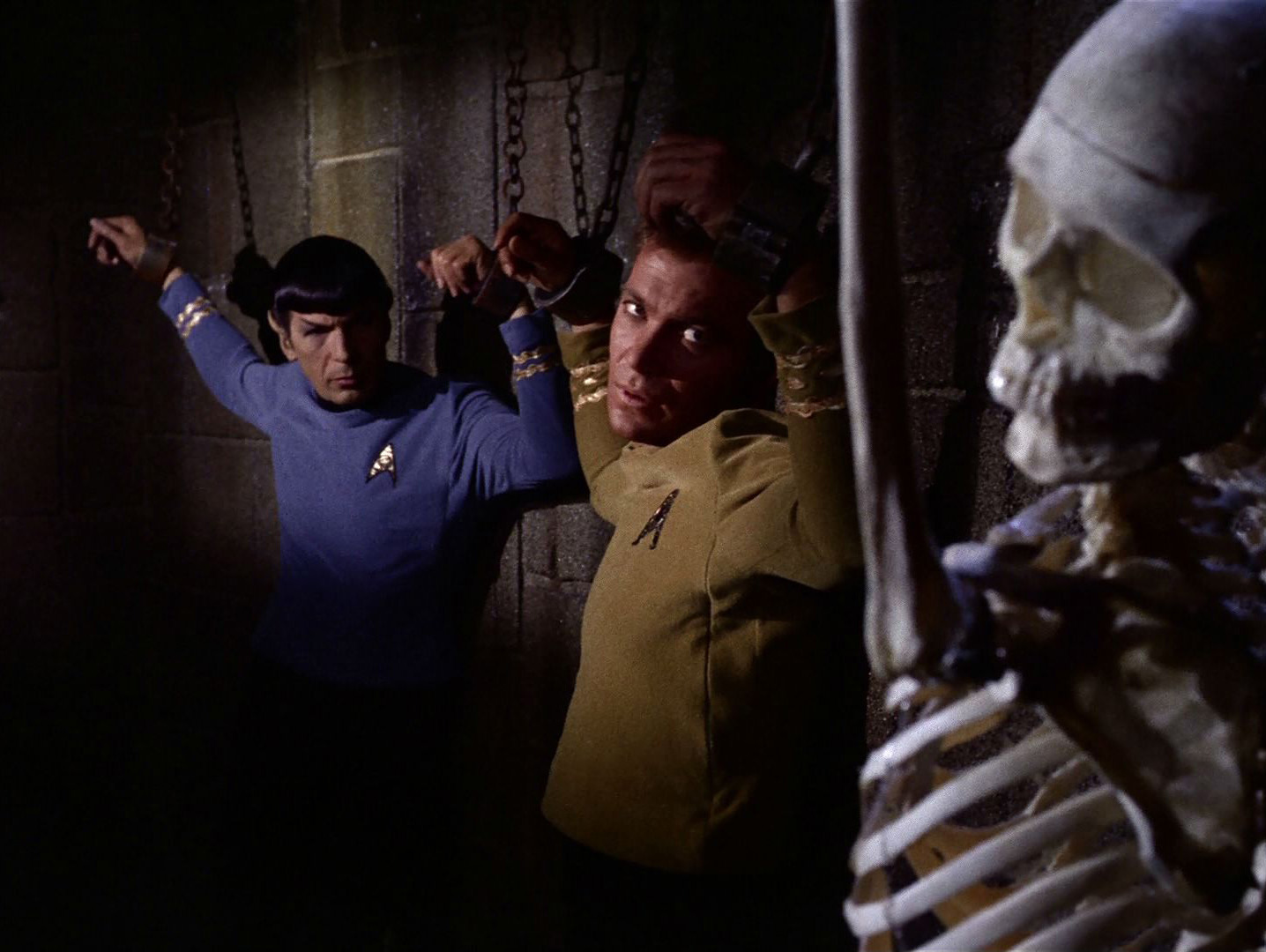
By network design the second season episode Catspaw from The Original Series, which had a distinct witchcraft theme to it, was broadcast on 27th October 1967. While not earth-shattering as a story it still holds the distinction to this day of being the only "themed" Star Trek episode ever made (by accident). We get rolling fog, three witches, black cats, dungeons, sorcery of the small-metallic spaceship kind and a couple of aliens to boot. All the makings of the perfect October 31st chiller. But why did we never get anything else? What's stopped Star Trek from ever repeating such an instance since 1967?

Actually, before we look at that, some of you may also have forgotten there was one other seasonal incident in Star Trek's illustrious past. While not an episode with a theme on a set day, it was once again a matter of illusion (as with Catspaw) but exceptionally real to those who are within it. If you haven't worked it out already, I'm talking about the Christmas scene in Picard's faux Nexus future from Star Trek: Generations. While it's the last thing I would have thought Picard would ever imagine, Christmas has an even more unique place in Star Trek history as it gets thrice the screen time even if the it's within Data's holodeck program in Devil's Due as part of the Charles Dickens novel A Christmas Carol. Oh - and Q2 turns Voyager into a Christmas bauble to hide from Q in Death Wish.


While they may not be seen in The Next Generation, the fourth season episode, Data's Day makes note that the android lieutenant commander is recording his log during the festivities of Divali. The only mention of any Earth non-Christian festival during the entire run of Star Trek - that means any series. That always shocks me because there are so many hours of Star Trek available but yet events that we would be familiar with are not even given a mention. Considering how it's supposed to be a multicultural series why is this the only non-Christian event that gets that lone mention?! The fictional Federation Day even manages more airtime  although the mention is during a poker game on the Enterprise-D (The Outcast).

Image from Memory Alpha
Now this might all be because the human race has put aside such differences by the 23rd Century in order to better humanity as Kirk and later Picard are so keen to point out (see Encounter at Farpoint for Jean-Luc vs Q on this one). Their removal from the equation not only as story vehicles but also as ways in which to theme episodes to specific times of the year in the 20th and 21st Centuries does seem odd though. We would expect some kinds of variations amongst the crew to display their cultures. Visually we do get this perhaps best from Uhura's African style clothing and jewellery in the original series or Chakotay's heritage in Voyager. I suspect a big thing is that by ignoring occasions which are more commercial  there is no need to try and explain how we moved away from consumerism to better ourselves as a species (Star Trek First Contact). , We are even reminded by Roddenberry himself that Star Trek is an exploration of humanity and in particular this is done through the exploration of other cultures and the brilliant stories that the crews are involved in. Surely theming episodes would cheapen the franchise and horrifically damage the ethos and foundations upon which Star Trek was built on in the 1960's. I was surprised to find that the recent Star Trek novel The Weight of Worlds mentions a shipboard celebration of all the cultures and differences of the crew - passing reference allows us to see the divergence but it is accepted and taken more as a part of everyday life rather than something that marks them out against someone else.

So if we're not seeing festivals and Earth-centric celebrations, what about the other cultures we meet along the way? Each of the sequel series The Next Generation, Deep Space Nine and Voyager, all explore religious cultural concepts post-Roddenberry (very noticable). Series five through seven of The Next Generation allowed viewers to investigate the Klingon religion - before that point we had really only talked about their warrior lifestyle notably in Sins of the Father, Reunion and Redemption. Episodes such as Ethics, Birthright and Rightful Heir meant that their beliefs were put to the test through the character of Worf. He becomes The Next Generation's portal into religion and culture. Each series following also has an individual who provides that insight but yet they are still for the most part devoid of any cultural events or points of significance. However this is until virtually the end of The Next Generation when we do get to experience the Kot'baval festival in the seventh season installment Firstborn. Notice the fact that we're only seeing this kind of episode post-Roddenberry. We know from the writers that delving deeply into cultures was something that got skated over in the earlier years of The Next Generation.

Deep Space Nine uses Major Kira as the primary route into the Bajoran culture and religion - full of factions, warring alien beings, orbs, Kais and Emissaries, this is probably the most deeply dissected religion of any Star Trek series. Starfleet becomes much more it's own culture here and the opposition to this belief system which is intrinsic to the Bajoran-sized way of life. It's seen for the whole seven years in minutiae through levels of the holy orders as well as the main characters and is an essential part to the overall story arc - but once again any mention of Earth's religions are more noticeably absent through the fact that so much time and space is allocated to the Bajoran belief system. Once more there's not a suggestion of aligning anything to do with an Earth-based occasion to what's happening on the station neither by our calendar or through the one our characters are living by in the 24th Century. Thanksgiving got a mention as part of Eddington's retorts to Sisko in Blaze of Glory but while it gets a throwaway line we never get to see what the station does on these occasions - neither did we see it on Kirk's ship when it was talked about during Charlie X.

I'm being slightly unfair though as we got to see events from the Bajoran calendar with two occasions coming strongly to mind. Firstly there's Fascination in season three with the Gratitude Festival and the season six finale The Tears of the Prophets there's the Gratitude Festival again! These guys have a lot to be grateful for apparently as it's the only festival we seem to get to know about (unless I'm mistaken). Once again though it's never compared to any Earth-centric community events even when this would seem like the perfect occasion. But let's move swiftly on to Voyager before the Prophets make their presence known.

Individual culture and religion were not the driving force in the Delta Quadrant that they were on Deep Space Nine and so the absence any festivities was less evident. Probably the imminent threats of the Kazon, the Vidiians, Species 8472, the Hirogen and the Borg were significantly higher on their priorities list than celebrating Christmas for instance or St George's Day. The religious angle was really Chakotay's corner with splatterings of Klingon and Vulcan culture for added flavourings on occasion. The most prominent of the former being the Day of Honor which B'Elanna hoped to celebrate during her time on Voyager. 

When he wasn't making moves on Seven of Nine in later years, there was always some room for a bit of spiritual guidance but again this seemed to be a lifestyle where his beliefs had no festive occasions and was more about personal enlightenment. This wasn't something that really hooked me in Voyager as it seemed a bit drippy in comparison to the more complex and thought out concepts that pervaded Deep Space Nine. What really hammered home the lack of substance was the episode Tattoo which effectively said that his whole spiritual belief system was a creation of an alien race and he spends the second season story tracing parallels between the sky spirits of his people and the creatures he finds hiding in caves. While not religion per-se it is the closest thing we get to exploring an Earthbased belief system but not a festive moment in sight. Even the Vulcans managed a bit of pon-farr every seven years! 

Janeway's ancestor, Shannon O'Donnell would be the candidate to bring true Earth events to the stars with the Millennium Gate in 11:59. This would almost be a "themed" episode  because it was designed to be Star Trek's turn in regards to the New Year and the approaching year 2000. One minor point - it was first aired in May 1999 so just a few months off being event relevant. But that's not all for the lost starship; it's in the final flings of Voyager's final year (Homestead) that First Contact Day gets a mention where Neelix and Naomi Wildman are planning to celebrate the event. While it's another tick it's also a fictional one which means in our reality it might not even count!

So what does all this mean? Star Trek is in no way ignoring its Earth heritage but in another sense it just gives a tip of the hat every so often to keep us grounded while making sure that the unknown and the unexplored are kept at the forefront of the series. Star Trek was not about the obvious; if we wanted to be able to join the dots from A to B and to C we'd be watching another series on another channel. Providing a seasonal installment or linking to a set event in our real world would have taken something away from the imaginative nature of the series. Star Trek has had its fair share of weird moments but stretching to this would have been too much.

Being blatant is not Star Trek's thing and a certain JJ Abrams could do with learning from that - to do a story around terrorism you don't need to be on Earth blowing things up. So will we ever see an event that isn't a birth, marriage or death on a Star Trek series and not just a wonderful passing mention that it's happening? For their sake I hope not. The fact that they are so obviously absent works well to remind us that they are a part of our world today and yet could well be no longer a part of our world in this fictional imagining of our future because we are one planet but then my question from that is whether that's actually the right thing to do? Is that not almost dictatorial and removing something of everyone's individuality if we are not provided with the chance to explore our own beliefs and celebrate occasions that we mark as special? Perhaps accidental alignment, which is what happened with Catspaw and the original series is nice to have as a one off never to be repeated (like McCoy's aside in Journey to Babel). 

Ok so that's a bit of a rant on the missed opportunities of festivals within the cultures of the characters we meet along the way, but let's take it from another angle. Where in Star Trek have there been occasions that episodes could have been placed at seasonal times of the year and thereby emphasising their content. While Generations openly flouted Christmas, Catspaw only represents Halloween because of how it was placed in TV schedules. If it had been shown in March then no one would have batted an eyelid. So, what episodes could have been moved or timed to coincide with annual events? I have a few suggestions which could help out networks in future years...

Father's Day 
The Icarus Factor - lashings of parental conflict and a nice rosy resolution at the end. Other suitable fathers day episodes might include Brothers, New Ground, Deep Space Nine's Doctor Bashir, I Presume or maybe Voyager's Lifeline. 

Easter 
What better than a good resurrection story so how about the Mirror universe tale of the same name or perhaps Ascension for Easter Sunday? Always good to have some kind of story of return on this occasion.  I might even suggest The Next Generation's Transfigurations for its concepts of transcending to another level of existence. 

Christmas 
What could be more suitable to gather round on the 25th December and watch Kahless return (also might be good to use this at Easter). Star Trek: Generations of course would be another one to add to your imaginary network schedule.

Valentine's Day
Fascination, His Way or You Are Cordially Invited from Deep Space Nine would fulfil all your romantic desires on the space station while you might also think about Data's foray into love with In Theory, someone to watch over me 

Mother's Day 
Interface - also a rare Geordi family story and begrudgingly anything with Lwaxana Troi 

Halloween 
Catspaw, Deep Space Nine's The Storyteller with its swiryl cloud creature or for something truly creepy Genesis or Sub Rosa from The Next Generation. Strange New Worlds from Enterprise would fit the bill with creepy caves and thunderous storms. Even Empok Nor might fit the bill for an edge-of-seat experience.

Independence Day 
Sacrifice of Angels with its retaking of the station or the return of USS Voyager to her crew in Basics, Part II would certainly generate some patriotic spirit. Would I be wrong to also offer up the Die Hard-esque Starship Mine for that hero feeling? 

So there are many examples that could have made it into the category with just a bit of clever schedule trickery but alas we'll never get to know just what seeing these linked to a specific date would have made on our though ts around that installment. I found it very difficult to find anything suitable from Enterprise except for the one potential Halloween episode. 

Do I have a final point to all this though? Well yes; besides have a great Easter and thanks to all of you who have sat and read my blog since November, it goes to show that there's something to see within every episode of Star Trek and we don't have to have it wrapped up in some chintzy one-off. Gene's vision has run true through the last 40-odd years and even JJ seems to have retained that thought.  Star Trek has remained exploratory and not sold out for the sake of a cheap laugh. It's a show that hasn't relied on gimmicks and seasonal episodes to examine religion, culture and everything in between or surrounding it. The exploration of humanity is evident perhaps in the way in which the writers have avoided the obvious. I for one am quite glad that we don't have to endure a seasonal special but Catspaw and Picard's Christmas tree do raise a smile. 

For those who want to see a deeper meaning it is there. The absence of these cultural differences and the very need to set an episode for airing on a certain day does more than ensure it gets a few more showings - it demonstrates that trek truly. Is multicultural within its fictional universe and for those watching. It's accessible to all and welcomes all to enjoy it. At points here I have been a little tongue-in-cheek heel and perhaps that's the seasonal spirit but maybe the final thought should be this - don't expect to see Janeway or Picard donning a Santa hat and breaking out the eggnog just yet. If they do, let's hope that it's just another alternative universe we haven't visited yet.


Have a great Easter break and see you all soon.