Showing posts with label Borg. Show all posts

Saturday, 31 August 2024

Ascendancy: Reloaded


Now let's be clear. This isn't a new game but it is one that has stood the test of Star Trek time extremely well.

Originally launched back in 2017, Star Trek Ascendancy pushed past the ship-to-ship combat of Wizkids Attack Wing and ventured into new and unexplored territory. Quite literally in fact. But why should we still be interested in this when there's Into the Unknown out there and GFN's own Away Missions? If you want galaxy building why not dip into Infinite on your PC?

Because this one is all about tactics and empire building that's physically on your table and brings fans together in one place to play and chat Trek. Magnificent.

It's a bigger galactic picture and offers varied gameplay versus those now established tabletop and digital experiences. This is going to take some time, a lot of thinking and a shuttlebay full of patience to manage so buckle in for a good long afternoon of gaming.

With a base game box that is packed to the gills with tokens, playing pieces, control panels, planets, space lanes, hazards and a rule book that covered every scenario, it's a Trek fan's dream. Players could start from their homeworld and expand out across the galaxy, discovering new worlds, new civilisations and boldly... ok... you get the picture.

Crucially Ascendancy has evolved through the last seven years of its life, adding in player expansion packs for the Vulcans, Cardassians, Ferengi, Andorians and Breen as well as two substantial game expansions with Borg Assimilation and The Dominion War. In comparison to Away Missions this is more galaxy spanning and fleet based rather than a set of characters on a single board so the two aren't competing for the same space.

As we head towards the end of 2024 I pulled out the box and got ready for a steady session on the table because Gale Force Nine (GFN) are set to release a single box which will contain everything produced to date as well as some new and exciting content. Definitely a great sign for the game after seven years!

So let's just refresh on the systems as we unpack the plethora of equipment.

In the original starter box players could choose from the Federation, Romulans or Klingons with each faction offering different tactics. For instance the Klingons can't run from a fight and the Federation will never try and take over an established civilisation by force. These factors and others come into play when you reach out from your starting planet and influence how you interact with your discoveries.

It's also an incredibly organic game because of how the stack of worlds may be played as they are "found" and each of these will only have a certain number of pathways that can be connected to it. As they are revealed by exiting the space lanes with your ship or fleet, each new destination will have some form of action to complete via the Exploration card that is turned when you "arrive".. It may be to make contact with an existing species, it could be to colonise an empty rock or worse, it might be to try and avoid a dangerous nebula or other such hazard lurking in the depths of space.  New planets to colonise will offer space to acquire additional Production, Culture and Resource nodes that can be used in the Building Phase of each round to enhance your existing facilities from ships to bases to completing research.

No two games will ever be the same but just make sure you're ready for a long haul because GFN expect that for every player on the board there's at least an hour of game time (three players, three hours). Each round of the game sees players Build (chips, assets etc), Command (exploring, combat) and Maintain (assessing victory qualifiers and collecting resources) but don't forget to keep an eye on where your adversaries are up to!

If you're not looking for that kind of commitment then there is also a one player option that was introduced as part of the Borg pack. More on that shortly.

Ultimately the aim of each player is to reach Five Ascendancy points which can be acquired by collecting and trading in your Culture tokens. In the case of the Federation should you flip over a Civilisation card when exploring a new world that will immediately give you a Culture token! Each level of Ascendancy unlocks new abilities so you can run more projects and fleets with each increase.

One of the things that I levelled against this game back in the day was that it focused heavily on TNG and TOS without much care for Voyager or Deep Space Nine. In terms of the latter, some of that has been accomplished with one of the two larger supplements which includes the Bajoran wormhole and the Gamma Quadrant. There is still to be anything forthcoming from the Delta Quadrant however!

But back to the main game for now and it can play out a few ways. Boundaries can be set and some players may choose to try and avoid other major races, instead choosing to cultivate new worlds and build up resources with which they can upgrade weapons, fleets and abilities while others may be looking for a fight. That's the genius of Ascendancy in that it can play out however you want it to.  Each journey along a space lane opens up a new and unknown challenge. You'll never (probably!) get through the entire planet stack (Exploration deck) in a game so there's always going to be a variation from the off. Nor is it a given that the Federation moves first each time so you never know what order events will unfold or who will have that key tactical advantage. Uncovering a planet might be a good thing but it could also draw the attentions of an opponent keen to expand their resources of a particular type or simply add some territory to their sector of the board. GFN includes sets of ships to represent fleets in the box but players can supplement further with different ships, starbases and dice packs if they so wish although some of these are now verging on rare to impossible to locate (especially the Defiant pieces).

Players can also be defeated if their homeworld is captured by an opposing force. The neat thing that the Dominion War expansion pack does is allow a conquered people to turn into a resistance force so that you're not left sitting out the rest of the game. 

The Borg expansion does add in a feature which makes it impossible to avoid the Collective as they will spawn and head directly for the nearest opponent. In a one player game that's a given and with their "AI" ability it actually becomes more of a challenge to see how long you can last out rather than attempting to defeat them which is near impossible.

As with Attack Wing before it, the Borg dynamic is naturally overpowered and almost invincible meaning that any true attempt to defeat them would likely require at least two if not three or more players hounding their cubes until the bitter end. There's a ton of new content in the Borg packs beyond the ships such as additional/expanded rules, new nodes and tokens. For me this has become something of a go to where I can try out different factions against the Collective to see which is most effective. So far the results are not promising!

One thing that frustrated me was how fast the Borg could come out of the gate and be on top of your home system. Best case three turns, worst case two - the margin was that fine. However, by a bit of YouTube research and just thinking more about strategy it's actually quite straight forward to elongate the game - just make sure that any pathways into your territory are completely used up. For example if a planet has four space lane options, use all of them to connect it into your network. This is where the additional resources and the built ships really come into play as otherwise players wouldn't stand a chance to build any form of defence.

So to that Dominion pack and that's an entirely different twist again. Adding in the Dominion as their own faction there is the chance to use Changelings as infiltrators onto opponent worlds and also to battle through a campaign loosely tuned into the Deep Space Nine saga.

This is a real step upon the multiplayer concept with the Dominion faction starting on the other side of the Bajoran Wormhole and having to make their way into the Alpha Quadrant as part of the initial setup. Of course they could just fly around the Gamma Quadrant but at some point trouble will come calling.

The nice piece here is that the Gamma Quadrant systems can ONLY be used on that side of the wormhole and there's some familiar planets in there for the Karemma, Dosi and of course the Great Link. 

The problem with the Dominion War campaign is that four players are needed to form two alliances consisting of four already developed and explored worlds (ready for conquering). That's a lot of people to get together and at least a four hour play time both of which I would personally struggle with but may suit other gamers perfectly. I expect that in this case I may field the Dominion as a faction against the Borg or in a smaller 2/3 player scenario perhaps even without the wormhole piece.

Ascendancy is a superb, detailed and in depth Star Trek game that does require some time and patience to get the most out of it. If you want quick and straight forward pick up some Fluxx cards or head for your copy of Away Missions but for a real test of your metal this is the game to do it. Will you try and conquer from the Gamma Quadrant? Dominate from the off with the Klingons? Offer peaceful co-existence via the Federation or watch your foes be assimilated by the Borg? You make the calls!

Star Trek Ascendancy is available NOW from retailers stocking Gale Force Nine. Prices (for expansions) start from around £25 ranging to around £75 for the base game set.

Enjoyed this article? Why not like and share to spread the word!

Like our page on Facebook 

Sunday, 30 July 2023

On a Mission: Gale Force Nine Beams You Aboard


Gale Force Nine’s last entry into the Star Trek market was the incredibly in-depth, long playing Ascendancy where anything above a two player game potentially means booking a week off work to see it through.

The arrival of Away Missions (due out in the UK in August) counters that intensity perfectly with a game that can be over and done in 90 minutes while still fulfilling that desire for some proper Star Trek tabletopping.

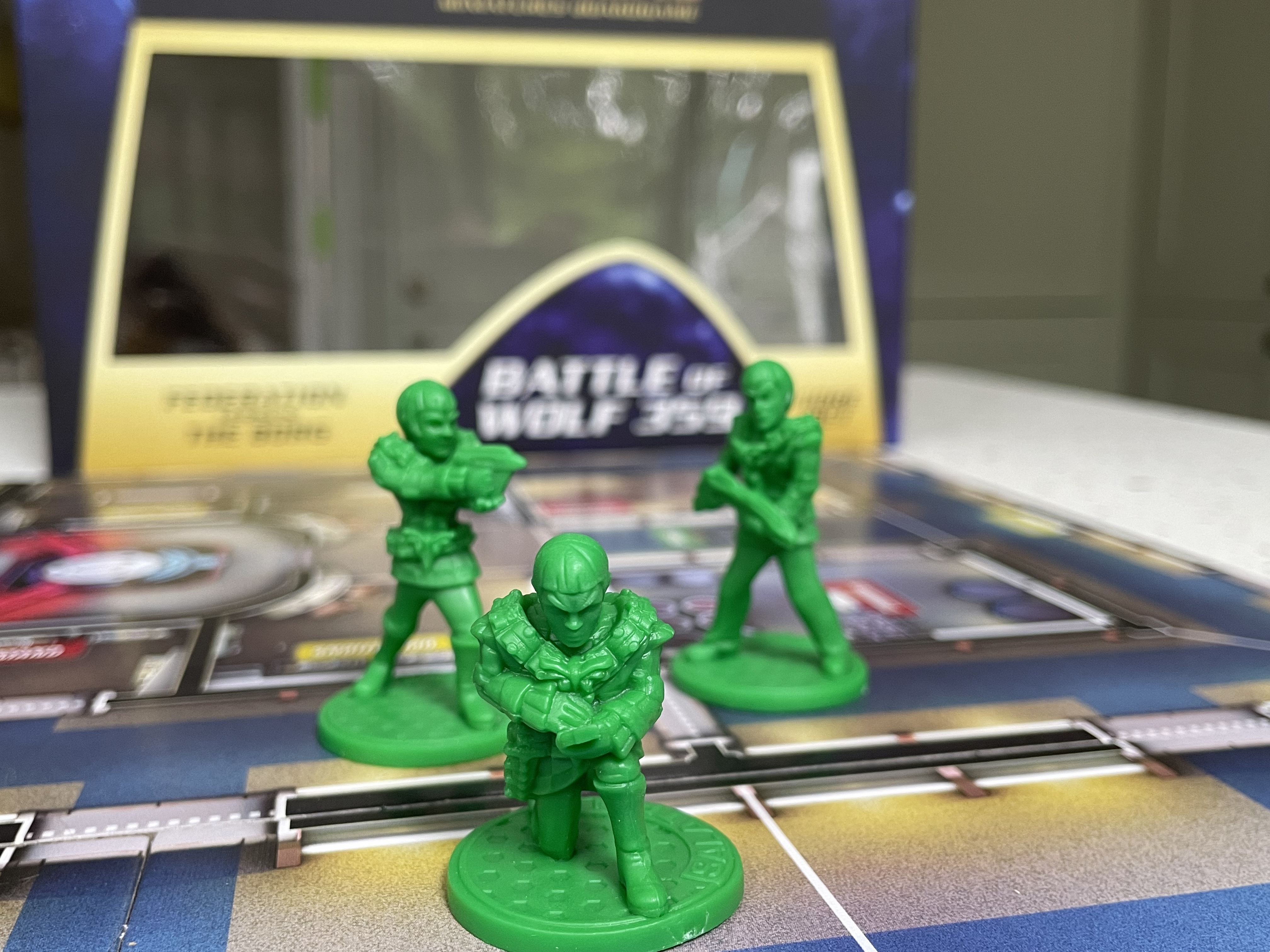
The premise behind the game sees away teams from one of the available factions dropped onto either a Borg Cube or the USS Ahwahnee (one of the ships lost at Wolf 359) with a main mission objective and several secondary objectives to complete. 

Time is limited with both sides having to play their actions out across just three rounds. Does it work? Absolutely and with that restriction you become a lot more honed in on exactly what you need to do and the strengths of one faction over another.

The core box contains the Federation and Borg parties. Initial concerns that the 4 vs 6 squads might be a little biased is quickly removed when you understand that bonus actions have been built into the mechanics to ensure that play is fair. Each miniature comes with an accompanying stats board referencing their personal traits and attack, defence and skill levels.

With a set of interchangeable double-sided boards there are a variety of layout combinations that can be achieved. Each board contains different stations (Command, Sciences, Operations, Medical) within sections of the ship or cube that players will need to interact with to complete challenges while also avoiding or engaging the opposition.

Let’s look at how each round works. Using the core box Federation set of Riker, Shelby, Data
and Worf, each character can conduct two actions per round aiming to complete tasks and build up the most points. These two Actions don't need to be a "Move plus something" and you can mix and match to suit your tactics.

The Borg start with two drones and add a further two characters to the board at the beginning of each subsequent round, rebuilding their forces and overrunning the ship. Ultimately there's the chance to have five drones and Locutus in play by the conclusion. That's no including any members of the opposition away team you might have managed to assimilate! Due to their hive mind nature the Borg can also transfer their actions to another drone which comes in useful when you’re needing to grab some final points  in the last throws of round three.

As part of each round you replenish your Support and Mission cards which will help gain points. Players keep these in their hand until they need to be played and the decks from which they are drawn (a set 20 cards) can be customised from the sets included in the core box. 

Support cards will add in benefits such as the phaser rifle or transporter pattern enhancers while Mission cards will provide side quests to boost your points total such as performing a skill test at a certain console. This in turn will depend on the abilities of your characters as to who is best suited for what (and is detailed on their stats card). That will then determine your path through the rooms of the ship or cube.

The model sculpts are nice but they are begging to be painted up and I can see a lot of players wanting to do that. Each does represent their respective onscreen persona very well adding in phaser, tricorders and a customary bat'leth for Worf - ideal since his hand-to-hand combat gains you an additional damage point.

Talking of that, facing off against six Borg can seem a little daunting however with the way the stats are built, three rounds is more than enough to dispatch at least one or two as combat is done on a comparison of scores from highest to lowest. This means that while you might stop the drones from completely taking over.

One thing that I really like about Away Missions though is the quick start guide. The rulebook itself (already available for download from the Gale Force Nine site) covers every eventuality but can be a bit of an overload on first glance. The quick start guide takes you through the basics of the game and in the box there are even a starter Support and Mission card decks comprising of 20 cards to ease you into the action. Once you've got the game down you can rip open the larger packs and start customising your 20 card deck depending on the board and opponents. What works against the Borg might not be the best option against the Romulans for example.

A large Borg force might be enticing but to be able to control any of the areas of the ship you do need to have assimilated members of your opposition since the drones themselves have no set skills until they, well assimilate them. This will mean that your starting tactic for round one might be to add to your workforce while Starfleet's could be to avoid the Borg completely and repair the ship asap.


The Klingons favour full on combat while the Romulans are all about their intel. The Federation is a bit of a mix although they will only stun opponents unless they're the Borg.

Once you get past the first few games and make a few mistakes (I had the Borg being able to do anything until I realised why assimilation was so key!) and how you can play the game more tactically dependent on your faction, this is a fantastic experience. The downside is that you can't get all four factions out at once unless you have two core box sets. That initially sounds a bit grim but given the number of spaces on the four boards you'd be falling over each other from the first move.

Away Missions is a great and thoughtful game for Trek fans and I can't recommend it enough. There has been a bit of bad commentary over the figures but you need to look beyond and actually play the game rather than worrying about representational pieces of plastic (if they bother you that much). I genuinely hope this gets super popular as I would definitely be interested in a Dominion pack or a Cardassian pack. Maybe there's scope for more boards and a DS9 setting and crew? Mix and match options to pick your best away team? Kirk and Spock on the original Enterprise?

The possibilities are right there for the taking and it would be great to see a fair few of them come to fruition.

Away Missions launches August 12th and is available to pre-order NOW.

Enjoyed this article? Why not like and share to spread the word!

Like our page on Facebook 
Follow us on Twitter

Tuesday, 23 November 2021

25 Years: First Contact Retrospective


After two and a half decades, First Contact still stands as The Next Generation's finest cinematic voyage.

A combination of time travel and the Borg, the eighth Star Trek movie combined two of the franchise's most successful elements into a movie of truly galactic proportions.

1996 was an interesting year for Star Trek; it was the 30th anniversary of the show and First Contact quite literally went back to the beginning, the pivotal moment in time where everything changed and looked at the very origins of the Alpha Quadrant. Voyager had produced Flashback and returned viewers to The Undiscovered Country while DS9 had perhaps more effectively commemorated its heritage with the mix of new and old in the sublime Trials and Tribble-ations. 

Star Trek was truly at the zenith of the Berman era with two popular shows in their third and fifth seasons and no apparent end in sight for Picard's crew on the big screen... but all that would change in seven years with the release of Nemesis in 2003.

However, at this point there were some changes taking place in the franchise thanks to the arrival of this eighth movie. While it's brilliant to note that passage of time it's also worth pointing out that this would be the debut of the grey/black uniforms, James Cromwell's Zephram Cochrane, the USS Enterprise NCC-1701-E and a striking redesign for the cinema screen of the Borg.

While the Enterprise-E would only make two further appearances in Insurrection and Nemesis, the new uniforms would transition onto DS9 and more recently Lower Decks while the Borg look would be seen again in the Delta Quadrant. Cromwell's Cochrane would even turn up in the premiere episode of Enterprise in 2001 to pass the torch. 

But it can't just be these factors that endure First Contact 25 years later. It came off the back of the successful - if flawed - Generations with a more natural gestation period than its predecessor. While the handover movie to the TNG crew had been hurriedly produced after the seventh and final season of the TV series in 1994, First Contact  had a chance to develop at a more sedate pace. Written by Generations and TNG scribes Ronald D Moore and Brannon Braga, the Borg were the natural go-to for villainy and First Contact probably fleshes them out more than any other single instalment of the franchise.

We've talked before about the differences in the Borg from TNG to Voyager but here in First Contact we have them at perfection. Assimilation en-masse is introduced as is the silky Borg Queen and in two hours we have a better picture of the Borg hive structure and even their true malevolence. In The Best of Both Worlds and the other TNG episodes there was always a sense of a blank slate with the drones and even a mindlessness but in First Contact they look threatening, they look determined. Take the look of the drone who attacks and presumably assimilates Lt Hawk on the main deflector dish. The menace is present not just his facial expression but in his movements and ultimately the costume. These were Borg you felt were genuinely unstoppable from the second they appeared on screen.

But again, First Contact isn't just about the Borg because even though they are a formidable threat, there are still moments of appropriate humour in here; Data and Picard touching the Phoenix, Barclay stalking Cochrane or Troi getting drunk. But they don't overwhelm the picture and help to alleviate some of the burgeoning tension that builds through the story.

There's a lot of variety in here with Picard's story on the Enterprise as he makes his way back to the bridge with Lily Sloane, the preparations for the first warp flight and then Data's peril at the hands of the Collective. While Generations placed the fate of an unseen planet - Veridian III - in danger, the Federation itself and more specifically Earth are targeted. 

Yet while we celebrate the dawning of another milestone in Trek culture, for us in the UK it was actually December 13th which marks our true 25th anniversary of its premiere. That's 21 days after the US experienced it.

Twenty-one days ladies and gents. OK, that was nothing like the wait we had for TOS or TNG or even DS9 if you were reliant on terrestrial TV in the mid-90's - but there was still a wait of some degree. Over time it became less and less until in the case of the latest shows it's 24 hours dependent on the platform.

But remember back then? We just had to wait whether you wanted to or not. You could always fork out £11.99 for two episodes on VHS and even then they were at least six months behind. Yet here we are again but having to wait an untold amount of time to see the latest Discovery episodes. The more things change, the more they do indeed stay the same however, while we can grump over the delays (which back in t'day we just dealt with and waited or got someone to post a video from the US!) TNG remains only one of two Star Trek shows to have made the jump to the big screen.

While it is 25 years since Picard, Data and the Enterprise crew faced off against the Borg Queen for (what should have been) the only time, it is still a rather jaw-dropping 18 years since Nemesis. Eighteen years since a Trek series last crossed to the big screen directly (not a reboot!) and surely now the clock on that possibility is ticking down rather than adding up.

After the rushed production of Generations, First Contact showed what the cast of TNG were capable of both in front and behind the camera. It set a benchmark that neither of its successors were able to match and in many respects that no Star Trek movie has managed to achieve since. It is the crowning glory in that short-lived big screen stint for the Enterprise-E and a stepping stone and reference point for many, many more adventures across the galaxy.

Enjoyed this article? Why not like and share to spread the word!

Like our page on Facebook 
Follow us on Twitter

Friday, 18 June 2021

Christmas Already? Borg Boxes for Advent...


Hero Collector has just unveiled its latest Star Trek-themed product, and it’s a Borg cube Advent calendar. 

Designed in the shape of the ominous and iconic Borg cube, the cube calendar overflows with 24 high-quality, all-new gifts and accessories, meant to be opened at a rate of one a day, including a coaster set inspired by the console screens from The Original Series, a pair of Enterprise-D socks, and an espresso cup commemorating the first warp flight in human history (in 2063). And while resistance is typically futile when it comes to the Borg, we can’t tell you what else is included, lest we ruin the surprises for fans.

Each day’s gift comes with a festive note detailing the story and trivia behind it, both wrapped together in branded tissue paper. And, so cool and practical is the Borg cube, that fans can use it as a storage and display unit for their Star Trek memorabilia. Perfect for the holidays, it’ll be available in September and can be pre-ordered now at herocollector.com/advent, priced at $139.95 in the U.S. and 109.99 British Pounds in the UK.

The price might be something that will put off a lot of fans, especially for something that's only "technically" around for 24 days however, even just the select teases from HeroCollector suggest this will be an epic product that, if successful, could be repeated and rejigged each year. Quality will be the key and it's not as if they have a vast bank of Star Trek merchandising experience behind them plus the knowledge of one Ben Robinson to knock it out of the park!

Enjoyed this article? Why not like and share to spread the word!

Like our page on Facebook 
Follow us on Twitter

Friday, 14 May 2021

Out in the Beyond: Star Trek Starships: The Borg and the Delta Quadrant


Never ones to slink away from a good book, HeroCollector have continued their Shipyards series by taking us into Voyager territory.

Now, the observant among you will of course be screaming "But this is just the Official Starships Collection magazines in a book!" - and to some extent you are totally correct. This first (of two) volumes covers the Borg plus A-K in the alphabet of Delta alien ships and yes,there's a degree of repetition which is unavoidable.

However, it's much more than that. Pages 10 - 44 are pure Borg with the Cube, Sphere, Queen's Ship, Renegade Ship, Tactical Cube and Probe all lifted page for page from the original 180 issue collection. There is the inclusion of a size chart but this is hardly going to get established fans and HeroCollector collectors(!) reaching for their debit cards. 

No, that's coming from the second section from pages 48 to 221. 

There are again some obvious culprits we've read before - Alice, the Bo'Mar Patrol Ship, USS Dauntless, Dala's Delta Flyer, the Hirogen Warship etc etc but of the 48 ships in this part of the book, 34 of them are brand spanking new. Yes - 34 and that's probably surprised you!

There is a real mix in there with some serious rehashing of established models from TNG and DS9 and would be recycled again for ENT. It also shouts out that there were a few significant craft that didn't make the 180 cut (looking at you Kazon Carrier) but are thankfully at least included on paper here. 

Certainly having them all in a smaller volume is going to save some weight on those shelves but the key is just how much the book expands onto lesser known ships both detailing their appearance in episodes and in some cases even adding in a whole new set of plan views.

Typically you do find that the ships covered in the magazines have a significantly larger amount of space handed to them. But this doesn't take anything away from the new CG of the Trans-Stellar Rally competitors, the odd Cravic Starship from Prototype or the spindly Dinaali Hospital Ship from Critical Care. The Hirogen Venatic Class is a standout entry although that Kazon Carrier is one that should have been, similarly the Fighter. The tragedy is perhaps that in some instances there's barely a paragraph on the ship and 3/4 of the page is taken up with a single picture. Maybe an opportunity to add in some background info - but then that's what the Designing Starships book series is there for isn't it...?

As the text of the book is kept "in-universe", HeroCollector have wisely added a couple of sections to the back of this volume detailing episodes A-Z where the ships appeared and immediately after an A-Z the other way of the ships then aligned to their respective episodes.

There's really nothing not to like here even given the amount of repeat content. There's a lot new in a very familiar layout that all Collection collectors will recognise in a heartbeat. Ben Robinson and Marcus Riley have put together an even more extensive book and in a lot of ways you can understand why they're gone this way.

There are a fair few ships in here that, while it's great to read about them they really didn't need to get the metal and plastic treatment as much as some others. The phrase "scraping the barrel" has been heard a few times as the series came towards its inevitable conclusion and although there are a couple of unforgivable misses, the authors have done well to condense and expand the Star Trek Starships reference material in a whole set of new avenues. 

Star Trek Shipyard: The Borg and the Delta Quadrant is available NOW from HeroCollector 

Enjoyed this article? Why not like and share to spread the word!

Like our page on Facebook 
Follow us on Twitter

Wednesday, 12 August 2020

All Good Things... The Official Starships Collection Issues 178,179...and 180


But alas...here we are....

One hundred and eighty issues, .six years and eleven months later it's come to the last edition.  


As you might expect, it's a real mix of expectations and delivery with the Husnock Warship from The Survivors, the Vidiian Starship from Voyager's Deadlock and finally, perhaps fittingly and conspicuous by its very absence, the Borg Cube from First Contact. The Husnock ship from The Next Generation's pivotal third season might look a little familiar - and so it should since it's the original form that would be altered to become the Bajoran Freighter and the Smuggler's Ship from Unification among several others.

in terms of its detail, the original is probably this model in its simplest version. Coated in a plain grey with darker grey highlights, the Husnock Warship has a subtle aztec pattern across its surface with some small, raised details. Towards the centre the darker grey denotes the bridge module painted in with blue windows around two sides of the ‘v’ shaped unit.

In comparison to its later variants, the Husnock Warship continues to build towards the rear and Eaglemoss have accurately captured its simple but distinctively angular shape at the back end too. I always remember this one looking particularly "plasticky" on screen and I'm glad that they have kept that manufactured feel in the replica here. 

Everything about it seems almost too good to be true and too pure in form with only a series of blue and white dots, indicating the size of this craft, spread across the central piece to the rear. 

Out to the sides that clean, minimal finish has been maintained into the darker grey wings with each of these tipped with an underslung, pointed energy weapon. Both of the prongs to the sides are a little flexible but still feel sturdy. Indeed, the whole ship feels very solid thanks to its blocky structure. 

The rear of the warship is tonally even darker than the forward sections and carries a more condensed form of the aztecing seen elsewhere. The lines continue to be cleanly finished and the painting in of the engine is also crisp alongside what seems to be a small docking port just below it.

On the bottom, there's a fraction more detail to be seen. You get a better look at the greebling on the underside of the two weapon prongs which are more visibly attached into the main body of the ship. You also get a clearer view of the windows that line both sides of the hull almost right to the front.

There's a third weapon prong slapped in underneath and right in the middle which wasn't present during the Husnock's first attack during the Enterprise's first visit to the planet. This is noted a few times and lines up both the screen appearance with the model.

While you can see where this and the wingtip weapons fit into the ship, the main join line is hidden away below the overhang from the top of the hull giving an overall seemless impression.

The first of the three magazines in this delivery provides the usual ship overview as well as the customary plan views to compare against the model. In fairness they are very close perhaps on this occasion the CG and images contained therein are even more plain than the mode.. Issue 178 also includes a relevant section dedicated to the making of The Survivors especially in note to the location work that made this one such a memorable episode. Alongside the text are a good selection of photos from the story as well as behind the scenes from the time out of studio.


An excellent final piece for The Next Generation here allows Hans Beimler a chance to recount his memories from his time on the series including writing this episode and being involved with the many-handed Yesterday's Enterprise instalment from later in the same season.

The penultimate edition of the collection takes us into Voyager territory with the Vidiian Starship. It's only the second occasion that the race famed for its ravaging Phage has appeared in the series following issue 103's Warship which was actually used later in the series.

The overall design theme of them both is extremely similar although this later creation has a more golden coat but retains the "front heavy" concept tapering to the rear.

Certainly the colour difference is striking and actually out of character with keeping an aesthetic with alien ship continuity. Perhaps with the Vidiians though it was easier to retain a visual impression alone in the shape of their ships.At the front the starship features a pair of pincers arcing out to the front paralleled by the two warp engine humps on either side. 

The golden finish is speckled with white dots to indicate internal lighting and are painted onto the hull rather than sitting into indentations that probably wouldn't be aligned. Rather than an aztec look, the Vidiian ship carries distinct panelling across the whole surface .

Both the warp engines mounted as part of the wing design are tipped with a slightly orange glow before curving back into the larger "shoulders" of the ship and the assembled gubbings on top of the craft. It's not a stunner but the detail of the hull is well replicated from its limited outings and does come across as a model that more time was taken to complete given the texture of the hull, the colour and well, everything.


The structure around those main, prominent features are supplemented with well defined supporting sprues to the rear from the hull to the engine exhaust and then to the front, either side of the predatory pincers. It contrasts quite starkly to the Husnock Warship with its simple lines and plain finish, demonstrating once more the difference just six years of model creation and CG had made on the franchise.

Even out to the edges of the wings there are the geometric panel forms both top and bottom with the underside losing the spinal feature of the dorsal piece but retaining the finely painted engine in the centre back.The other less noticeable details that do reappear on both sides are the blacked out, recessed grilles on the engine pods, again with their painting precisely aligned with the indents. 

For a ship that, for once was used more than once but not more than twice, the Vidiian Starship is somewhat seductive with a smooth slimline shape and profile that Eaglemoss have done well to recreate. The stand positioning works very well with the negative space of the hull allowing for a central grip more evenly distributing the weight of the ship over the stand. It's a bit of a fiddle due to the length of the forks that grip the main hull from the back and how far the go back against the main hull but the end effect looks good.

This magazine is our last trip into the Delta Quadrant exploits of Voyager and focuses mainly on the second season. Opening by compiling the stats for the Vidiian Starship, the magazine suffers from not having that many good photos of this vessel to work with, leaving the visuals a little fuzzy or, at best, long distance. 

The CG here is better than the real thing, adding more texture to the ship than we received on screen or in the flesh. 

Starting out as another ship - that from an earlier season two episode, Parturition - the Vidiian ship made just two appearances in the excellent Deadlock and later in Fury before being replaced with the even more angular Warship.

Finally we take a look into the filming of the Voyager episode in which this starship appeared and it's one that took a lot to complete since there are two of the hero vessel, a challenging-to-film death scene and a sequence which saw Janeway meet Janeway. This probably provides more detail on the filming of the episode than the Voyager Companion (not the greatest series guide written) including how some of the pieces were successfully committed to film.

Deep breath now. 

Here we go - and forgive me if I stumble over this because we are now here...the Borg Cube and the end of the regular collection. Grab a hankie.

Now the last time we welcomed a six-sided addition to the series was the Tactical Cube in issue 58 from October 2015(!). Now we have our sixth Borg ship and the first "proper" Cube since we're not going to count the oh-so-well-remembered light up box that was among the initial free gifts way back when.

Unsurprisingly the whole thing is plastic so it's a bit of a double-edged finale since we would have sincerely loved this to be a true combo of the metal and plastic builds we've been used to since issue one.

But hey, there is one major redeeming feature which sets this one right above the Tactical Cube. That Borg craft cleverly repeated each of its sides meaning there were only three distinct elements combined in duplicate to make the threatening starship. Here, each side is unique, each piece carries its own markings and hull nuances and every surface is filled with technical detail including - and it would have been a major error to leave out - the hatch for the Borg Sphere on which the Queen makes her escape into the 21st Century.

Coated in a single dark grey, the hull of the cube is highlighted with marks of green to show the pulsing energy through the structure. This effect is a bit lost on a plastic model and it doesn't help that the depth of the craft that you see on the big screen is lost due to the nature of the building material which only allows for minor changes in the undulation of the detail. Final tip of the hat to Eaglemoss because I could swear point blank that the surface of the Tactical Cube under the added armour plating is almost identical to that of the First Contact cube - nice but of continuity/cheap option to reuse the mould...!

As for the fit together, the six sides are clipped into place internally with only a slight seam around two of the face to give any indication of the construction. As for the stand, it's the same principle as was utilised for the Tactical Cube - just sit it on a plastic shelf and attach to the base. Job. Done.


So to our last look into the magazines and we have a straight forward retelling of the opening battle sequence from First Contact  along with some crisp new CG of the distinctive craft and shots from the movie. As for designing the ship, it's a bit like trying to reinvent the wheel as we discover from the perspective of John Eaves.

Voyager introduced Borg Probes, the Queen's ship and the already hat-tipped Tactical Cube but it's odd to think that the lead alien vessel could have looked very different before the designers returned to the familiar - but even then it did look, initially, different to the screened version which even has its visual cues in the Artifact from Picard. 

Closing out this issue ahead of the Key Appearance is a brisk two page piece on how some of the Borg technology in the film came to be...you'll be surprised as to what was used so I won't ruin the surprise.

And that's it. 180 issues over and done. We've reviewed every one from the very beginning and it's been an utter pleasure to do so. As for the pick of the crop from these three, well, let's not select a top dog this time. All three have some great merits and are pretty damn screen accurate all round. The magazines have a right mixture of quality with, as we've come to expect, some articles being over long and others that merit more length getting a few paragraphs.

Apparently we will have more collections coming in 2021 - so that'll be Picard and Lower Decks at a minimum...but who knows what else. For now the binders on this one can be snapped shut and filed. Could there have been more issues? Yes, but what would we have been left with since this felt as though we were already starting to get the splinters from the barrel bottom. The Official Starships Collection has been a major game changer for the franchise and one would suspect, Eaglemoss/Hero Collector as well and that will never ever be surpassed. 

You did us fans proud. 

Thank you.


Read all our other reviews of The Official Starships Collection from issue ONE here.

Enjoyed this article? Why not like and share to spread the word!

Like our page on Facebook 
Follow us on Twitter
Find us on Tumblr 


Saturday, 18 April 2020

Breaking Borg, Part III


The last time we saw the Borg, they were seemingly vanquished. The Queen has been corrupted and the virus implanted by Admiral Janeway had apparently sealed the fate of the Collective, infecting the core to destroy the body.

But is that where it all stopped? The Borg we’re back to their malevolent best - possibly their most dangerous form since Picard drew a line and allowed them to go no further. 

Picking up 18 years after the events of Nemesis, 2020’s Picard brought the Borg out of semi-retirement but this was a very unusual Collective and focused purely on one, lonely disconnected Cube.

A cube that had been severed from the Hive mind and subsequently held by the Romulans as a reclamation centre, repatriating drones (XB’s) from the horrors of the Collective. 

Led by director Hugh, the facility seeks to restore something to the lives of these apparently broken individuals and Picard shows us, within the events of The Impossible Box that these drones are struggling to regain themselves after a life of enforced servitude.

Del Arco's take on this version of Hugh is a lot lighter and more sensitive than I would have imagined. He is a shining example of someone who has truly regained his individuality and has sought to better others lives. I'm not in the least shocked by his extreme reaction to the execution of the other XBs by Narissa but Hugh is now the exception to the rule. While I, Borg may not have initially seemed a good idea, here we have the expansion of Picard's decision in the right way that Descent, Part II didn't quite muster. Here Hugh has a strong purpose, he leads and sees the positives everywhere while Picard and Seven actually have a leaning towards the darker events of the galaxy. 

Notably Picard chooses in no way to ‘cuddle’ the Borg and give them a humanising slant that we have witnessed before and has been done with every major alien race in Star Trek. In this series we are exposed psychologically and physically to the terrors of assimilation and years of torment associated with being part of the Borg Collective. 

The Impossible Box in fact takes us back to Wolf 359 and, as noted in the review of that episode, Star Trek actually addresses PTSD. Jean-Luc is visually shaken by his first trip back to a Borg cube since he was partially assimilated into the Collective and for a few moments we see him revisiting that traumatic time. It’s not something that dominates the series but it is addressed and dealt with alongside the correct material. Family dig into the immediate aftermath and here we have the long term effects and we have Jean-Luc interacting with the two people who can understand his pain the most; Hugh and Seven. 

Picard does nod to First Contact but it’s real focus is The Best of Both Worlds as well it should be. That was the keystone of his experiences with the Borg and the series hits the damage caused by their incursion head on.

Picard does nothing to make the Borg seem less than menacing. Seven’s own past with the Borg is resurrected with the savage murder of Icheb for the acquisition of Borg technology pushing the visual envelope of the franchise that bit further than ever before. This also reflects the severe hatred for the Borg - there’s no grace in removing the implants for profit and they are only seen as a resource nothing more even in XB’s.

The future of the Star Trek universe isn't quite the utopia we have seen before by the time we get to Picard. A lot's changed with contempt for the former Borg drones just being one tip on the iceberg. The Borg threat itself may not be as present as it was thanks to the intervention of Admiral Janeway but the fear of assimilation is still there.

When Seven reconnects with the limited-scale Collective in order to defeat the Romulans, one of her first actions is to reactivate the dormant drones and reconnect them to a smaller hive mind controlled by her. It's a dangerous narcotic for the former Borg with a demonstration that the Collective is a brutal force even in reduced numbers.

Ultimately these XB's - or whatever is left of them by the end of the series have chosen to stay away from returning to the unified consciousness. Perhaps the most telling moment of the season is the conversation between Seven and Picard as she leaves the La Sirena which delivers the blow that neither has ever truly been the same since their time with the Collective even though its two decades in the past. There's always going to be a part of each of them which will be associated to that period.

What Picard chooses NOT to do is answer what has happened to the Borg in the years since Endgame. The acquisition of the Artifact indicates that the Borg have been active since Voyager ended but it does nothing to indicate what damage was done to the Collective or how it survived or rebuilt itself following Admiral Janeway's attack. 

We don't even know if this was a lone cube which assimilated the only Romulans to ever to part of the Borg or if there was a fleet - it's all kept very vague and in some respects this goes right back to the more ambiguous roots that we discussed in Part I. 

Picard has taken just one element of the Borg and focused on it, choosing to dig into the torments and terror that comes from life after being separated from the hive mind and leaving us to imagine what has occurred elsewhere.

The cube is still terrifying and the fact that they have been collecting new drones nods to the fact that the Collective are back to their singular, emotionless focus to become better and strike down everything in their path. The Borg are, it seems, very much still out there....so maybe this isn't the last time we'll be seeing them in the franchise.

As we've seen in this three part overview, the Borg have certainly had their fair share of change - they have been adapted to the show and each of the times they have been utilised either on the big or small screen. Picard has returned the mysticism to the Collective while at the same time bringing the horrors of their actions back to the fore and away from the occasional sensitive mush that Voyager meandered into during its sixth season. 

Even if you don't agree with moving corridor walls and a slightly different aesthetic to the Borg (not the first time), you can't help but feel that Michael Chabon and his Picard team have really gone back to the roots of the Borg and what made them interesting. I was originally intending to deal with Seven in here but now I think she's worth her own future supplement - and that's on the way.

You can read the rest of Breaking Borg here


Enjoyed this article? Why not like and share to spread the word!
Like our page on Facebook 
Follow us on Twitter
Find us on Tumblr