Showing posts with label Wolf 359. Show all posts

Sunday, 30 July 2023

On a Mission: Gale Force Nine Beams You Aboard


Gale Force Nine’s last entry into the Star Trek market was the incredibly in-depth, long playing Ascendancy where anything above a two player game potentially means booking a week off work to see it through.

The arrival of Away Missions (due out in the UK in August) counters that intensity perfectly with a game that can be over and done in 90 minutes while still fulfilling that desire for some proper Star Trek tabletopping.

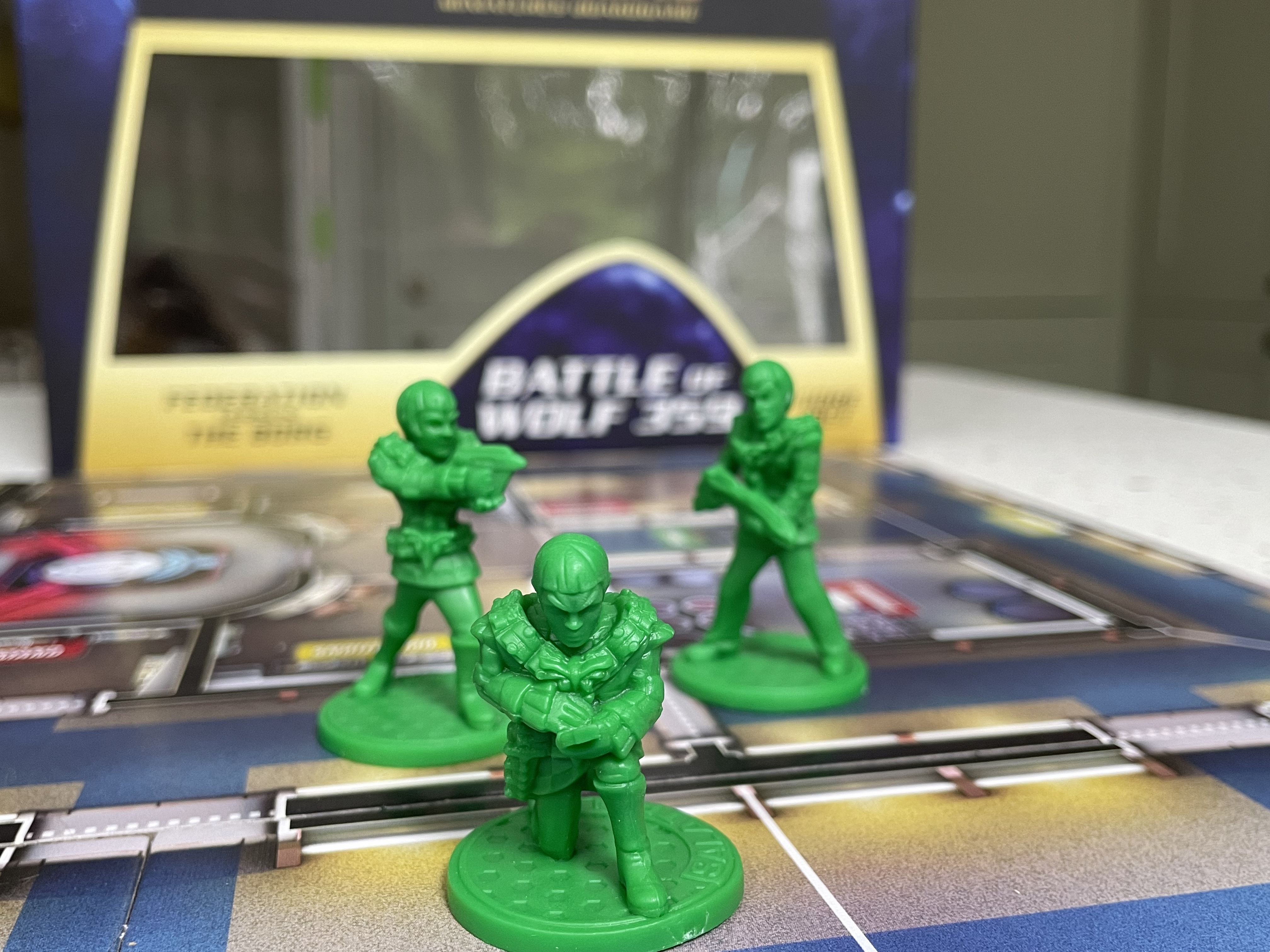
The premise behind the game sees away teams from one of the available factions dropped onto either a Borg Cube or the USS Ahwahnee (one of the ships lost at Wolf 359) with a main mission objective and several secondary objectives to complete. 

Time is limited with both sides having to play their actions out across just three rounds. Does it work? Absolutely and with that restriction you become a lot more honed in on exactly what you need to do and the strengths of one faction over another.

The core box contains the Federation and Borg parties. Initial concerns that the 4 vs 6 squads might be a little biased is quickly removed when you understand that bonus actions have been built into the mechanics to ensure that play is fair. Each miniature comes with an accompanying stats board referencing their personal traits and attack, defence and skill levels.

With a set of interchangeable double-sided boards there are a variety of layout combinations that can be achieved. Each board contains different stations (Command, Sciences, Operations, Medical) within sections of the ship or cube that players will need to interact with to complete challenges while also avoiding or engaging the opposition.

Let’s look at how each round works. Using the core box Federation set of Riker, Shelby, Data
and Worf, each character can conduct two actions per round aiming to complete tasks and build up the most points. These two Actions don't need to be a "Move plus something" and you can mix and match to suit your tactics.

The Borg start with two drones and add a further two characters to the board at the beginning of each subsequent round, rebuilding their forces and overrunning the ship. Ultimately there's the chance to have five drones and Locutus in play by the conclusion. That's no including any members of the opposition away team you might have managed to assimilate! Due to their hive mind nature the Borg can also transfer their actions to another drone which comes in useful when you’re needing to grab some final points  in the last throws of round three.

As part of each round you replenish your Support and Mission cards which will help gain points. Players keep these in their hand until they need to be played and the decks from which they are drawn (a set 20 cards) can be customised from the sets included in the core box. 

Support cards will add in benefits such as the phaser rifle or transporter pattern enhancers while Mission cards will provide side quests to boost your points total such as performing a skill test at a certain console. This in turn will depend on the abilities of your characters as to who is best suited for what (and is detailed on their stats card). That will then determine your path through the rooms of the ship or cube.

The model sculpts are nice but they are begging to be painted up and I can see a lot of players wanting to do that. Each does represent their respective onscreen persona very well adding in phaser, tricorders and a customary bat'leth for Worf - ideal since his hand-to-hand combat gains you an additional damage point.

Talking of that, facing off against six Borg can seem a little daunting however with the way the stats are built, three rounds is more than enough to dispatch at least one or two as combat is done on a comparison of scores from highest to lowest. This means that while you might stop the drones from completely taking over.

One thing that I really like about Away Missions though is the quick start guide. The rulebook itself (already available for download from the Gale Force Nine site) covers every eventuality but can be a bit of an overload on first glance. The quick start guide takes you through the basics of the game and in the box there are even a starter Support and Mission card decks comprising of 20 cards to ease you into the action. Once you've got the game down you can rip open the larger packs and start customising your 20 card deck depending on the board and opponents. What works against the Borg might not be the best option against the Romulans for example.

A large Borg force might be enticing but to be able to control any of the areas of the ship you do need to have assimilated members of your opposition since the drones themselves have no set skills until they, well assimilate them. This will mean that your starting tactic for round one might be to add to your workforce while Starfleet's could be to avoid the Borg completely and repair the ship asap.


The Klingons favour full on combat while the Romulans are all about their intel. The Federation is a bit of a mix although they will only stun opponents unless they're the Borg.

Once you get past the first few games and make a few mistakes (I had the Borg being able to do anything until I realised why assimilation was so key!) and how you can play the game more tactically dependent on your faction, this is a fantastic experience. The downside is that you can't get all four factions out at once unless you have two core box sets. That initially sounds a bit grim but given the number of spaces on the four boards you'd be falling over each other from the first move.

Away Missions is a great and thoughtful game for Trek fans and I can't recommend it enough. There has been a bit of bad commentary over the figures but you need to look beyond and actually play the game rather than worrying about representational pieces of plastic (if they bother you that much). I genuinely hope this gets super popular as I would definitely be interested in a Dominion pack or a Cardassian pack. Maybe there's scope for more boards and a DS9 setting and crew? Mix and match options to pick your best away team? Kirk and Spock on the original Enterprise?

The possibilities are right there for the taking and it would be great to see a fair few of them come to fruition.

Away Missions launches August 12th and is available to pre-order NOW.

Enjoyed this article? Why not like and share to spread the word!

Like our page on Facebook 
Follow us on Twitter

Sunday, 5 April 2020

Breaking Borg; Part I


As synonymous as the Klingons and Romulans are with Star Trek, the Borg were established as one of if not the biggest threat to galactic peace - but where have the last 30 years taken them?

Rambling back to 1988 you start out at Q Who from The Next Generation's second season. You knew when this aired that the opportunity to bring the Borg back wouldn't be lost nor would it be too long in the making. If things had gone the way they were planned, the 88-89 season would have ended Borg rather than Grey. The writers' strike put paid to that but it did mean that Michael Piller came on board and pulled out one of the all-time top episodes of Star Trek; the first part of The Best of Both Worlds. Potentially that strike turned the Borg from being the enemy of the year ad a year that was certainly mixed in its quality into one of the deadliest foes Star Trek ever brought us...to a point.

But just look at the Borg in those fledgling The Next Generation years especially the ambiguous Q Who (in which ironically Q takes a massive backseat). There's no sign of assimilation, there's a nursery which would be revisited and promptly forgotten again in Voyager's episode Collective but that sinister, silent, menacing arrogance is there in every aspect of the race. All they want to do is acquire technology and advance themselves further.

Their appearance had been suggested back in The Neutral Zone in a still unexplained reference to all the machine parts being scooped up in the same way as J-25 and also Jouret IV but when you link everything together this thrown in observation doesn't work - wouldn't the Borg have just continued on if they were that close to the Federation or the Romulan Empire? Anyway, that's a conversation to be filed alongside "What Happened to the Conspiracy Aliens..."

Q Who is an exemplary episode introducing us to the cybernetic organisms, their cubic mode of transport and their haunting regenerative ability which we see on the hull of their ship. We're chilled by the way in which they adapt to phaser fire after only a shot and for once the Enterprise looked defeated, relying on the omnipotent Q to save the day. It effectively told us nothing about them. No queen, no real understanding of the hive, no idea where they were from, only that they were coming and come they did.

That flagrant arrogance is even more evident through the lone cubes which attempt to attack Earth in both the legendary two-parter The Best of Both Worlds and Star Trek First Contact but even going solo, their appearances in The Next Generation always brought a chill and a lump to the throat. Their interference was ominous, dangerous to the end and always to be feared. There is not one thing redeeming about them at this point. They exist solely to conquer, assimilate technology and move on, "bettering" themselves at every step.

Both Q Who and The Best of Both Worlds also chillingly pre-empt something else for me - the arrogance of the Federation and more specifically Starfleet. They admit in the two part cliffhanger that solutions to combat the Borg are years off and Picard himself in Q Who believes they are more than prepared for what's out in the great beyond. Starfleet sees itself as untouchable, a force for peace that other races will join or not choose to "oppose" because of its size and potential might (Dominion might have other ideas...) and it takes a cube making it to Earth and be within seconds of attacking before they step up preparations to another level.

The Best of Both Worlds demonstrates everything right about the portrayal of the Borg themselves as they head straight for Sector 001. We still known very little about them and the only assimilation we see on screen is that of Picard to become their figurehead/spokesperson Locutus. Later Voyager does tell us of Starfleet personnel who were taken at Wolf 359 (Unity, Unimatrix Zero, Part II) but at this time the only reason they take Picard is to have a human face and voice when they talk to humanity. The difficulty in defeating them here and in Q Who adds to their menace as an enemy that is keeping Starfleet absolutely on its toes. They are relentless, picking off anything that even looks like it might try and think about putting up some form of defence (Mars defences) or anything that simply gets in its path (USS Lalo) without a care. 

The cube is stopped with the single command; "Sleep" with only the kidnap of Locutus from the cube showing any kind of concern for the Collective but only momentarily. This story remains etched into the core of Star Trek lore to this very day with Deep Space Nine's pilot, Emissary bouncing off the seminal Wolf 359 battle and the loss of Sisko's wife key to the character's motivations. 

Even First Contact opened with Picard remembering his experiences as Locutus. How many references to the encounter are made over the course of the franchise I would hate to count but I think it's a lot and still with Picard it continues to this day. Off the back of it, the season five I, Borg offered the Federation a chance to destroy the race that ultimately backfired but once again that sense of danger posed by them was always there in the background. Hugh may well have broken free from his collective restraints but at the core the Borg were still the cybernetic machines we had seen in Q Who although this time on a little scout ship but there is still something inherent about who this lone Borg is although we are given hints that there is the chance for them to change.

Ultimately we know he returns to the Collective and this is the first point where I think Star Trek managed a disservice to the Borg. Picard's choice not to take out the Collective comes back again and again and for someone who has experienced the true horrors of assimilation, I'm one of those who believes he should have made the call.

The resulting story, Descent, is very much a tale of two halves. The first opens up a lot of questions, adds a new spin to the infamous enemy and then idiotically has Lore show up declare that they are going to take down the Federation. The subsequent season opener doesn't build on this vast opportunity and we have an hour of Geordi trying to convince Data not to torture him. The destruction of the Federation fizzles in ten minutes, the Borg individuality is restricted to a single ship and the edge and action that was borne from the opening firefight and Data's first experience of emotion feel totally underplayed. OK, so it rounds off the Lore story but it left us with the question as to what had happened to the Borg? What's going on with the rest of the Collective?


The Borg here are totally unique. Still drones, still recognisable physically as the beings from Q Who and The Best of Both Worlds the clever choice was to keep this rogue individuality confined to Hugh's ship. I take this as a somewhat standalone Borg piece since they are their own collective unit, not quite total individuals and still somewhat threatening. Perhaps even more deadly given their potentially "illogical" actions such as the desire for revenge we see in the encounter which opens the story. They remained sinister and unknown in these early years with so much unsaid and therefore so much that our imaginations conjectured as to their nature.

The influence of the Borg does expand beyond just the episodes they appear in with repeated nods to the rebuilding of the fleet following Wolf 359. The way in which the updated Starfleet would appear in the form of the Steamrunner, Norway, Saber and Akira classes were designed with a more military purpose in mind and, of course, in the creation of the Defiant which had one, sole reason behind its existence - to defeat the Borg.


To count the episodic one liners that nod to The Next Generation's creation of the Borg are extensive and in at least one Parallels future there's a big-bearded Riker still commanding (if it hasn't exploded) one of Starfleet's last remaining ships... I'd love to see how that universe evolved.

The movie appearance of the Borg is a massive change from their televisual origins. Given the scope of the cinema screen there's no surprise that the basic outfits and pale make-up are taken to another level, giving the drones an even more menacing physical presence. The armour has a more organic feel and the assembly more patchwork and less perfect. First Contact gave us our first real, graphic look at the assimilation process. In fact this is the first time we ever see or understand that the Borg are out to add more drones to the Collective. Truly a terrifying series of events, to this time only Picard had been joined to them onscreen but now it was an ever-present threat. 

First Contact cemented the hive mind concept with the powerful introduction of the Borg Queen, a character seemingly unrestricted by time and space due to her repeated, inexplicable avoidance of death. Her entrance in the movie is one of the great moments from the last 50 years however did she overstay her welcome after First Contact

We'll discuss that later. Here she provides that one-on-one nemesis for Picard, a perfect foil for the captain and for Data allowing the audience to easily follow the story and have a figurehead against whom the crew can be directly pitted. Imagine the movie without the Queen and it would be almost a silent production in some scenes. She is the voice of the Collective and ultimately does her death (spoiler!) truly offer the moment when the Borg should have been defeated? Significantly it's also the only time that the Defiant ever took on the purpose for which it was originally built and only just survives. Back to the drawing board perhaps?

Just as with Locutus, the Queen becomes the face of her people and draws the audience successfully into the nature of the species, how they operate and the motivations behind their actions. I solemnly believe that First Contact is the final point in the franchise where the Borg retain some of their mystery and eeriness that makes them a compelling enemy. I suppose their failing is that mass consciousness which means that there has to be some kind of vocal point to which we have to focus but it doesn't take away from their nature. 

The Borg of First Contact are a calculated step forward wielding more deadly weapons (that never get used) and with empty zombified facial expressions to chill you to the core. There's a much less human feel to the drones than we ever see in The Next Generation as well as those variants on the assimilated species - Cardassians, Klingons and more including the Enterprise crew themselves. Aside from the Queen they do remain faceless and as relentless as always but that mystery is somewhat quashed with the introduction of their imperious leader. 

The Borg Queen would reappear more in Voyager (played by Susanna Thompson apart from the finale where Alice Krige returned) but First Contact offers a pivotal point in the evolution of the Borg onscreen from an army of minions led by a central voice to being overseen by a single entity that refers to itself in the singular rather than the plural. 

Linking nicely to that eighth film - but perhaps not sitting too well with fans is the Enterprise episode - and the final appearance of the Borg ironically - in Regeneration. Now aside from the crew of the NX-01 managing to survive the attack in the first place when the crew of the Enterprise-D barely escaped in Q Who it's a fairly neat idea but does screw around with the continuity a bit but we have to understand that techniques develop over time.

The discovery of the Sphere wreckage from First Contact is a brilliant way to bring the series and the cyborgs full circle almost, giving us a core reason as to why they chose to head in the direction of Sector 001. Aside from introducing us to the Borg before we were introduced to them, Regeneration does have one core feature which aligns itself more correctly with The Next Generation than Voyager. It regains the air of mystery and danger that the species represented in that earlier series and gives away nothing to the nature or reasons for the Borg actions. It is a story which, for all its temporal failings, does stay more faithful to their origins than a lot of the Voyager entries. 

Separating the drones from the Queen and placing them against a less powerful adversary than the later Enterprise-E returns them to the faceless minions they were in Q Who and The Best of Both Worlds but adds in the twist that while the viewer knows what might be around the corner, the NX-01 crew are none the wiser to the escaping Borg and we the viewer appreciate just how damn lucky they are to have been spared from assimilation...

I am a firm believer that The Next Generation presented the best and most frightening presentation of the Star Trek foe even if physically the outfitting of the Borg is the most basic. So if that's the case, what happened when Starfleet stepped into the Borg's home turf of the Delta Quadrant...?

To be Continued...


Enjoyed this article? Why not like and share to spread the word!

Like our page on Facebook 
Follow us on Twitter
Find us on Tumblr 

Sunday, 10 June 2018

Brainy Remastering: The Official Starships Collection Issues 126 and 127


We’re back with the next two issues of the Starships Collection which transport us to 1968 and 1990...

Initially we have our seventh starship from the Wolf 359 graveyard. The USS Princeton NCC-59804 is only one of two onscreen triple-warp-engined starships across the whole 52 years of the franchise - and to be honest, it wasn't really supposed to be noticed  because it was built solely as wreckage for the aftermath of the Borg encounter.

Response to this one has already been overwhelmingly positive given the comments I've seen on social media so let's get into our usual nitty-gritty.

The saucer section will be recognisable straight away if you've already received/purchased/stolen the Freedom Class starship since it has the same simple surface detail and quintuple phaser banks around the edge of the primary hull. The two-tone aztec colour scheme mirrors down the front to back central line with the paint shade reminiscent of the first issue (remember that far back?) USS Enterprise NCC-1701-D. 

It's a grey/beige combo that allows the lighter grey to stand out ever so slightly more than we've seen on the white on white aztecing on other ships such as the Reliant and the Enterprise-A. The numerous lifeboat hatches across the upper surface are lifted in a third and again slightly darker grey. It's not overwhelming but manages to isolate each element and make it highly visible on the Princeton

The raised bridge module is a subtle extension from the hull, raising to a quadruple tier which continues the aztec paint work nicely although in the metal some of the bridge detail is lost due to the size of the module on that tiered design. The decal to the rear of the bridge is centrally aligned and in turn screams out that the two recessed window blocks just behind at the rear of the saucer are well out of sync with their black and white light effects. Thing is, when you see that you then start to realise that all the windows on the main saucer areas (not the tiers oddly) are out of alignment be it only slightly.

Perhaps this highlights that different detailing takes place at different points since the registry and all of the red phaser end "brackets" are all spot on.

Underneath the saucer we have five similar phaser banks and also another series of lifeboat hatches covering the established two-tone scheme. I love the smooth finish on this one because it allows that aztecing to flow right across the hull and even though there's the transition from the edge to the plastic central insert it all stays perfectly co-ordinated. At the centre of the underside is what appears to be a sensor platform but again there's a slight loss in detail due to the moulding.

Everything from here on in is plastic with the Niagara Class and our path to the secondary hull takes us across the narrowest of neck sections and into very, very familiar ground. After all, the Engineering section of the Princeton is identical to that of the Ambassador Class more well known as the Enterprise-C.You have to love the fact that the aztec scheme runs right on through into the curved body which is finished off with more painted on lighting and two Starfleet pennants on either side. 


The build work here - especially for a ship that was originally built for screen damaged is seemingly flawless. The join that marks out the connection of the left and right parts of the hull is hidden away in the spine of the ship with only its appearance down the shuttlebay doors to the rear any evidence of its existence. For once Eaglemoss have managed to paint in the impulse engine on that stubby neck section and very precisely too.

It's a real hallmark with this one how precise the result is (apart from those damn windows) and also impressive that there's one other massive change in play - the main deflector dish is painted in rather than being stuck on as it was on the Enterprise-C. In fact there's a lot that can be taken from this ship for when the XL version of the Ambassador Class vessel is produced. That deflector did cheapen an already disappointing model but the painted on option here works much better.

So to the back my friends and the most unique thing about the Niagara Class - it's three warp engines. Evidently taken from the Galaxy Class, each sits atop its own pylon which in this case were designed an built purely for this model in the show. The finishing detail is again meticulous with dark grey panelling highlights, the continuation of the aztec colour scheme and even strong hull lines all coming together in these small plastic spaces. The same can be said for the engines themselves which all contain translucent blue sections for the warp field grilles and crimson red elements for the bussard collectors.

These are smoothly constructed, each with its own Starfleet pennant streaking across the top and the gold of the coils just adding that finishing touch - actually hold that because the engines are all aligned!!! Magnificent!

The stand fitting for the Princeton is a bit fiddly requiring some manoeuvring of the clips around the body and nacelles to clip to the saucer section. This does mean that it's a steady grip and a nice mid-point balancing position. 

Seriously though, it really is brilliantly made and such a different ship to have in the collection but its a little sad since this is probably the last entry for the ships featured in The Best of Both Worlds cliffhanger conclusion.

In the magazine there's a real sense of unity between the CG and the model with only the noticable dark grey edging on the saucer being a difference. Spot also that the CG pic doesn't have the dark grey panels on the upper two nacelle pylons.

In the Ship Profile we find out about the Niagara Class' main purpose as well as the advantages and disadvantages of that third nacelle experiment. Take note as well that the Princeton later turned up as a wreck in Unification I's Qualor II scrapyard. The plan views are also a bit confusing since the side shot appears to show gaps within the upper pylon struts - bit of inconsistency across all areas there.


Building the Niagara Class covers how Greg Jein's model shop utilised moulds from other craft and some extra spare parts to create the Princeton and the Freedom Class new for the Wolf 359 scene - in fact constructing them ready-damaged!

Third and finally in issue 126 we get Ira Steven Behr's take on the time he spent working on The Next Generation's third season well ahead of his taking the reins for Deep Space Nine. As a writer, Behr was massively involved in key stories through the transition year of the show, dealing with Romulans, terrorists, Klingons and whether or not Data did shoot Kivas Fajo in The Most Toys. It also spins around Behr's memories of the other stories around in that year including his near involvement with The Best of Both Worlds. Well worth a read.

Now, usually I skip over the episode appearance page because it's usually fairly obvious after the preceding 14 pages but here the magazine does something slightly different and steps out of universe to drop some key facts about the conclusion of the Borg story that opened season four. I had to double-take when I read it because it's so out of character for the production! 

Overall, great ship and magazine - brilliant package for this one and well worth a punt.

So yes, our second new arrival is one of the ships to be featured within the remastered versions of The Original Series and begrudgingly it’s from Spock’s Brain.

The Eymorg Starship fits right in with the majority of the remastered starships in that it’s a bit dull. Now you know that the design of the craft isn’t any of Eaglemoss’ fault and frankly it’s a step up from what graced the third season episode back in the day but it lacks that excitement factor and will surely be a completists requirement only. 

That said, Ben Robinson and Eaglemoss have done a splendid job of making the CG craft into an issue of the series and, begrudgingly, I have to admit that the end result is decent...but not stand out.

Based around a central circular design the one-woman Eymorg ship is nothing if not unique in the folds of the franchise so this time we're going to have to go front to back rather than the traditional top to bottom.

At the front as said there's a mushroom-shaped nose that bears a full azteced grey finish and also a wonderfully asymmetrical range of hull features with orange (weapons ports) and dark grey call outs bringing it to life. The central dark grey indicates the entry hatch to the craft.

Joined to the main body at five points is the propulsion ring. Detailed with the aztec grey pattern, there are five ion drive engines attached to the hoop. Both the ring and the engines have darker edging detail and to the rear of each is an orange translucent insert to indicate the exhaust ports. There is evidence of the mould line across the engines and ring which are one of the few machining indications on the starship. Around the ring there are open sections which seem to be hull detail rather than offering some form of practical use.

Spinning round to the rear the slitted exhaust ports are fitted into the metal forward body section and are coloured in orange paint rather than a series of translucent inserts, all clustered around another the central primary engine exhaust.

The design isn't out of this world but what you can say is that Eaglemoss have done a great job of reproducing the craft from the remastered third season of The Original Series

The stand fixing for the ship is exceptional, gripping one of the curved engine pods firmly with absolutely no movement at all once in place.

The Ship Profile piece recounts the events of the "classic" Spock's Brain and the part in which the craft played to steal the Vulcan's mind. The plan views offer minimal identification of the ship parts but there is a strong correlation between the model and the renders in the magazine.

What does seem not to translate too well is that the hull aztecing in the magazine looks more like weathering (this ship is supposed to be quite old) than paint effect. From a distance it does work but close up and in good lighting it doesn't do it any favours.

Niel Wray then discusses creating the new Eymorg Starship for Spock's Brain and how he diverted from the original 50's style rocket used in the '68 episode. The end result is visually much better than the rocket and was produced, as we discover, under some tight budget and time constraints.


Last article up in issue 127 recounts the story of Gene L Coon (or Lee Cronin to use his pen name) who was instrumental in the first two seasons at creating some of Star Trek's most iconic characters, concepts and races from Khan and the Horta through to the Klingons and the Prime Directive. Even after leaving his production position, Coon provided four scripts under the Cronin pseudonym for season three. 

Two well prepped and made models this month no matter what you think to the design of either. Both have exemplary build quality, stand position and finishing details across the board so it's very difficult to be critical. As part of the collection they work well and continue to demonstrate how the series continues tp move forward with each new craft. The Princeton is the easy winner for visual result this time round but I can think of a few other ships that wouldn't have even garnered a second look against the Eymorg ship. 

What do you think to the remastered ships of The Original Series? What other kitbashes should Eaglemoss make?


Live on YouTube
Like our page on Facebook 
Follow us on Twitter
+1 us on Google+
Add us on Tumblr

Thursday, 1 March 2018

Singular Propulsion: The Official Starships Collection Issues 118 and 119


Here we go with a hectic month of delayed specials, specials delayed until next month and finally two regular issues that have left me a little needy. 

Opening up the first of the two we return - once again - to Wolf 359. It combines elements from the Galaxy and refitted Constitution Classes into the most compact Starfleet ship in the fleet.  Comprising of three elements - saucer, neck and engine, the Freedom Class USS Firebrand is pretty much devoid of intricacy or delight with the simplest of builds. 

The saucer itself, the top half of which is metal, carries five phaser strips around its elliptical hull rather than a single curved bank. Reflecting its simple and hurried origins for a graveyard scene, the Firebrand has this aura of being almost unfinished with the aztec paint scheme coming across as more dirty than a subtle two tone paintjob. I might also have this feeling because the one I got sent has some rather obvious glue marks to the side of the saucer which you csn clearly make out on the photos. 

The registry is similarly sketchy and although this will never make my favourites list, the fact that it seems incomplete does well to reflect the scene it was used for as well as its preparation for that moment. This was never something that was going to be at the forefront of the show but due to popular demand its now HAD to be there and Eaglemoss have done the best they can from fhe less than perfect source material.  

The saucer is smooth to a fault with only the five phaser banks and an almost missable bridge module to break up the plain surface. Note that there are no panel lines in play, only painted on white and black windows for more sporadic detailing. The bridge module itself barely rises above the hull and is finished with the thin slit of a shuttlebay to the back.

Turned over,  the now trademark metal/plastic border ring is very evident, running about midway round the centre of the primary hull. There are again five phaser banks marked out with three larger to the front and two smaller to the back. As with the top bu not mentioned, each bank does have red trimming at either end - something present on all these The Next Generation era ships. 

There's one more thing to this one because it has a very unique central feature in the shape of a whopping great phaser cannon. It makes the Firebrand more than memorable because its such an unexpected piece of tech to see bolted onto Starfleet vessel. 

That underside is still smooth and azteced but fortunately whoever put it together managed to avoid spreading their gluey fingers onto a second surface.

Down the back now and the borrowed neck section from a Constitution Class Starship is quite the angular contrast against the more curvy lines of both the saucer above and the warp engine below. The window detailing is all in place which is one thing that I find can be missing when it comes to these models. In this case there’s enough room to get them blobbed on and given the distance between the saucer and the engine it would have been obvious if it hadn’t been.

Right at the base of the neck section is a very familiar feature in the shape of a photon torpedo launcher. Resting on top of the engine might not be the safest place to fire high explosives from however it’s painted cleanly and clearly so from an accuracy perspective we have to let it pass. From a logic perspective this is utter madness!

Finally at the base of the Firebrand we have that single warp engine. Bearing all the hallmarks from the Galaxy Class, Eaglemoss have managed to squeeze in both the blue translucent warp field grilles and the crimson red bussard collector giving that much needed depth to the simplest of starships.

The nacelle is well decalled with ship registry and minor tech style callouts which breakup the uniform Starfleet grey overcoat. At the bottom you might also spot a small grey blob thats hanging down. If you’re a little confused I totslly understand because this, if you look closely at the magazine cover, is a tiny navigational deflector. Given the size of this item on the model i can see why it isn’t painted.

Given this is one of the smallest Starfleet ships from the whole collection I’m actually amazed at how seemingly overpowered and overarmed this thing is with multiple phaser banks, that idiotically big cannon and a low-placed torpedo bay. I think the Defiant might have had less weapons...

Issue 118’s magazine gives skant detail on the background of the Freedom Class noting only is main features , the likely heritage of its parts and its role before Wolf 359 as well as its part in the fateful battle. The plan views show how close the model is to the ‘real thing’ plus highlight some of the fiddlier features that have not been coloured due to their size such as that deflector and the torpedo tubes. 

Adding to your library of reference for the fourth season of The Next Generation, we have an interview with series writer Ronald D Moore on his contributions to the show with a strong focus on his stories including Family, Reunion and Redemption, the latter two being part of Moore’s work to revamp and update the Klingon Empire. The next four pages are given over to another key member of the behind the scenes team that made The Next Generation into the show it was, Michael Piller. For me he is the most significant player in the story of the show and the way in which Star Trek developed through Deep Space Nine and into Voyager with its tight storylines and focus on character.

Next to tick off the list is the Hirogen Holoship and it’s the second part of that name which sends chills down my spine. Remember the Federation Holoship from Insurrection? Y’know, the one that looked like a cheap TV remote control? Well upon hearing that we would be seeing this one from Voyager’s seventh season two parter Flesh and Blood, I started on the flashbacks to that review. 

Tragically they do have one thing in common - they’re both pure plastic models. The Federation block was two pieces painted and slapped together but here the luck that the Hirogen has a bit more flair to their starship design has saved what could have been another dire result.

The Hirogen Warship from issue 51 (yes, that long ago!!!) was a decent enough ship and as I start to be more selective on what’s displayed, it still remains out as one of the better craft produced. The Holoship likewise is a good representation being a little more streamlined than its more aggressive cousin. 

The paint scheme is instantly recognisable as being Hirogen with that gold and brown pattern playing out across the whole of the model. First impressions are that it’s a decent build with some nice minutiae to get engrossed with so let’s dive a bit further in.

This slimline starship has a slightly insectoid look to it starting right at the front. Those twin antennae only have a little flexibility in them but then they aren’t the only appendages to be aware of on this ship. 

The front probes lead back to a bullet shaped forward hull section. Here we have some basic hull detailing with grooved bodywork and a distinct bridge module sitting right at the top. Compare the model to the magazine and you can see that the CG emphasises the slight variation in tones between the panels on the hull, keeping instead to a single gold colour for the whole surface. From the bridge there's a raised section of hull which runs the length of the ship to the central, main engine at the rear. Stop when you see the two grill-finished dome structures because these are clearly not the correct colour versus the show or the plan views in the magazine. They have a more red tint to their finish while on the model they are rendered in the same gold as the rest of the hull. This error also covers the two similar structures on the underside.

Now this ship has a pretty clever build to it with a top and bottom half placed together and with a join hidden away thanks to the brown/gold wing formations that extend along the sides. Top and bottom these protruding pieces have some raised detail but then have some more spindly appendages sweeping rearwards. Also that paint scheme - it has an incredibly slight hue change dependant on the right light meaning it's not quite the solid colour you initially believe it to be.

I'm actually surprised that Eaglemoss have decided to keep these rather flexible aerials on the model as usually they are omitted because they are harder to reproduce although maybe their equipment is offering better results these days, I don’t exactly know. 

The hull is solidly built and evades the need for a particularly detailed paint job by adding a ton of surface detail, ridges and call outs. The biggest of these features of sorts have to be the horizontal fins that hide that central join but there’s also two extremities that seem to act as shields to the outside two of the three engines (the warp engines). As you do look towards the back, the panelling on the main hull becomes less and contrasts to the increased detail on those side fins. The grey/gold combination almost has a camouflage/worn effect to it and unusually it's not symmetrical left to right. For me that's a really great feature on this ship and something that's not often seen in this mass produced collection. That uneven nature gives a more hand-finished feel to the Holoship although some of the grey seems to have bled over onto the orange dotted sections to the rear of the craft just ahead of the engine exhausts.

I do have to correct myself because if you are paying attention to the Holoship you'll realise I've messed up - it does have a metal section that runs inside the craft and can only be seen at the back in the form of the central engine. That weight also cleverly helps to balance the model when it comes to slotting the impulse engine exhaust into the rather unique stand which grips only that protruding piece of the Holoship - might not be the most secure fitting ever by the way.

On the bottom the central panelling pattern is identical to that on the upper side and it also carries on the two slight golden shade variations in the paint. One difference though is that the detailing on the top of the two (outer) warp engines is a darker orange shade than the slots on the top which have a more yellowed finish to them. It's a minor touch but as with that non-symmetrical grey paintwork on both sides of the fins but it's these things which make it a bit different as does the tiny etched detail that circles the forward section in a slightly orange band.

Challenge with this one though is that it's not very exciting as a single episode Hirogen craft. It's barely memorable from the back end of Voyager and is overshadowed by its smaller warship version that played a part in season four of the series.

Opening the issue 119 magazine gives us a recap of the Flesh and Blood story in quite a lot of detail and with very little focus on the ship itself. Eaglemoss follow this up with the plan views which highlight just how different the hull finish could have been and how the warp engines bring life to the hull through the orange vents that are under the engine carapaces.

Robert Blackman then explains the design and varied build process for the Hirogen armour and how it changed from the fourth to the seventh season which shed a lot of weight for the actors to have to carry. Finally - and well worth the admission price alone for this issue - is a six page interview from Bryan Fuller about his involvement with Voyager which was conducted just after the show finished in 2001. Covering stories including Flesh and Blood as well as The Raven, Barge of the Dead and Mortal Coil, it discusses Fuller's time on the show through the latter stages of its journey.

So, yet another very average month from the Halls of Eaglemoss which adds to the legendary Wolf 359 fleet and puts some more meat onto the bones of the Voyager range within the series. I've not found either of these ships to be that incredible. They both offer some nice features but each month I find with these single appearance ships that I do want for more. Fortunately next month we are going to get that with the arrival - finally - of the USS Bozeman from Cause and Effect and also the Xhosa from Deep Space Nine as used by Sisko's other half, Kasidy Yates.

I'm geinuinely excited by the prospect of both these ships much more than I have for a while since the Bozeman is such an iconic part of The Next Generation and one of its most important episodes.

How do you feel about this month's ships? Is the Freedom Class a winner? What's your thoughts on the Holoship?
Live on YouTube
Like our page on Facebook 
Follow us on Twitter
+1 us on Google+
Add us on Tumblr